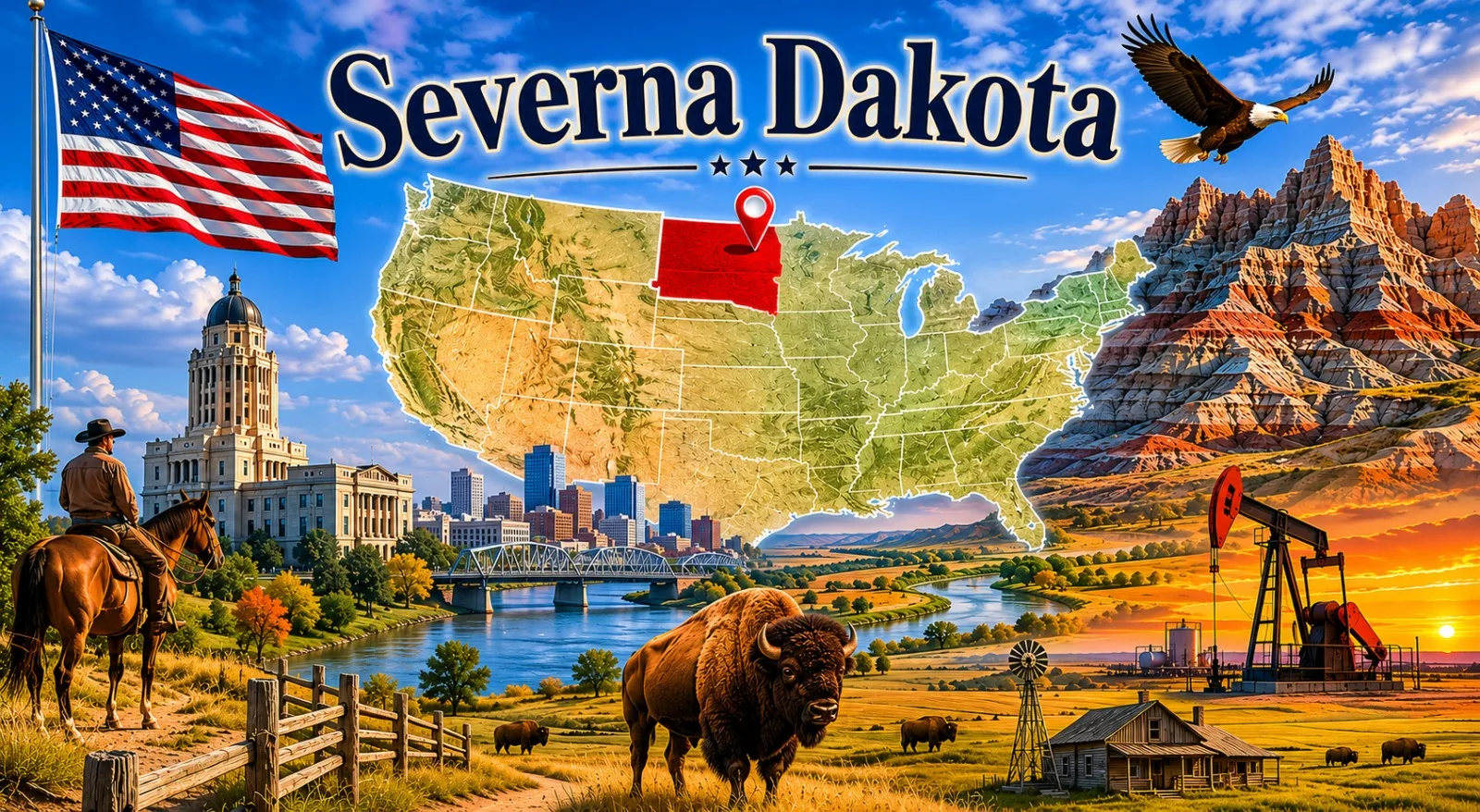
You’ve seen the name Severna Dakota somewhere online, and now you’re wondering what it actually is. A hidden state? A new country? A typo? The answer is simpler and far more interesting than you might expect. Severna Dakota is the Slavic-language name for North Dakota, one of the most underrated and genuinely breathtaking states in the entire United States.
The word “severna” means “northern” in languages like Slovenian, Serbian, and Croatian. Put it together with “Dakota,” and you get a direct translation of North Dakota. Same place. Different language. Completely real. This guide covers everything behind the name: the linguistic roots, the geography, the history, the economy, the top travel destinations, and the cultural story that most English-speaking articles never bother to tell you.
Quick Facts: Severna Dakota (North Dakota)
| Detail | Information |
| Official English Name | North Dakota |
| Slavic Name | Severna Dakota |
| Meaning of “Severna” | Northern |
| Capital City | Bismarck |
| Largest City | Fargo |
| Statehood Date | November 2, 1889 |
| State Number | 39th state admitted to the Union |
| Total Area | 70,698 square miles (183,108 sq km) |
| Population (2024 est.) | 796,568 |
| Nickname | The Peace Garden State |
| Geographic Center of N. America | Rugby, North Dakota |
| Highest Point | White Butte, 3,506 feet |
| Famous For | Badlands, Theodore Roosevelt National Park, agriculture, oil |
What Severna Dakota Actually Means and Why People Keep Searching for It
Severna Dakota is not a mystery once you understand how language translation works. In Slovenian, Serbian, Croatian, and several other Slavic languages spoken across Central and Eastern Europe, cardinal directions are always translated. “North” becomes “severna.” “South” becomes “južna.” But proper names, like “Dakota,” stay unchanged because they carry cultural and historical meaning that doesn’t translate.
That’s why North Dakota becomes Severna Dakota and South Dakota becomes Južna Dakota in these languages. The same logic produces “Italia” for Italy in Italian, or “Deutschland” for Germany in German. Languages adapt geographic labels to fit their own vocabulary. It’s entirely standard.
The reason Severna Dakota appears so often online today is because global search engines, translation tools, multilingual maps, and international travel websites all use localized place names. When a person in Slovenia searches for American states, they see Severna Dakota on the page. When that page gets indexed globally, English speakers start encountering the term and searching for it. Curiosity is natural.
Why Slavic Languages Don’t Change “Dakota”
The word “Dakota” comes from the Dakota Sioux people, the Indigenous nation whose ancestral lands covered much of the northern Great Plains. The Dakota people have lived in this region for centuries. Their name was applied to the territory when it was officially established as Dakota Territory by the U.S. government in 1861. When the territory split into two states on November 2, 1889, both states kept the Dakota name because it was already deeply rooted in the land and its people.
Since “Dakota” is a proper cultural noun tied to a specific Indigenous group, it doesn’t get translated. Languages borrow it as-is, the same way “Manhattan” or “Chicago” appear identically across dozens of languages. Only the directional word changes.
Where Severna Dakota Is Located: Geography That Will Surprise You
North Dakota, the real place behind the name Severna Dakota, sits in the northern region of the United States. It shares its entire northern border with Canada, specifically the provinces of Saskatchewan and Manitoba. To the east lies Minnesota, separated by the Red River of the North. South Dakota borders it to the south, and Montana stretches along its western edge.
The state covers 70,698 square miles, making it the 19th largest in the country. Yet with a population of approximately 796,568 people as of 2024, it’s one of the least densely populated states in the nation. That means wide open spaces, clean air, and a quiet that cities simply can’t replicate.
The Badlands: A Landscape Unlike Anything in the World
The western half of North Dakota is where the terrain gets dramatic. The Badlands rise from the plains in a jagged, colorful maze of canyons, buttes, and eroded ridges shaped over millions of years by wind, rain, and the Little Missouri River. Layers of clay, sandstone, red scoria rock, and black coal veins create a color palette that looks almost painted. General Alfred Sully described the Badlands in 1864 as “hell with the fires out.”
That description has aged into something of a travel brochure headline. The eastern half of the state is part of the Central Lowland region. Here you find the Red River Valley, a flat glacier-formed lake bed that’s among the most fertile agricultural land anywhere in North America. Farmers grow wheat, sunflower seeds, canola, sugar beets, corn, and barley across thousands of square miles of rich black soil.
The Geographic Center of an Entire Continent
Rugby, North Dakota holds a distinction almost no other place on Earth can claim. A stone obelisk in the town marks the geographic center of the North American continent. Not the United States. The entire continent. That single fact, largely unknown outside geography circles, tells you something about where Severna Dakota sits on the map.
Severna Dakota Through History: From Indigenous Lands to Statehood

Long before European explorers arrived, the northern Great Plains were home to several Indigenous nations. The Mandan, Hidatsa, and Arikara peoples built permanent villages along the Missouri River. These were not small settlements. They were major trading centers, sophisticated communities with agriculture, trade networks, and complex social structures.
Nomadic tribes including the Dakota Sioux, Assiniboine, and Cheyenne moved across the plains, following bison herds and adapting to the seasons. The arrival of horses in the early 18th century transformed how these nations traveled and hunted.
European explorers reached the region in the mid-1700s, followed by the Lewis and Clark Expedition of 1804-1806, which wintered with the Mandan people near present-day Bismarck. That winter marked one of the earliest sustained contacts between the United States government and the peoples of what would become North Dakota.
The Dakota Territory and the Rush to Settle
The U.S. government officially organized Dakota Territory in 1861. Between 1905 and 1920, the population surged from 190,983 to 646,872 people. Scandinavian immigrants from Norway, Sweden, Denmark, and Finland settled heavily in the eastern and north-central regions, drawn by the promise of farmland along the Great Northern Railroad.
Today, about 38% of the state’s population is of Scandinavian descent, with 33% specifically of Norwegian heritage. Germans from Russia, who had originally emigrated from Germany to Russia in the early 1800s, arrived in large numbers in the 1880s. They settled in south-central North Dakota, farming semi-arid land similar to the Russian steppe they had left behind.
North Dakotans of German descent now make up about 43% of the population. On November 2, 1889, President Grover Cleveland signed the proclamations making North Dakota and South Dakota the 39th and 40th states in the union simultaneously. To this day, no one is sure which was officially signed first, making their birth order a friendly historical puzzle.
The Economy of Severna Dakota: Far More Than Farms
Most people picture farms when they think of this state, and agriculture is genuinely central to it. North Dakota ranks at or near the top nationally in the production of spring wheat, durum wheat, sunflower seeds, flaxseed, canola, dry edible beans, and peas. These crops feed people far beyond American borders.
But the economy made a sharp turn in the 21st century. The discovery and development of the Bakken Formation in the western part of the state turned North Dakota into one of the top oil-producing states in the nation. Hydraulic fracturing, or fracking, unlocked vast reserves of oil trapped in shale rock.
The Bakken oil boom brought thousands of workers to cities like Williston, created massive infrastructure development, and delivered a period of historically low unemployment rates. At its peak, this boom made North Dakota’s economy one of the fastest-growing in the entire country.
The energy sector now sits alongside agriculture as a defining pillar of the state’s economy. Wind energy is growing rapidly too, given the wide open plains and consistent winds across the region.
Top 5 Places to Visit in Severna Dakota (North Dakota)

1. Theodore Roosevelt National Park
This is the crown jewel of Severna Dakota’s natural landscape. The park covers more than 70,000 acres of rugged Badlands terrain in southwestern North Dakota and is divided into three separate units: the South Unit near Medora, the North Unit near Watford City, and the Elkhorn Ranch Unit along the Little Missouri River.
Theodore Roosevelt himself ranched here after the deaths of his wife and mother on the same day in February 1884. He sought the Badlands for solitude and found something that changed him permanently. He later said: “I would never have been President if it had not been for my experiences in North Dakota.” That quote alone explains why the park carries his name.
The South Unit offers approximately 100 miles of hiking trails and a scenic loop drive where visitors regularly spot free-roaming bison, wild horses, elk, bighorn sheep, prairie dogs, and mule deer. The North Unit’s 14-mile scenic byway delivers some of the most dramatic panoramic views anywhere in the Great Plains. In 2026, National Geographic’s editors named the North Dakota Badlands one of the best places in the world to travel.
Wildlife at the Park
The park shelters at least 186 species of birds, along with the full range of Great Plains wildlife. Bison were nearly driven to extinction in the 19th century but were reintroduced and now roam the park in healthy numbers. Watching a herd of bison move across the Badlands at dusk is one of those experiences that reframes how you see this country.
2. Enchanted Highway
Running for 32 miles through the southwestern prairie, the Enchanted Highway is a road lined with enormous metal sculptures. Geese in Flight, the world’s largest scrap metal sculpture, stands 110 feet tall and stretches 154 feet wide. These sculptures were built by Gary Greff, a former school principal who wanted to draw visitors to a small rural community. They draw thousands of people every year who weren’t expecting to be moved by roadside art, and are.
3. Knife River Indian Villages National Historic Site
Near Stanton, North Dakota, this National Historic Site preserves the remains of three Hidatsa earth lodge villages that were occupied for centuries before European contact. The site includes the remains of hundreds of circular depressions where lodges once stood, plus a reconstructed earth lodge visitors can enter. The Hidatsa woman Sakagawea, who later guided the Lewis and Clark Expedition, was born near here. Lake Sakakawea, formed by Garrison Dam on the Missouri River, is named in her honor.
4. Fargo
Fargo is North Dakota’s largest city and its cultural and economic center. Named after William Fargo, co-founder of Wells Fargo & Company, the city has a thriving arts scene, a respected university in North Dakota State University, strong locally owned restaurants, and a character that reflects its Scandinavian and German roots. The television show “Fargo” made the name internationally known, though much of the show wasn’t actually filmed there.
5. Fort Union Trading Post National Historic Site
Near the confluence of the Yellowstone and Missouri Rivers, Fort Union was the most important fur trading post on the upper Missouri River from 1828 to 1867. Traders, Indigenous nations, and explorers all moved through here. A reconstructed bourgeois house and palisade wall give visitors a vivid sense of what 19th-century frontier commerce looked like.
Severna Dakota in Slavic Languages: A Linguistic Map
The usage of Severna Dakota isn’t random. It follows clear linguistic patterns across several countries and languages.
| Language | Name for North Dakota | Country |
| Slovenian | Severna Dakota | Slovenia |
| Serbian | Severna Dakota | Serbia |
| Croatian | Sjeverna Dakota | Croatia |
| Bosnian | Sjeverna Dakota | Bosnia & Herzegovina |
| Macedonian | Severna Dakota | North Macedonia |
The Slovenian and Serbian versions use “severna” while Croatian and Bosnian use the slightly variant “sjeverna,” both meaning “northern.” The root is the same. This is the name you find in Slovenian school textbooks, Serbian atlases, and bilingual dictionaries throughout Central and Eastern Europe. For residents of these countries, Severna Dakota is simply the ordinary, correct name for the state.
Why Severna Dakota Gets More Online Attention Than You’d Expect
Global internet usage continues to grow in Central and Eastern Europe. As more Slovenian, Serbian, Croatian, and Macedonian speakers use English search engines or browse multilingual content, their localized place names appear in search indexes. Google’s algorithm doesn’t filter by language origin. It simply records what people search for and serves content that matches.
When a person in Ljubljana sees “Severna Dakota” in a geography article, then types it into Google out of curiosity, that search gets logged. Over time, repeated searches from many users build enough search volume to create a trending keyword. The term then appears in content recommendations, suggested searches, and travel roundups, pulling in more readers who encounter it for the first time.
This is a broader phenomenon in SEO and search behavior. Place names in foreign languages regularly become active search terms in English-language markets. The curiosity is genuine, the name is real, and the place behind it is absolutely worth knowing.
Climate and Best Times to Visit Severna Dakota
North Dakota’s climate is continental, meaning hot summers, cold winters, and relatively low precipitation year-round. Temperatures in July average around 70°F (21°C), though they can reach the high 90s in the plains. January temperatures average around 7°F (-14°C), with extreme cold possible.
Spring and early summer bring wildflower blooms across the prairie. Fall delivers dramatic color changes in the Badlands and along river valleys. Summer is peak tourist season for Theodore Roosevelt National Park, but fall offers quieter trails and excellent wildlife viewing as animals prepare for winter.
The park does not require timed entry permits, which makes spontaneous visits entirely possible, a rarity among major national parks.
(FAQs)
What does Severna Dakota mean in English?
Severna Dakota means “North Dakota” in English. The word “severna” translates directly to “northern” in Slavic languages including Slovenian, Serbian, and Croatian. Dakota is the original name kept in its unchanged form, derived from the Dakota Sioux people.
Is Severna Dakota a real place?
It is not a separate place on the map. Severna Dakota is the Slavic-language name for North Dakota, a real and existing U.S. state. Searching for Severna Dakota and researching North Dakota will bring you to the same destination.
What languages use the name Severna Dakota?
Slovenian and Serbian use “Severna Dakota.” Croatian and Bosnian use “Sjeverna Dakota,” a closely related variant. These languages appear across Slovenia, Serbia, Croatia, Bosnia and Herzegovina, and among diaspora communities worldwide.
What is North Dakota known for?
North Dakota is known for the Badlands, Theodore Roosevelt National Park, agriculture including wheat and sunflower production, the Bakken Formation oil industry, the geographic center of North America in Rugby, and its low population density that creates some of the darkest night skies and quietest landscapes on the continent.
What is the capital of Severna Dakota (North Dakota)?
The capital is Bismarck, named after German Chancellor Otto von Bismarck in an attempt to attract German investment in the 1870s. Fargo is the largest city.
When did North Dakota become a state?
North Dakota became the 39th state on November 2, 1889, when President Grover Cleveland signed its statehood proclamation simultaneously with South Dakota’s, on the same day.
Who were the original people of North Dakota?
Several Indigenous nations have called this region home for centuries, including the Mandan, Hidatsa, Arikara, Dakota Sioux, Assiniboine, and Cheyenne. The Mandan and Hidatsa peoples built permanent earth lodge villages along the Missouri River and served as major trading centers long before European contact.
What is Theodore Roosevelt National Park?
Theodore Roosevelt National Park is a 70,000-acre national park in the Badlands of western North Dakota. It has three units and is named for the 26th U.S. President, who ran in the region in the 1880s. The park is home to bison, wild horses, elk, bighorn sheep, and over 186 bird species.
Why is North Dakota so sparsely populated?
Harsh winters, limited urban job markets historically, and the departure of younger generations to larger cities contributed to slow population growth throughout the 20th century. The Bakken oil boom in the 21st century reversed some of this trend, particularly in western counties, but the state remains one of the least populated in the country.
Is Severna Dakota worth visiting?
Absolutely. Theodore Roosevelt National Park alone justifies the trip, and National Geographic included the North Dakota Badlands on its list of the world’s best travel destinations. The state offers uncrowded national parks, genuine frontier history, incredible wildlife, and a vast prairie landscape that most travelers never think to explore.
A Place That Rewards the Curious
Severna Dakota is proof that a name can be a doorway. What starts as a confusing phrase on a translated map leads to one of North America’s most genuinely remarkable places. A state where bison outnumber tourists on some trails. Where the sky at night is darker than most city-dwellers have ever seen.
Where the geographic center of an entire continent sits marked by a stone monument in a small prairie town. North Dakota doesn’t perform for visitors. It doesn’t chase popularity or manufacture spectacle. It simply exists, wide and unhurried, shaped by millions of years of geology and centuries of human history.
The Indigenous nations who built villages along the Missouri River, the Scandinavian and German settlers who broke the prairie soil, the oil workers who arrived in the 21st century chasing a different kind of wealth all left their mark on a landscape that was here long before any of them.
Whether you came looking for Severna Dakota out of linguistic curiosity or genuine travel interest, you found something worth knowing. North Dakota is the kind of place that gets remembered after one visit and that visitors quietly tell their friends about, the ones who actually listen.
For a deeper look at the geography and history of this state, you can explore the full background of North Dakota on Wikipedia.
Read More: Pabington Explained: Real Meaning, Fascinating Origin & Why It’s Brilliantly Going Viral