Key Takeaways
- Unlike a chatbot that only replies after being asked something, an AI agent is software that can plan and act toward a goal autonomously (or nearly so).
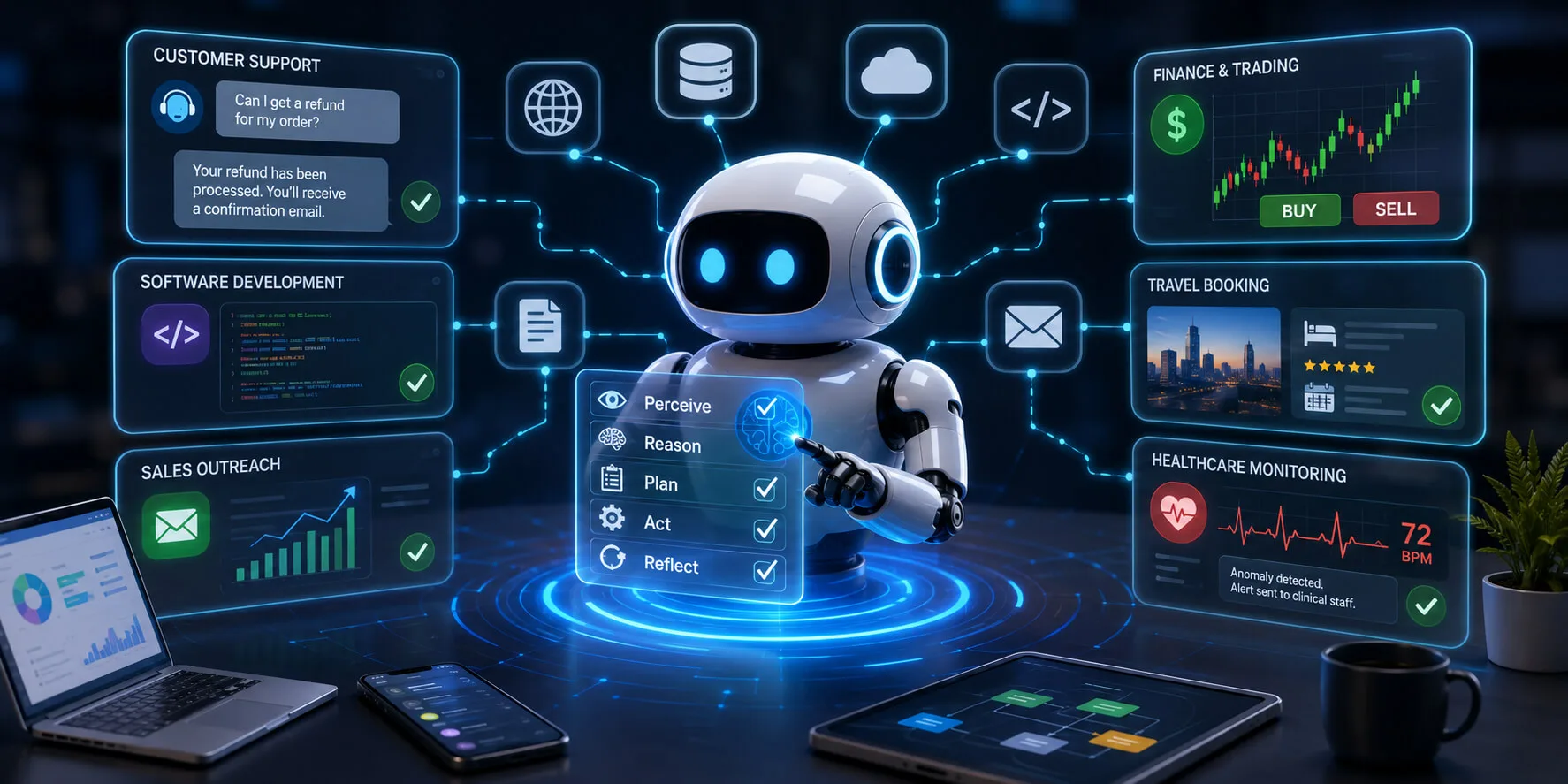
- The biggest use case (that all the AI agents do now), is a large language model, with tools/ mem and a planning loop, to perceive /reason and act.
- From the most autonomous and with considerable memory use, reactive agents, deliberative agents, learning agents to multi-agent systems.
- AI agents that are used by businesses for customer support, coding, sales outreach, finance and back-office automation, often cutting manual work by large margins.
- Gartner projects that over 40% of agentic AI projects will be canceled by the end of 2027, mainly due to unclear ROI and weak governance, not because the technology fails (Source: Gartner, June 2025).
What Is an AI Agent?
An AI agent is a computer program that uses artificial intelligence to pursue a goal on its own. It perceives information, decides what to do next, and takes action, usually by calling tools or software, without a human directing every step.
What Does “AI Agent” Actually Mean?
I have spent the past year testing agent tools for content operations, from research assistants that pull competitor data to agents that draft and schedule posts. The pattern that stands out every time is this: an agent does not wait for you to ask a question. It figures out what needs to happen and gets moving.
That is the core difference between an AI agent and a regular AI tool. A calculator app waits for input. A chatbot waits for a prompt. An agent takes a goal like “find the five lowest-competition keywords in this niche” and works through the steps itself, checking data, comparing results, and delivering an output.
Technically, an AI agent combines three things: a reasoning engine (usually a large language model), a set of tools it can call (APIs, databases, browsers, code), and a memory system that tracks what it has already tried. This combination is sometimes called agentic AI, a term that describes the broader shift toward AI systems that act rather than just answer.
How AI Agents Work: The Perceive, Plan, Act Loop
AI agents follow a repeating cycle rather than a single input-output exchange. Understanding this loop explains why agents can handle multi-step work that a chatbot cannot.
- Perception. The agent gathers information from its environment: an email inbox, a spreadsheet, a website, a customer message, or a live API feed.
- Reasoning. It interprets that information using its underlying model, working out what the data means in context.
- Planning. It breaks the overall goal into smaller steps it can actually execute, often in a specific order.
- Action. It calls tools to carry out each step, such as sending an email, updating a record, or writing code.
- Reflection. It checks whether the action worked and adjusts its next move if something failed.
Here is a plain example. A support agent receives a message from a customer asking for a refund. It reads the message, checks the order against the refund policy, decides the customer qualifies, processes the refund through the payment API, and replies with confirmation. No human touched a single step.
See More: Skaipi: The Easy Tool That Replaces Messaging, Meetings, and More
AI Agents vs Chatbots vs AI Assistants
People often use these terms interchangeably, but they describe different levels of autonomy.
| Feature | Chatbot | AI Assistant | AI Agent |
| What it does | Answers questions | Helps you complete a task | Completes the task itself |
| Autonomy | Low, only reacts to input | Medium, needs guidance at each step | High, works toward a goal independently |
| Memory | Little to none | Short-term, session based | Persistent, tracks history and context |
| Tool access | Limited or none | A few connected apps | Full access to APIs, databases, and software |
| Example | A website FAQ widget | A calendar assistant that suggests times | An agent that books, reschedules, and follows up on meetings on its own |
A chatbot talks to you. An assistant works alongside you. An agent works on your behalf.
Types of AI Agents
AI agents are grouped by how they reason and how much independence they have. Here are the main categories used across AI research and enterprise software.
Simple Reflex Agents
These agents react to specific triggers using fixed rules, without weighing past experience. A thermostat that turns on heating below a set temperature is a basic example. They are fast and predictable but cannot handle situations outside their rules.
Model-Based Agents
These agents keep an internal model of their environment, so they can handle situations even when they cannot see everything directly. A warehouse robot that tracks shelf locations it cannot currently see is a model-based agent.
Goal-Based Agents
These agents evaluate multiple possible actions and choose the one that gets them closest to a defined goal. A route-planning agent that compares several paths and picks the fastest one fits here.
Utility-Based Agents
These agents go a step further than goal-based agents by weighing trade-offs, not just reaching a goal but reaching it in the best possible way. A trading agent balancing profit against risk is a utility-based agent.
Learning Agents
These agents improve their performance over time by analyzing outcomes from past actions. A recommendation agent that gets better at suggesting content the more it learns about a user’s habits is a learning agent.
Multi-Agent Systems
Instead of one agent handling everything, multiple specialized agents work together, each with a defined role. A content pipeline where one agent researches, one writes, and one edits is a multi-agent system. This setup is becoming common in 2026 for complex workflows that need different types of expertise at each stage.
Real-World Examples of AI Agents
Abstract definitions only go so far. Here is where AI agents are already doing real work.
Customer support. Agents read incoming tickets, check order history, and resolve refunds or exchanges without waiting for a human agent to pick up the case.
Software development. Coding agents scan a codebase, find bugs, write a fix, and open a pull request for review.
Sales outreach. Agents research a lead’s company, personalize an opening message, and schedule a follow-up sequence automatically.
Finance and trading. Agents monitor market data continuously and execute trades within pre-set risk limits, reacting faster than a human trader could.
Travel booking. Agents compare flights, hotels, and layover times against a traveler’s budget and preferences, then book the full itinerary.
Healthcare monitoring. Agents track patient vitals from connected devices and flag abnormal readings to clinical staff in real time.
Benefits of Using AI Agents
Round-the-clock output. Agents do not need breaks, so repetitive tasks like data entry or ticket triage keep moving outside office hours.
Lower operational cost. Businesses cut manual labor on repetitive processes, freeing staff for work that needs human judgment.
Faster decisions on large data. Agents can scan far more information than a person could review in the same time, surfacing patterns a human might miss.
Consistent service quality. Because agents follow the same logic every time, response quality does not dip on a busy day the way it might for an overworked support team.
Scale without proportional headcount. An agent handling 50 requests works the same way handling 5,000, so growth does not require hiring at the same pace.
Drawbacks and Limitations of AI Agents
High setup complexity. Building a reliable agent takes real engineering work, clean data pipelines, and testing, not just plugging in an API key.
Data and privacy exposure. Agents often need access to sensitive systems, which raises real security risk if permissions are not tightly controlled.
Errors compound quickly. A wrong decision at step two can cascade through the rest of an automated workflow before anyone notices.
Governance gaps. Without clear rules, agents can get stuck in repeat loops or take actions nobody approved, which is why oversight frameworks matter.
Unclear ROI in early deployments. A lot of agent projects launch without a measurable success target, which makes it hard to know if the investment paid off.
See More: Crackstube: What It Is, How It Works, and Why People Are Talking About It
Pros and Cons at a Glance
| Pros | Cons |
| Handles repetitive work continuously | Requires technical setup and maintenance |
| Cuts long-term operational costs | Carries data privacy and security risk |
| Processes large data volumes quickly | Errors can cascade through a workflow |
| Scales without matching headcount growth | Needs governance to avoid runaway actions |
| Frees staff for higher-value work | Many early projects lack a clear success metric |
Why Do So Many AI Agent Projects Fail?
This question comes up constantly, so it deserves a direct answer. Gartner projects that more than 40% of agentic AI projects will be canceled by the end of 2027, based on a poll of over 3,400 organizations investing in the technology (Source: Gartner, June 2025). The reason is rarely the technology itself.
Gartner analyst Anushree Verma pointed to projects driven by hype rather than a clear business case, often launched without understanding the real cost of running an agent at scale. The practical lesson: agents succeed when a team defines a specific, measurable problem before building, not when they deploy an agent because competitors are talking about it.
How Much Value Can AI Agents Actually Create?
Broader generative AI, the technology category that powers most modern agents, has significant economic potential. McKinsey Global Institute estimates generative AI could add $2.6 trillion to $4.4 trillion in value to the global economy annually, largely through customer operations, marketing, software engineering, and R&D (Source: McKinsey Global Institute, 2023). That figure covers generative AI broadly, not agents alone, but it shows the scale of what agentic workflows are tapping into as they mature.
Best Practices for Implementing AI Agents
Start with one well-defined task rather than trying to automate an entire department on day one. A narrow scope makes it easier to measure whether the agent actually works.
Keep a human in the loop for high-stakes decisions, such as anything involving money, legal risk, or sensitive customer data.
Set up monitoring from the start. Track what the agent does, not just what it produces, so errors get caught before they compound.
Feed the agent clean, structured data. An agent is only as reliable as the information it can access.
Define success in numbers before launch, such as reduced response time or fewer manual tickets, so the project has a clear pass or fail line.
How Is an AI Agent Different From Traditional Automation?
Traditional automation, like a rules-based script or RPA bot, follows fixed if-then logic and breaks the moment it hits a scenario it was not coded for. An AI agent reasons through new situations using its underlying model, so it can adapt when the input does not match a pre-written rule.
Common Mistakes When Adopting AI Agents
Skipping the scope definition. Teams that say “we want an AI agent” without naming the exact task usually end up with something that does not solve anything specific.
Ignoring data quality. An agent connected to messy, inconsistent data will make confident, wrong decisions rather than obviously bad ones, which makes errors harder to catch.
No human checkpoint. Removing all human review from irreversible actions, like financial transactions, invites costly mistakes.
Treating deployment as the finish line. Agents need ongoing monitoring, since their performance can drift as underlying models or data patterns change.
The Future of AI Agents
Multi-agent systems are becoming the default for complex work. Rather than one general-purpose agent trying to do everything, organizations are building small teams of specialized agents, each handling a piece of a larger workflow, similar to how departments split responsibility inside a company. Expect tighter integration between agents and existing business software, along with stronger governance tools as adoption grows past the early experimentation stage.
The concept of software that perceives its environment and acts autonomously toward a goal has roots in the broader field of the intelligent agent, a term used in artificial intelligence research long before today’s LLM-based tools existed.
What I’d Tell Anyone Starting With AI Agents
After a year of testing these tools inside real content workflows, the biggest shift in my thinking was this: an agent is not magic, it is a system that needs the same clarity you’d give a new employee. Give it a narrow job, clean information, and a way to check its work, and it earns its keep fast. Skip that groundwork, and you end up with expensive automation nobody trusts.
FAQs
What is an AI agent in simple terms?
An AI agent is software that can understand a goal, decide the steps needed to reach it, and carry out those steps on its own, using tools and data it has access to.
What is the difference between AI agents and agentic AI?
AI agents are the individual tools or systems. Agentic AI is the broader term for the technology and capability that lets those systems act with autonomy and intent.
Are AI agents the same as LLM agents?
Mostly, yes. An LLM agent is an AI agent that uses a large language model as its core reasoning engine, which describes most agents built today.
Do AI agents need coding knowledge to use?
No. Many platforms now offer no-code agent builders, though building highly custom agents from scratch still requires technical skills.
Are AI agents safe to use in a business setting?
They can be, provided the organization sets up proper governance, access controls, and human oversight for high-stakes decisions.
What industries use AI agents the most right now?
Customer service, software development, finance, and healthcare show the fastest adoption, according to industry reporting through 2026.
How is an AI agent different from RPA (robotic process automation)?
RPA follows fixed, pre-programmed rules and cannot adapt to new situations. AI agents reason through unfamiliar scenarios using a language model instead of a static script.
What is a multi-agent system?
A multi-agent system uses several specialized AI agents that each handle part of a larger task, working together the way team members split up a project.
Why do so many AI agent projects fail?
Most failures trace back to unclear goals, poor data quality, or weak governance rather than the underlying AI technology not working (Source: Gartner, June 2025).
Can AI agents replace human employees entirely?
Not fully. Agents handle repetitive, well-defined tasks well, but decisions requiring judgment, ethics, or nuanced context still need human oversight.