If you have spent any time testing customer support tools this year, you have probably felt the shift. Chatbots used to feel like talking to a vending machine. Now some of these systems seem to actually get things done. That gap is not marketing hype. It is a real architectural difference, and it changes what these tools can do for your business.
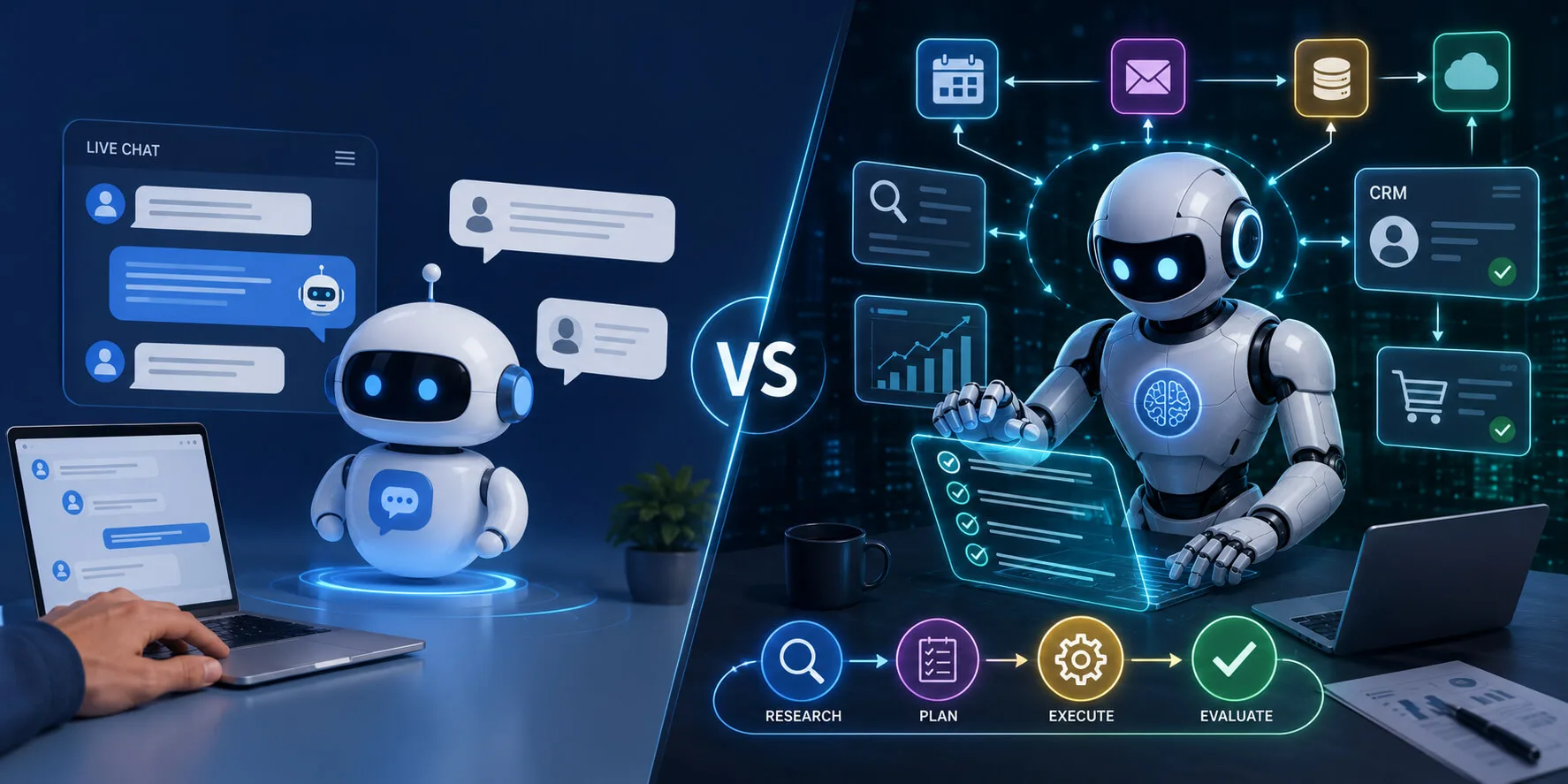
A chatbot responds to messages using scripts or a language model, but it stops once it replies. An AI agent goes further. It plans, uses tools, remembers context, and takes multi-step actions to finish a task without a human pushing every button.
Key Takeaways
- Chatbots are reactive. They answer what you ask and wait for the next message.
- AI agents are goal-driven. You give them an objective and they work toward it.
- The core technical difference is autonomy, not just intelligence.
- Agents use a reasoning loop that includes observing, planning, acting, and checking results.
- Most businesses start with chatbots and grow into agents as their workflows get more complex.
What Is a Chatbot?
A chatbot is software built to hold a conversation through text or voice. Early chatbots followed rigid scripts. You typed a keyword, and the bot matched it to a pre-written answer.
Today’s chatbots are smarter. Many use large language models to understand phrasing and context instead of exact keywords. But their job stays the same: answer the question in front of them, then stop.
Think of a chatbot on an airline’s website. Ask about baggage rules and it gives you the policy. Ask it to actually rebook your flight after a cancellation, and it usually cannot. It will hand you off to a human or a form.
What Is an AI Agent?
An AI agent is a system built around a large language model, but the model is only one part. The agent also has memory, access to tools, and a reasoning process that lets it decide what to do next on its own. Instead of matching a question to an answer, an agent works in a loop. It observes the request, reasons about the best path forward, takes an action like calling an API or checking a database, then evaluates whether the goal was met.
This pattern is often called a React loop, a term that came from the research paper that first described reasoning and acting together in language model systems. Give an AI agent a goal like “find open slots on my calendar next week and book a call with this client,” and it can search the calendar, check for conflicts, send an invite, and confirm the booking. No one has to walk it through each step.
AI Agent vs Chatbot: The Core Differences
| Factor | Chatbot | AI Agent |
| Autonomy | Needs a human to trigger each step | Works toward a goal with little supervision |
| Memory | Often limited to the current conversation | Retains context across sessions and tasks |
| Tool use | Rarely connects to outside systems | Calls APIs, databases, and software directly |
| Best for | FAQs, order tracking, simple routing | Multi-step workflows across tools and teams |
| Failure mode | Gives a generic or wrong answer | May take an incorrect action if not supervised |
The distinction that matters most is autonomy. A chatbot is read-only in practice. It tells you information. An AI agent reads, writes, and acts.
How Does an AI Agent Actually Work?
An AI agent’s reasoning loop has four phases. It observes the request and any relevant context, reasons about what needs to happen, acts by calling a tool or generating a response, then checks whether the result actually solved the problem. If not, it tries again or asks for help.
This loop is what separates an agent from a chatbot with a few added features. A chatbot processes one message at a time. An agent can chain several actions together to solve a problem that needs more than one step.
When Should You Use a Chatbot Instead of an Agent?
A chatbot is still the right tool for simple, repetitive interactions. If your support volume is mostly FAQs, store hours, or basic order status checks, a chatbot handles that well and costs far less to build and maintain.
Agentic systems add complexity that is not always worth it. When a task fits neatly into a decision tree with a handful of branches, a scripted or lightly AI-enhanced chatbot solves it without the overhead of tool integrations, permissions, and monitoring that agents require.
When Do You Actually Need an AI Agent?
You need an agent when a request cannot be solved in one reply. That includes tasks that span multiple systems, decisions that depend on context, cases that require follow-up, or work where a human is currently doing repetitive copy-paste between tools.
Gartner projects that by 2028, at least 15% of daily work decisions will be made autonomously by AI agents, a sharp rise from close to zero today. That kind of shift only makes sense for tasks with real complexity, not for answering “what are your store hours.” The JADA Squad
Real-World Examples
A customer support chatbot answering “where is my package” from a shipping API is a chatbot task. A system that notices a shipment is delayed, checks the customer’s order history, issues a partial refund based on your policy, and emails the customer an update is agent territory.
In sales, a chatbot can answer a lead’s question about pricing on your website. An AI agent can identify a promising lead from your CRM, research the company, draft a personalized outreach email, and schedule a follow-up if there is no response within a set window.
Common Mistakes When Choosing Between the Two
Many teams jump straight to an AI agent for tasks a simple chatbot could handle, which adds unnecessary cost and risk. Others stick with a rigid chatbot long after their workflows outgrew it, creating bottlenecks that frustrate customers.
The better approach is to map your actual workflows first. Count how many steps each task takes and how many systems it touches. That number tells you more than any vendor pitch will.
Pros and Cons
Chatbots
- Pros: cheaper to build, easier to maintain, predictable behavior
- Cons: limited to conversation, cannot execute multi-step tasks, often needs human handoff
AI Agents
- Pros: handles complex workflows, reduces manual work, adapts to context
- Cons: costs more to build and monitor, requires safety controls, mistakes can compound across steps
See More: Skaipi: The Easy Tool That Replaces Messaging, Meetings, and More
FAQs
What is the main difference between an AI agent and a chatbot?
A chatbot answers questions and stops. An AI agent plans and takes multi-step actions on its own to reach a goal, often using outside tools and data.
Can a chatbot become an AI agent?
Yes, incrementally. Once a chatbot gains the ability to call tools or trigger actions instead of only replying with text, it starts behaving like an agent.
Are AI agents replacing chatbots?
Not entirely. Chatbots still make sense for simple, high-volume, repetitive questions. Agents are replacing chatbots mainly in workflows that need multiple steps or system access.
Do AI agents use large language models?
Yes. The language model is the reasoning engine inside an agent, but it works inside a loop with memory, tools, and planning, not as a standalone chat interface.
Is an AI agent more expensive than a chatbot?
Generally yes. Agents need tool integrations, monitoring, and safety controls that simple chatbots do not require, which raises both build and maintenance costs.
What industries benefit most from AI agents?
Customer service, sales operations, finance, and software development see the biggest gains, mainly because these fields involve multi-step tasks across several systems.
Can AI agents work without human oversight?
Some can operate with minimal supervision, but most production systems include checkpoints where a human reviews or approves key actions before they execute.
What is a reasoning loop in an AI agent?
It is the observation, reason, act, and evaluation cycle an agent uses to decide what to do next, repeating until the task is complete or it needs human input.
Do I need an AI agent for basic FAQ support?
No. A chatbot handles FAQ-style questions efficiently and at lower cost. Agents are built for tasks that go beyond answering a single question.
How do I decide between a chatbot and an AI agent for my business?
Map your workflows and count the steps and systems each task touches. Simple, single-step tasks fit a chatbot. Multi-step tasks across tools call for an agent.
I have spent enough time testing both types of systems to know the choice rarely comes down to which one sounds more advanced. It comes down to what your workflow actually needs. A chatbot that answers questions well beats an agent that overcomplicates a simple task, and an agent that closes the loop beats a chatbot that just deflects to a human. Match the tool to the job, not the trend.