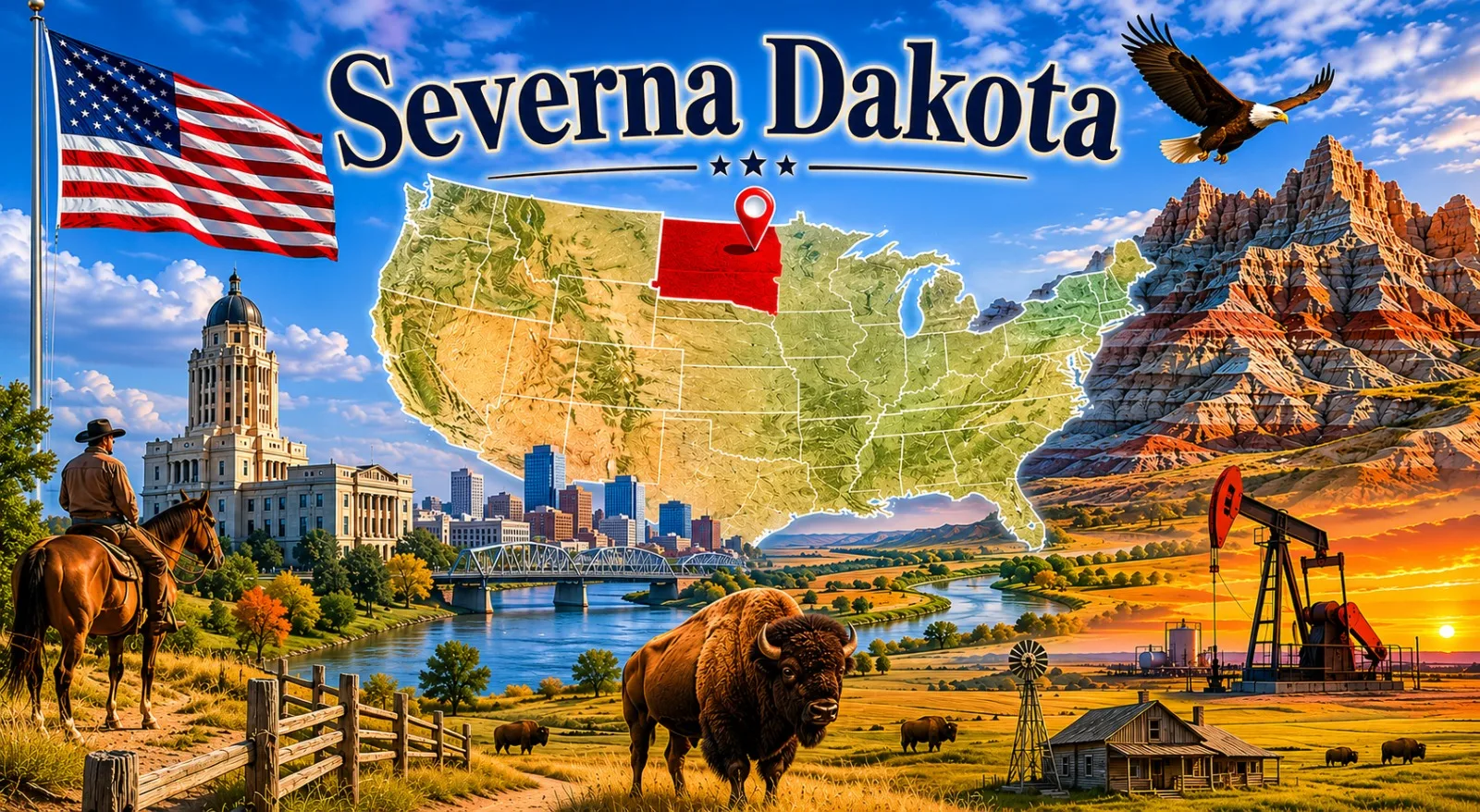
The name Severna Dakota may look unfamiliar to people who usually read about American states in English. However, it does not refer to a separate country, city, or newly discovered region. It is a translated geographical name used in languages such as Slovenian and Serbian to refer to North Dakota, one of the 50 states of the United States.
North Dakota is located in the north-central part of the country, along the Canadian border. It is known for its wide agricultural landscapes, historic communities, Native American heritage, open prairies, and the rugged scenery of Theodore Roosevelt National Park. Although it receives less international attention than some larger American destinations, the state has a distinctive history and geography worth exploring.
Understanding Severna Dakota therefore involves more than translating a place name. It also means learning about the actual American state behind it, including its location, historical development, population, economy, climate, culture, and attractions. This guide explains the name first and then explores North Dakota using reliable geographical and historical information.
What Does Severna Dakota Mean?
Severna Dakota is a translated form of the English geographical name North Dakota. The expression appears in language and geographical references, including Slovenian and Serbian resources. It does not identify a separate territory or an additional American state.
The word severna is associated with the meaning “northern” in the relevant South Slavic language forms, while Dakota remains the name of the state. In English, the corresponding name is North Dakota. The difference is linguistic rather than geographical, which means both names point to the same place.
The Slovenian language reference Fran – ePravopis identifies Severna Dakota as a geographical name and gives North Dakota as its English equivalent. A Serbian geographical names dictionary published by the University of Novi Sad also records North Dakota as Severna Dakota.
Is Severna Dakota a Real Place?
Yes, when the term is used as a translated name for North Dakota, it refers to a real US state. However, it is not a separate administrative location with its own independent government, borders, or capital.
The official English name used by the United States government is North Dakota. The state is part of the Upper Midwest and Northern Great Plains region. Its northern border meets Canada, while its other boundaries connect it with Montana, South Dakota, and Minnesota.
This distinction is useful when reading translated websites, maps, educational material, or international geographical references. If a source mentions Severna Dakota, checking its language and context can help confirm that it is discussing North Dakota.
Why Does the Name Appear Online?
Translated place names often appear in international search results because geographical names are adapted to the spelling and grammar of different languages. Search engines may display these forms when users browse multilingual websites, translated pages, dictionaries, or international educational resources.
For example, someone researching American geography in Slovenian may encounter Severna Dakota instead of the English wording North Dakota. Serbian geographical references also use the translated form. This does not indicate that a new destination has appeared or that the state has changed its official name.
The distinction between a translated name and an official English name is especially important when searching for government information, travel guidance, maps, or historical records. Using North Dakota alongside Severna Dakota will usually make it easier to find authoritative American sources.
Where Is North Dakota Located?
North Dakota is located in the north-central United States, within the Great Plains region. It shares its northern border with the Canadian provinces of Saskatchewan and Manitoba. Montana lies to the west, South Dakota is directly to the south, and Minnesota borders the state to the east.
Its geographical position gives North Dakota a landscape strongly influenced by plains, river systems, agricultural land, and prairie ecosystems. The state is far from the Atlantic and Pacific coasts, so its climate and regional character differ from coastal American destinations.
North Dakota is also part of the larger Upper Midwest, a region that includes several states with agricultural economies and extensive freshwater resources. Its location has influenced settlement, transportation, farming, trade, and connections with neighbouring Canadian communities.
Capital and Largest City
The capital of North Dakota is Bismarck, located in the central part of the state along the Missouri River. It is the centre of state government and contains the North Dakota State Capitol, government offices, public institutions, and other important civic facilities.
Bismarck is an important administrative and regional centre, although it is not the state’s largest city. That distinction belongs to Fargo, which is located in eastern North Dakota near the Minnesota border. Fargo is a major centre for business, education, healthcare, culture, and regional services.
Other notable communities include Grand Forks, Minot, West Fargo, Dickinson, and Williston. Each has its own regional role, from education and agriculture to energy, transportation, and local commerce.
How Large Is North Dakota?
North Dakota covers approximately 70,700 square miles, making it a relatively large state by land area compared with many other US states. Despite its size, its population is comparatively small, so extensive rural areas and open landscapes remain important features of its identity.
The state’s population is not distributed evenly. Fargo and its surrounding communities form a major population centre in the east, while Bismarck and other cities serve different regional areas. Many smaller communities are connected to agriculture, local services, energy production, and transportation.
Its combination of substantial land area and a relatively small population contributes to the open character that visitors often associate with the Northern Plains.
North Dakota Population and Demographics
Population information helps explain how North Dakota has developed and how its communities are distributed. According to the US Census Bureau’s QuickFacts data, North Dakota had an estimated population of 799,358 on July 1, 2025. This is an estimate, not a new decennial census count, and it provides a recent reference point for understanding the state’s population.
The state experienced population growth between the 2020 census and the 2025 estimate. The Census Bureau reports a 2.6% increase from the April 2020 estimates base to July 2025. However, population patterns differ between individual cities, counties, and rural areas.
For the latest figures and demographic details, readers can consult the US Census Bureau’s North Dakota QuickFacts page.
Population Distribution
Fargo is the largest city and a major population centre in eastern North Dakota. Its position near the Minnesota border makes it important for regional trade, education, healthcare, and employment. The wider Fargo-Moorhead area also connects communities across the state boundary.
Bismarck serves as the state capital and an important centre for government, healthcare, business, and public services. Grand Forks has a strong educational identity, while Minot supports regional commerce and other services in north-central North Dakota.
Outside these cities, many residents live in smaller towns and rural communities. Agriculture, local businesses, schools, healthcare facilities, and regional employers play important roles in maintaining these communities.
Cultural and Demographic Diversity
North Dakota’s population includes people with different family backgrounds, cultural traditions, and community identities. The state’s history includes Indigenous nations, European immigration, and more recent population changes connected with education, employment, and economic development.
The US Census Bureau records American Indian and Alaska Native residents as an important part of the state’s population. Indigenous communities have deep historical connections to the region and continue to contribute to its cultural, political, and social life.
Understanding North Dakota’s population therefore requires looking beyond its cities and agricultural economy. Its communities reflect a range of experiences and histories that have shaped the state over generations.
History of North Dakota
North Dakota’s history extends far beyond the establishment of the modern state. Indigenous peoples lived across the Northern Plains long before European-American settlement expanded into the region. Their communities developed social systems, trade relationships, agricultural practices, and cultural traditions connected to the land and its natural resources.
The arrival of European explorers, traders, settlers, and later railroad companies changed the region significantly. Over time, territorial government, immigration, agriculture, and political organisation contributed to the creation of North Dakota as a separate state.
Indigenous Peoples and Early History
The Northern Plains have been home to Indigenous communities for thousands of years. The State Historical Society of North Dakota documents the presence of different groups in the region, including the Mandan, Hidatsa, Arikara, Dakota, Lakota, Assiniboine, and Cheyenne peoples.
These communities had different languages, traditions, political structures, and relationships with the environment. Some relied heavily on hunting and seasonal movement, while others developed established agricultural settlements. Bison were particularly important to many Plains communities because they provided food, clothing, tools, and materials for everyday life.
The introduction of horses during the eighteenth century changed travel, hunting, trade, and other aspects of life for several Plains nations. These developments formed part of a much longer history of adaptation and cultural exchange.
For historical background, the State Historical Society of North Dakota’s First People overview provides an introduction to the Indigenous communities connected with the region.
Formation of Dakota Territory
A major political change occurred in 1861, when the United States Congress established Dakota Territory. Its boundaries were much larger than those of modern North Dakota and changed several times during the territorial period.
At different stages, Dakota Territory included areas that later became North Dakota, South Dakota, and parts of other western states. Its government, settlement patterns, transportation routes, and political institutions developed as American expansion moved across the Northern Plains.
The territorial capital was first established at Yankton and later moved to Bismarck in 1883. Railways helped connect settlements and agricultural communities with wider markets, while federal land policies encouraged additional settlement.
These developments contributed to population growth and increased political interest in dividing the territory into separate states.
North Dakota Became a State in 1889
North Dakota officially joined the United States on November 2, 1889, when President Benjamin Harrison approved its admission to the Union. South Dakota entered the Union on the same date, becoming a separate state.
The establishment of North Dakota involved a constitutional convention, political negotiations, and the division of Dakota Territory. Its new government began building the institutions and administrative systems needed to operate as a state.
Bismarck became the capital, and the first state legislature convened in November 1889. The early years involved debates about taxation, agriculture, political influence, public institutions, and the role of government in economic development.
The State Historical Society’s account of North Dakota statehood provides further historical detail about this important period.
Agriculture and Settlement
Agriculture played a major role in North Dakota’s development during the late nineteenth and early twentieth centuries. Fertile areas, particularly in the Red River Valley, attracted farmers who established communities and contributed to the state’s growing agricultural economy.
Railroad expansion made it easier to transport grain, livestock, and other products to distant markets. New settlements developed around railway routes, while farming operations became increasingly connected with commercial trade.
Immigration also influenced the cultural development of the state. People from Scandinavian and German-speaking communities were among those who settled in North Dakota, bringing languages, religious traditions, food, farming knowledge, and community practices.
These influences remain visible in parts of the state’s architecture, festivals, food culture, and local heritage.
Geography and Natural Landscape of North Dakota
North Dakota is part of the Northern Great Plains, but its landscape is not completely uniform. The state contains broad agricultural valleys, gently rolling prairie, river systems, lakes, grasslands, and the more rugged badlands in the west.
Its geography is commonly divided into three broad natural regions: the Red River Valley, the Drift Prairie, and the Missouri Plateau. Each has distinctive landforms, soil characteristics, and environmental conditions.
The Red River Valley
The Red River Valley lies in eastern North Dakota along the boundary with Minnesota. It is known for its relatively flat terrain and fertile soils, much of which developed from sediment deposited by ancient glacial Lake Agassiz.
These conditions have supported extensive agricultural activity, making the valley one of the state’s important farming regions. The Red River also forms a significant part of the international and state boundary landscape.
Fargo, Grand Forks, and several smaller communities are located in or near this broad region. Its agricultural importance and settlement history have contributed to eastern North Dakota’s economic and cultural development.
The Drift Prairie
The Drift Prairie lies between the Red River Valley and the higher western landscape. It includes rolling plains, wetlands, lakes, and areas shaped by glacial activity.
Its terrain is more varied than the flat eastern valley, with small hills and water features appearing across the region. Farming and livestock production remain important, although soil and local environmental conditions vary from one area to another.
The region also supports outdoor activities and wildlife habitats. Wetlands and lakes are important for birds and other species, making parts of the Drift Prairie interesting for nature observation.
The Missouri Plateau
The Missouri Plateau covers much of western North Dakota. It contains higher elevations, prairie landscapes, river valleys, and the distinctive badlands associated with the western part of the state.
The Missouri River is an important geographical feature, and Lake Sakakawea forms a large reservoir along its course. The region also includes areas of rugged terrain that attract visitors interested in hiking, scenic drives, wildlife, and outdoor photography.
The western landscape is particularly associated with Theodore Roosevelt National Park, where erosion has shaped colourful buttes, valleys, and exposed geological formations.
Climate and Weather in North Dakota
North Dakota has a continental climate with substantial seasonal temperature differences. Winters can be extremely cold, while summers are often warm or hot. Temperature changes can also occur over relatively short periods because of changing air masses and weather systems.
The state’s northern location and inland position contribute to these conditions. Unlike coastal areas, North Dakota does not receive the same moderating influence from nearby oceans, so winter cold and summer heat can both be pronounced.
According to the North Dakota Game and Fish Department, average annual temperatures range from approximately 37°F in the north to 43°F in the south. January is generally the coldest month, while July is usually the warmest.
Winter Conditions
Winter is an important part of North Dakota’s climate and can bring snow, strong winds, icy roads, and very low temperatures. Cold air masses from the polar region influence the state, creating conditions that require preparation for residents and visitors.
Some rural roads and outdoor routes can become difficult to use during winter weather. Travellers should check forecasts, road conditions, and local travel advice before driving long distances.
Winter also affects daily life, agriculture, transport, and outdoor recreation. Suitable clothing and awareness of weather conditions are essential for anyone spending time outside.
Summer Conditions
Summers in North Dakota are generally warmer, with July typically recording the highest average temperatures. The season offers opportunities for hiking, camping, fishing, boating, festivals, and road trips.
However, summer conditions can still vary. Thunderstorms, strong winds, and periods of hot weather may affect outdoor plans, so checking forecasts is useful even during the warmer months.
Many visitors prefer late spring, summer, and early autumn for exploring the state’s parks and natural areas because road and trail access may be more convenient than during winter.
Rainfall and Seasonal Changes
Annual precipitation varies across North Dakota, with the eastern and southeastern parts generally receiving more moisture than some western areas. June is commonly one of the wetter months, while seasonal conditions influence farming, grassland growth, and water levels.
The state’s climate information is available through the North Dakota Game and Fish Department. Its overview explains temperature patterns, precipitation, and the influence of different air masses.
Economy and Major Industries
North Dakota’s economy has historically been connected to agriculture, natural resources, and transportation. Over time, other sectors such as healthcare, education, manufacturing, technology, construction, and professional services have also contributed to economic activity.
The state’s relatively small population and large land area influence the way businesses operate. Many economic activities are linked to regional centres, while rural communities depend on a combination of farming, local services, and resource-based industries.
Agriculture
Agriculture remains one of North Dakota’s most recognisable industries. The state produces a range of crops, including wheat, soybeans, corn, sunflowers, and other agricultural products.
Its farming sector also includes livestock production and businesses connected with food processing, storage, transportation, and agricultural equipment. The Red River Valley is especially important because of its productive soils and established farming communities.
North Dakota’s official government portal highlights the state’s agricultural production and its role in national crop markets. More information is available through the North Dakota food and agriculture overview.
Energy Production
Energy is another important part of the state’s economy. North Dakota has significant oil production in the western region, particularly around the Bakken formation. Oil development has influenced employment, infrastructure, population movement, and business activity in several communities.
The state also produces natural gas and has a history of coal-related energy development. Wind power is another part of its energy landscape, supported by the region’s open terrain and wind conditions.
The energy industry can create economic opportunities, but it also involves challenges related to infrastructure, environmental management, changing market prices, and the long-term transition of energy systems.
Education and Healthcare
Education and healthcare are important employers across North Dakota. Universities, colleges, hospitals, clinics, and research institutions provide services to residents across urban and rural areas.
The University of North Dakota in Grand Forks and North Dakota State University in Fargo are among the state’s major educational institutions. They contribute to research, professional training, business development, and cultural activities.
Healthcare facilities also serve regional populations, making them important to communities located far from the state’s largest cities.
Business and Technology
North Dakota’s economy includes a growing range of business and technology-related activities. Fargo and other urban centres support companies in financial services, software, manufacturing, logistics, and professional services.
Small businesses also play a significant role in local communities. Retail, hospitality, construction, transportation, and other service industries support residents and visitors throughout the state.
The economy is therefore more diverse than agriculture and oil production alone, even though those industries remain important to its identity.
Culture and Lifestyle in North Dakota
North Dakota’s culture reflects Indigenous history, European immigration, agricultural traditions, and modern community life. Its identity has developed through different generations, and local traditions vary between cities, rural areas, and individual cultural communities.
The state’s Scandinavian and German-Russian heritage is especially visible in some communities. Food, festivals, music, architecture, and historical organisations provide ways for residents and visitors to explore these cultural connections.
At the same time, Indigenous nations and communities remain an essential part of North Dakota’s cultural identity. Their histories and present-day contributions should be understood as living parts of the region rather than simply as subjects from the past.
Scandinavian and German-Russian Heritage
Immigration from Scandinavia and German-speaking areas influenced North Dakota’s settlement and community development. Many immigrant families brought agricultural experience, religious traditions, and cultural practices that became part of local life.
These influences can still be seen in selected festivals, traditional foods, community celebrations, and historic buildings. Norwegian heritage, for example, has a visible presence in parts of the state.
The cultural history of North Dakota is not limited to one European background, however. Different communities contributed to the state’s development, creating a diverse regional identity.
Indigenous Culture and Heritage
Indigenous history is central to understanding North Dakota. The Mandan, Hidatsa, Arikara, Dakota, Lakota, and other nations have long-standing relationships with the region.
Their languages, cultural practices, art, political institutions, and connections to ancestral lands continue to shape the state’s wider cultural landscape. Visitors interested in learning about this history should seek information from tribal organisations, museums, and educational institutions that represent these communities.
A respectful understanding recognises that Indigenous nations are contemporary communities with their own governments, priorities, and cultural activities.
Food and Local Traditions
North Dakota’s food culture reflects its agricultural economy and the backgrounds of different communities. Wheat, potatoes, meat, dairy products, and other locally produced ingredients feature in many traditional and modern meals.
Some communities maintain recipes and food traditions connected with Scandinavian and German-Russian heritage. Festivals and local gatherings can provide opportunities to explore these influences.
Food is also connected to the state’s farming identity. Agricultural fairs, local markets, and community events often celebrate regional products and the people who produce them.
Top Places to Visit in North Dakota
North Dakota offers several attractions for travellers interested in nature, history, outdoor recreation, and smaller American cities. It may not have the same concentration of internationally famous tourist landmarks as some coastal states, but its national park landscapes and regional heritage sites provide distinctive experiences.
A road trip is often a practical way to explore the state because attractions and communities can be spread across considerable distances. Visitors should plan travel times carefully and check seasonal conditions before setting out.
1. Theodore Roosevelt National Park
Theodore Roosevelt National Park is one of North Dakota’s best-known natural attractions. Located in the western part of the state, it protects areas of the Little Missouri Badlands and landscapes associated with former US President Theodore Roosevelt.
The park contains three separate units: the South Unit, North Unit, and Elkhorn Ranch Unit. Its scenery includes colourful rock formations, grasslands, river valleys, and wildlife habitats. Visitors can enjoy scenic drives, hiking, camping, and opportunities to observe animals in their natural surroundings.
The National Park Service provides information about park access, activities, and current visitor guidance through the official Theodore Roosevelt National Park website.
2. Fargo
Fargo is the largest city in North Dakota and an important centre for business, education, shopping, and entertainment. Located near the Minnesota border, it is part of a wider urban area connected with Moorhead, Minnesota.
The city offers museums, cultural venues, restaurants, parks, and events throughout the year. It is also home to North Dakota State University, which contributes to its educational and sporting identity.
For visitors, Fargo can serve as a convenient starting point for exploring eastern North Dakota. Its combination of urban facilities and regional attractions makes it one of the state’s most accessible destinations.
3. Bismarck
Bismarck is the state capital and an important centre for government and public services. Its location along the Missouri River gives the city a connection with one of the region’s major geographical features.
Visitors can explore the North Dakota State Capitol grounds, museums, historic locations, and riverfront areas. The city also provides access to nearby outdoor activities and regional attractions.
Bismarck is a useful destination for people interested in North Dakota’s political history and the development of its state institutions.
4. Lake Sakakawea
Lake Sakakawea is a large reservoir on the Missouri River and an important destination for water-based recreation. It offers opportunities for boating, fishing, camping, and enjoying the surrounding landscape.
The lake has an extensive shoreline and attracts visitors who enjoy outdoor activities. Its recreational areas also contribute to the wider tourism economy of western and central North Dakota.
Visitors should check local conditions, boating rules, access information, and seasonal services before planning a trip.
5. Medora
Medora is a small town in western North Dakota near the South Unit of Theodore Roosevelt National Park. It is known as a visitor gateway for people exploring the Badlands and the surrounding region.
The town has a strong connection with North Dakota’s western history and tourism. Its attractions, local businesses, and seasonal activities make it a useful stop during a road trip.
Because Medora is close to the national park entrance, it can be a convenient base for exploring scenic drives, trails, and nearby landscapes.
6. International Peace Garden
The International Peace Garden is located along the border between North Dakota and Manitoba, Canada. It was created as a symbol of friendship and peace between the United States and Canada.
The garden includes landscaped areas, walking spaces, floral displays, and memorial features. Its location makes it a distinctive attraction for visitors interested in international relations and peaceful cross-border connections.
Travellers should check current entry requirements and operating information before visiting because the attraction is situated at the international border.
7. Knife River Indian Villages National Historic Site
Knife River Indian Villages National Historic Site preserves the history and cultural heritage of the Mandan and Hidatsa peoples. The site includes archaeological remains of historic earthlodge villages and educational resources about Indigenous life in the region.
Visitors can learn about traditional village organisation, agriculture, trade, and the importance of the Missouri River area. The location provides valuable context for understanding the history of Indigenous communities before and during European-American expansion.
It is particularly relevant for travellers who want to explore North Dakota beyond its natural scenery and learn about the people who have lived in the region for generations.
Best Time to Visit North Dakota
The best time to visit North Dakota depends on the activities a traveller wants to enjoy. Summer is generally suitable for road trips, camping, hiking, and exploring national park landscapes. Late spring and early autumn can also be attractive for visitors who prefer changing scenery and potentially milder temperatures.
Winter has its own appeal for people interested in snow-covered landscapes and cold-weather activities, but it requires more preparation. Low temperatures, snow, wind, and icy roads can affect travel plans, especially in rural areas.
Visiting in Spring
Spring brings changing temperatures and the return of warmer weather after winter. It can be a pleasant time to see the landscape becoming greener, although rain and changing road conditions may affect some outdoor plans.
Visitors should check park access and trail conditions before travelling. Some activities may depend on weather, maintenance, or seasonal services.
Visiting in Summer
Summer is a popular season for exploring North Dakota’s parks, lakes, and outdoor attractions. Longer daylight hours provide more time for scenic drives, fishing, boating, camping, and walking trails.
However, summer can also bring thunderstorms and periods of hot weather. Carrying water, checking forecasts, and planning suitable breaks can make outdoor activities more comfortable.
Visiting in Autumn and Winter
Autumn can bring changing prairie colours and cooler temperatures, making it suitable for scenic drives and quieter travel. Winter offers a different view of the state, but travellers should be prepared for potentially severe weather.
Before driving in winter, check road reports and local weather updates. Visitors planning to explore remote areas should also confirm access conditions and carry suitable supplies.
Living in North Dakota: What Should People Know?
North Dakota offers a different lifestyle from densely populated American states. Many communities have smaller populations, open surroundings, and strong connections with local industries such as agriculture, healthcare, education, and energy.
Larger cities provide shopping, healthcare, educational institutions, and entertainment, while rural areas may offer a quieter environment with greater distances between services. The best location for an individual or family depends on employment, housing, education, transport, and personal preferences.
Cost of Living
Housing and everyday expenses vary between cities and rural communities. The US Census Bureau’s QuickFacts page provides information about housing values, rents, household characteristics, and other demographic indicators.
However, a statewide average does not necessarily describe every neighbourhood or town. Anyone considering relocation should compare local housing, transportation, utility, insurance, and employment costs before making a decision.
Employment Opportunities
Employment opportunities are available in different industries, including agriculture, energy, healthcare, education, manufacturing, construction, and business services.
Fargo and Bismarck offer a broader range of urban employment options, while smaller communities may have opportunities connected with local industries and public services. Job availability and salaries depend on qualifications, experience, and local economic conditions.
People considering a move should review current job listings and employer requirements rather than relying on general descriptions of the state’s economy.
Education and Community Life
North Dakota has public schools, colleges, universities, and technical education institutions. Higher education contributes to local employment, research, and community development.
Community activities often include school events, agricultural fairs, sports, festivals, and local cultural programmes. These activities can be important parts of everyday life, especially in smaller towns.
As with any state, the experience of living in North Dakota varies according to the community, personal circumstances, and individual expectations.
Frequently Asked Questions About Severna Dakota
1. What is Severna Dakota?
Severna Dakota is a translated geographical name for North Dakota, a US state located in the north-central part of the country. It is used in language and geographical references, including Slovenian and Serbian resources. It does not refer to a separate state or country.
2. Is Severna Dakota the same as North Dakota?
Yes. When used as a translated place name, Severna Dakota refers to the same American state officially known in English as North Dakota. Both names identify the same geographical location.
3. Where is Severna Dakota located?
Severna Dakota refers to North Dakota, which is located in the Northern Great Plains of the United States. It borders Canada to the north, Montana to the west, South Dakota to the south, and Minnesota to the east.
4. What is the capital of North Dakota?
Bismarck is the capital of North Dakota. It is located along the Missouri River and serves as the state’s main centre for government and public administration.
5. What is the largest city in North Dakota?
Fargo is the largest city in North Dakota. It is located in the eastern part of the state near Minnesota and is an important centre for education, healthcare, business, and regional services.
6. What is the population of North Dakota?
The US Census Bureau estimated North Dakota’s population at 799,358 on July 1, 2025. Population figures change over time, so the Census Bureau’s QuickFacts page is a useful place to check the latest available estimates.
7. When did North Dakota become a state?
North Dakota became the 39th state of the United States on November 2, 1889. South Dakota also joined the Union on the same date.
8. What is North Dakota famous for?
North Dakota is known for agriculture, prairie landscapes, the Missouri River, its Indigenous heritage, and Theodore Roosevelt National Park. It is also associated with energy production, small communities, and Scandinavian and German-Russian cultural influences.
9. What language uses the name Severna Dakota?
The translated form Severna Dakota appears in Slovenian and Serbian geographical references. It is used as the equivalent of North Dakota rather than as the official English name of a separate place.
10. What are the best places to visit in North Dakota?
Popular destinations include Theodore Roosevelt National Park, Fargo, Bismarck, Lake Sakakawea, Medora, the International Peace Garden, and Knife River Indian Villages National Historic Site. The best choice depends on whether visitors prefer nature, history, outdoor recreation, or city attractions.
11. Does North Dakota have very cold winters?
Yes. North Dakota has a continental climate with cold winters and warm summers. Winter temperatures can become extremely low, and snow, wind, and icy roads may affect travel.
12. Is North Dakota a good destination for nature lovers?
North Dakota can be appealing to visitors who enjoy open landscapes, wildlife, hiking, fishing, camping, and scenic drives. Theodore Roosevelt National Park is one of its most important natural attractions, while lakes and prairie areas offer additional outdoor opportunities.
Final Thoughts
Severna Dakota is not a separate country, city, or American state. It is a translated geographical name for North Dakota, a state in the north-central United States. Understanding this language difference makes it easier to recognise the location when it appears in international dictionaries, translated articles, or geographical references.
The actual state has a distinctive identity shaped by Indigenous history, territorial development, agriculture, immigration, and modern economic activity. Its landscapes range from the fertile Red River Valley in the east to the rolling Drift Prairie and rugged Missouri Plateau in the west.
North Dakota also offers a variety of experiences, including Fargo’s urban attractions, Bismarck’s government and historical sites, Lake Sakakawea’s outdoor recreation, and the dramatic scenery of Theodore Roosevelt National Park. These features make it an interesting subject for anyone researching American geography, culture, history, or travel.
For more informative guides and articles covering places, people, and subjects of public interest, explore Zents Magazine. When researching Severna Dakota, remember that the translated name and the official English name refer to the same place: North Dakota.