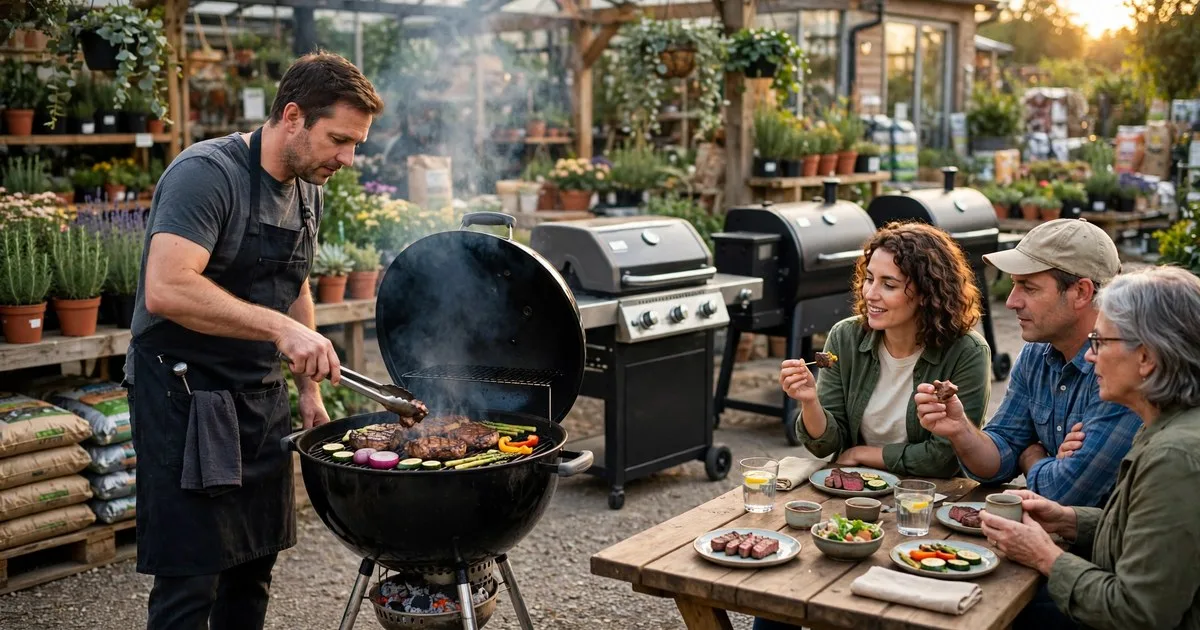
A weber grillvorfuhrung is a live grilling demonstration, run by Weber or one of its authorised dealers, in which a trained grill master cooks a full menu in front of an audience, explains the techniques as he works, and lets the audience taste the results. The word is German, and it means exactly what it sounds like: a demonstration of grilling, on Weber grills, in real time, with real food.
It is not a cooking course, and it is not a sales pitch dressed up as one, although it is both a showcase and a lesson. A Weber Grillvorfuhrung is something you watch, taste, and ask questions about. A course is something you do yourself, for hours, with your hands on the grill. The ranking blogs blur that line constantly, and they also disagree with each other about how long a demonstration lasts and what it costs. This article leads with what Weber itself publishes, describes the format in general terms, and keeps the free demonstration separate from the paid course, because that distinction is the single most useful thing a reader can take away.
What Does Weber Grillvorfuhrung Mean?
The German word breaks into two parts. “Grill” means grill or barbecue. “Vorführung” means a demonstration, a showing, or a performance, in the sense of showing how something works. Cambridge’s English-German dictionary gives “die Vorführung” as the translation of “demonstration” in exactly this sense, as in “we recently saw a demonstration of the new computer system”. So a weber grillvorfuhrung is, literally, a Weber grill demonstration.
Weber itself uses the term officially. The company’s own website hosts a recipe booklet titled “GRILLVORFÜHRUNG, LIVE EXPERIENCE 2026”, published by Weber for its German-market grill demonstrations. Its introduction reads, in German, “The Weber Way ist unser Ansatz zum Grillen, den wir seit über 70 Jahren perfektioniert haben”, which means “The Weber Way is our approach to grilling, which we have perfected over more than 70 years”. The booklet covers direct and indirect grilling on charcoal and gas, and it gives demonstration recipes, including a perfect steak, chicken breast from the Sear Zone, a club sandwich, pork fillet, rotisserie chicken with pineapple, and a rolled roast, with the grill models named for each recipe, among them the Spirit, Genesis, Summit, Pulse, Lumin, Q 1400, and Traveler.
The correct German spelling is “Grillvorführung”, with an umlaut over the u. The slug of this article, “grillvorfuhrung”, is the ASCII version used in the web address, where the umlaut is dropped. This article gives the correct spelling here and otherwise uses the ASCII form, since that is the form of the web address and the search term. There is no single event called “the Weber Grillvorfuhrung”. It is a recurring format, run by many different dealers and academies across Germany, Austria, the United Kingdom, and elsewhere, under names such as “Grillvorführung”, “Schau Grillen”, “Discover Weber”, “Erlebnisgrillgenuss”, and “Live Experience”. Any article that gives one date, one venue, and one price for it is describing one event, not the format.
The Weber Story in Brief
A demonstration only makes sense if you know what is being demonstrated, and the Weber story is worth telling briefly, because it explains the shape of the grill on the table. In 1952, George Stephen Sr. was working at Weber Brothers Metal Works in Chicago, Illinois, a company founded in 1887 that made metal buoys for the Coast Guard and the Chicago Yacht Club. Stephen cut a metal buoy in half, added legs and air vents, and used the other half as a lid, creating the dome-shaped kettle grill. He first marketed it as “George’s Barbecue Kettle”, priced at 29.95 dollars. The story is told by the Smithsonian and by Weber’s own About Us page, and it is one of the best-documented origin stories in the barbecue world.
There was never a person named Weber behind the grill. The company name came from Weber Brothers Metal Works. Stephen later bought the company, and it became Weber-Stephen Products. That detail matters, because it stops a common mistake before it starts. The name on the grill is the name of a metalworks, not a founder.
The product line grew from the kettle. The Smokey Joe, a small portable kettle, arrived in 1962. The first gas barbecue kettle arrived in 1971. The Smokey Mountain Cooker, a charcoal smoker, arrived in 1981. The Genesis gas grill line, introduced in 1985, was the company’s answer to the shift towards gas, and Weber’s own history says the Genesis line “literally saved the company” as consumers moved to gas. The company stayed family-owned until a majority stake was sold to BDT Capital Partners in 2010. Weber went public on the New York Stock Exchange in August 2021 at 14 dollars a share, under the ticker WEBR, and BDT Capital Partners took it private again in 2023, buying the remaining shares at 8.05 dollars a share, in a deal with an enterprise value of about 3.7 billion dollars. The headquarters is in Palatine, Illinois.
What Actually Happens at a Weber Grillvorfuhrung
A weber grillvorfuhrung follows a loose format, and the details vary by dealer, but the shape is consistent across the official Weber booklet and every ranking blog that describes one. It is hosted by an authorised Weber retailer or Weber World dealer, or by a Weber-trained grill master, at a store, a garden centre, a barbecue festival, or a Weber Grill Academy location. A grill expert cooks a multi-course menu live on Weber grills, explains the techniques as he goes, and the audience watches, asks questions, and usually tastes the food.
The usual order is a welcome, then live cooking, then tasting, then questions. The grill master works through several dishes in sequence, so the audience sees the grill used for different jobs in one session. He will sear a steak over direct heat, then move a roast to indirect heat and close the lid. He will show a two-zone fire on a charcoal grill, with coals on one side and an empty cool side on the other. He will show a rotisserie turning, a smoker running on wood chips, and a thermometer being used to check the core temperature of a piece of meat. Between dishes, he will answer questions about the grills on display, the accessories, and the techniques.
The Weber Grillvorfuhrung format is part product showcase, part cooking class, and part tasting event, and that is the point. The audience is there to learn how to grill, but also to see the grills working, side by side, before buying one. A Weber Grillvorfuhrung answers the question a showroom cannot answer, which is what the grill actually does when it is hot, full of food, and being used by someone who knows it well. That is why the format has lasted, and why dealers keep running it.
The Weber Way: Lid On, Two Zones, Direct and Indirect
Weber’s own term for its approach is “The Weber Way”, and the booklet defines it as grilling with the lid closed, with precise temperature management, using direct and indirect techniques. The booklet says the approach has been perfected over more than 70 years, meaning since 1952, and it is worth quoting that as Weber’s own wording rather than rounding it into another number.
The direct method means the food sits directly over the heat. It is for dishes that take under about twenty minutes, or that need searing, such as steaks and burgers. The indirect method means the food sits away from the heat, with the heat circulating inside the closed grill. It is for dishes that take over about thirty minutes, such as roasts. Both definitions come from the official booklet, for charcoal and for gas. The two-zone fire is the single most important charcoal technique, and every blog and the booklet agree on it: coals or burners on one side for searing, the other side empty and cool for slow cooking. Food moves between the zones as it cooks.
Lid-on cooking is the heart of the Weber Way. With the lid closed, the grill works like a convection oven. The lid seals in smoke flavour and gives the cook temperature control, because the vents manage the airflow and therefore the heat. A kettle grill with the lid off is a campfire. With the lid on, it is an oven with a fire inside it. That is the idea the demonstration is built to show, and it is the idea most first-time grillers miss.
Other techniques shown at a Weber Grillvorfuhrung include reverse searing, in which a thick steak is cooked slowly at low heat and then seared hard at the end, smoking with wood chips or chunks, rotisserie cooking, and using a thermometer to hit core temperatures. The official 2026 booklet gives the target temperatures for its demonstration recipes: a perfect steak to 53 degrees Celsius at the core, chicken breast to 74 degrees, pork fillet medallions to 63 degrees, rotisserie chicken to 75 degrees, and a rolled roast to 72 degrees. Those numbers are from the booklet, and they are the numbers a grill master will quote while he works.
The Grills You Will See Side by Side
A Weber Grillvorfuhrung is useful partly because it puts the grill families side by side, and the differences between them become obvious when they are hot and in use. There are four Weber fuel types: charcoal, gas, wood pellet, and electric. Each one suits a different kind of cook, and the demonstration lets a visitor compare them without buying any of them.
Charcoal is the original family. The Original Kettle, in the classic 22-inch size, is the grill George Stephen invented. The Master-Touch and the Performer are larger and better equipped versions of the same idea, and the Smokey Joe, at 14 inches, is the portable version. The Smokey Mountain Cooker, in production since 1981, is a dedicated charcoal smoker. Charcoal gives the most smoke flavour and the highest searing heat, and it demands the most attention. A two-zone fire on a charcoal grill is the technique that separates a confident griller from a beginner.
Gas is the convenient family. The Spirit is the entry and mid-range line, redesigned in 2025 with a Boost Burner and a Sear Zone. The Genesis, launched in 1985, is the premium line. The Summit is the top-end line, including built-in models. The Q series and the Traveler are portable gas grills. Gas lights at the push of a button, holds a steady temperature, and suits a cook who grills several times a week and wants no fuss. A Weber Grillvorfuhrung will show a gas grill running a Sear Zone for steaks and an indirect zone for a roast, side by side, on the same grill.
Wood pellet grills are the newest family. The SmokeFire, in the EX4 and EX6 sizes, uses Weber Connect smart grilling, with a probe and an app. The Searwood arrived in 2024, and the Smoque, a budget pellet grill, arrived in 2025. Pellet grills burn compressed wood pellets, which gives them a smoky flavour with the convenience of a thermostat. Electric grills are the fourth family: the Q 1400 and Q 2400, the Pulse 1000 and 2000 with digital temperature control and iGrill, and the Lumin. Electric suits a balcony or a place where open flame is not allowed, and a demonstration will show that it can still sear, given time and a hot grate.
The accessories shown at a Weber Grillvorfuhrung are part of the lesson too. The Gourmet Barbecue System, known as GBS, is a grate with a removable centre that takes inserts such as a wok, a pizza stone, or a sear grate. WEBER CRAFTED is the newer accessory line, with a plancha, a pan, and grill plates. The Sear Zone and Sear Grate are the high-heat areas on gas grills. The rotisserie, or Drehspieß in German, is the spit that turns meat slowly over the fire. A Bluetooth thermometer is the tool that turns guessing into knowing. All of these are named in the official 2026 booklet, and a good demonstration will show most of them in use.
Rotisserie and the Turning Tradition
One technique a Weber Grillvorfuhrung always shows well is the rotisserie, because it is visual. A chicken or a joint of meat turns slowly on a spit over the fire, basting itself as it goes, and the audience can see the skin crisping and the juices running. The idea of turning meat over a fire is very old, and it is worth naming the tradition it belongs to, because the same word sits at the centre of a related story.
In Turkish, the word “çevirme” means turning, and it is the root of a famous dish. Döner kebab is seasoned meat cooked on a vertical rotisserie, turned slowly and shaved off as it cooks, and the Arabic word shawarma derives from Turkish “çevirme”, which also means turning. The real turning-meat tradition is explained in our article on ceivir, which traces the Turkish verb “çevir”, meaning to turn or to translate, and the food tradition that grew from it. A Weber rotisserie is the same idea in a different form: meat, turning, fire, and patience.
A Weber Grillvorfuhrung will also show simpler ideas that are easy to take home. Cedar-plank grilling, in which food cooks on a soaked wooden plank over the fire, is one of them, and the safety rules for it are explained in our article on plangud, which covers cedar-plank grilling in its section on timber: only untreated, food-safe planks should ever be used for cooking, and a grilling plank should be soaked in water for at least one hour before use, so that it steams rather than catches fire. A dry plank on a hot grill is a fire risk, and a soaked, untreated plank is a normal cooking tool. That is the kind of practical detail a demonstration teaches best, because the audience can see the plank going onto the grill and smell the smoke it makes.
How to Find a Demonstration Near You
There is no single central calendar for weber grillvorfuhrung events, and any page that claims to link to one is overstating the case. No central public schedule of Grillvorführungen was found during the research for this article. The verifiable route is the Weber dealer and store locator on Weber’s website, and the announcements of individual dealers, who advertise their own demonstration days on their own sites and social media pages.
Real examples show how varied the format is. A free “Weber Schau Grillen” was held at the Lothring store in Gmunden, Austria, on Saturday 17 May 2025, from 08:00 to 12:00, at Grüner Wald 21, 4810 Gmunden, with the invitation “Erlebt live, was die Weber Grills alles können”, meaning “experience live what Weber grills can do”. In the United Kingdom, Weber ran a “Discover Weber” programme at Weber World garden centres in the summer of 2022, including the Sunshine Garden Centre in Bounds Green from 22 to 24 July, the Brigg Garden Centre from 8 to 10 July, and the Alton Garden Centre in Wickford across June to August, with hands-on demonstrations by Weber Grill Instructors, featuring the 2022 Genesis gas barbecues and the WEBER CRAFTED accessory line. In northern Germany, the Genusswelt Wilken store runs ticketed evening events called “Weber Erlebnisgrillgenuss”, with the grill master Michael Friese, under themes such as “Weber meets Thermomix”, using gas, charcoal, and a smoker. Those are three different formats, three different countries, and three different price points, and they are all the same idea.
The practical advice is simple. Check the Weber dealer locator for an authorised dealer near you, then check that dealer’s own site or social media for demonstration days. Garden centres and barbecue specialists announce their events weeks ahead, and the free Weber Grillvorfuhrung sessions are usually open to anyone who turns up. If a dealer runs a ticketed evening event, it will say so, with the price and the minimum number of participants, and it will need a booking.
Demonstration or Grill Academy: Do Not Mix Them Up
The distinction that matters most, and the one the ranking blogs blur most often, is between a demonstration and a course. A weber grillvorfuhrung is a demonstration. You watch, you taste, and you ask questions. The Weber Grill Academy is a course. You cook, for hours, with your hands on the grill. They are different products, with different prices, and confusing them leads to disappointed visitors.
The Weber Grill Academy is Weber’s network of grilling schools, run across Europe and in the United States, Australia, Singapore, and Japan, organised in Europe by Weber-Stephen Deutschland GmbH. A Basic course typically runs for about four hours, and it covers charcoal, gas, and electric barbecue theory and practice, including cooking a starter, an intermediate course, a main, and a dessert, a blind taste test across fuel types, and use of the Gourmet Barbecue System. Weber’s terms state that courses generally only run with a minimum number of registered participants, 12 in the United Kingdom terms and 20 in some other markets.
The prices show the difference clearly. Live course listings from November 2026 give the Weber Grill Academy in Berlin, at Elsterwerdaer Platz 1, 12683 Berlin, with “American BBQ” on 21 November 2026 at 135 euros, “Wintergrillen” on 22 November at 145 euros, and “Das perfekte Steak” on 28 November. The Weber Original Store and Grill Academy Wien Süd, in Brunn am Gebirge, Austria, lists “Das perfekte Steak” on 18 November 2026 at 130 euros, with “American BBQ” and “Wintergrillen” in the same week. In Adelaide, Australia, the Weber Grill Academy at 142 to 144 Fullarton Road, Rose Park, caps courses at 20 to 22 attendees, includes food and three beverages in the ticket, and charges 199 Australian dollars for a popular class. Those are course prices, for four hours of hands-on cooking with a meal included.
A short weber grillvorfuhrung, by contrast, is typically free. The Gmunden “Schau Grillen” in May 2025 was free and open from 08:00 to 12:00. The United Kingdom “Discover Weber” demonstrations in 2022 were free to attend, with registration. The ticketed dealer evening in northern Germany, the “Weber Erlebnisgrillgenuss”, charged 99 euros per person, including drinks, food, apron hire, and recipes, with a minimum of 20 participants. That is a dealer evening, not a short demonstration, and the price reflects a full evening with food and drink. The honest line is this: short in-store demonstrations are typically free and under an hour, full Academy courses are ticketed and run about four hours, and dealer evenings sit in between. Any page that gives one duration or one price for all of them is wrong.
Grilling Around the Fire: An Old Habit
There is a reason a live Weber Grillvorfuhrung draws a crowd, and it is older than Weber, older than the kettle grill, and older than the barbecue itself. Gathering around a fire to cook and to talk is one of the oldest human habits. A Weber Grillvorfuhrung works because it recreates that habit in a shop: a fire, food, and people standing around it, asking questions. The grill master is doing what cooks have always done, which is to show the next person how it is done, in person, with the food in front of them.
That instinct is the same one that produced the great storytelling traditions of the north. The Norse sagas are stories told around fires, in halls, over long winter nights, and they survived because they were told aloud, in company, by people who knew them well. A grilling demonstration is a smaller version of the same thing: knowledge passed on in person, around a fire, with an audience that can interrupt and ask. The sagas are literature. The demonstration is lunch. The mechanism is the same.
What the Ranking Blogs Get Wrong
The English-language pages that rank for this term are all low-authority SEO blogs, and they agree on the core format but overreach on the specifics. The overreach is worth naming, because it is what a reader will meet first in search results, and it is what this article corrects.
First, duration. One blog says a typical demonstration lasts 45 to 90 minutes. Another says one to three hours. Neither cites a source. The honest statement is that a short in-store demonstration runs under an hour and a full Academy-style session runs several hours, and the two should not be averaged into a single figure.
Second, price. Several blogs say demonstrations are “usually free”, while others say some “might charge” or require tickets. The truth is split, and it must be kept split: short retailer demonstrations are typically free, full Academy courses are ticketed, and dealer evenings charge their own price. The blogs frequently conflate the free demonstration with the paid course, and the reader who believes them will arrive expecting a free class or a paid demonstration and find the opposite.
Third, the “find a demonstration near you” advice. Several blogs tell readers to visit the official Weber website or contact their nearest authorised dealer to check schedules, but no blog links to an actual Weber event-listing page, and no central public schedule was found. The verifiable route is the dealer locator and individual dealer announcements, as described above. A vague instruction to “check the website” is not a schedule.
Fourth, invented colour. Several blogs assert specifics with no source: that demonstrations include beer-can chicken, cedar-plank salmon, grilled pizza or dessert, exclusive show specials, and discounts. These are plausible generic demonstration dishes and offers, but none is sourced. They are treated here as typical examples, not as facts about any specific event. The official booklet’s own recipes are the sourced examples, and they are the ones this article quotes.
Frequently Asked Questions
What is a weber grillvorfuhrung?
It is a live grilling demonstration, a weber grillvorfuhrung, run by Weber or one of its authorised dealers. A trained grill master cooks a multi-course menu in front of an audience, explains the techniques as he works, and lets the audience taste the food. The word is German, and it means “Weber grill demonstration”. Weber itself uses the term officially, in its “GRILLVORFÜHRUNG, LIVE EXPERIENCE 2026” recipe booklet.
Is a Weber Grillvorfuhrung a cooking course?
No. A Weber Grillvorfuhrung is something you watch, taste, and ask questions about. The cooking course is the Weber Grill Academy, a paid, hands-on school that typically runs for about four hours and includes cooking a full menu yourself. The two are different products, and the blogs that blur them are wrong.
How much does a Weber Grillvorfuhrung cost?
There is no single price for a weber grillvorfuhrung, because there is no single event. Short retailer demonstrations are typically free, as the Gmunden “Schau Grillen” in May 2025 was. Full Grill Academy courses are ticketed, with live November 2026 listings at 130 to 145 euros in Berlin and Vienna, and 199 Australian dollars in Adelaide. Ticketed dealer evenings, such as the “Weber Erlebnisgrillgenuss” in northern Germany, charged 99 euros per person. Quote a price only with its specific event attached.
How long does a demonstration last?
The blogs disagree about how long a weber grillvorfuhrung lasts, giving 45 to 90 minutes on one side and one to three hours on the other, and neither figure is sourced. The honest answer is that a short in-store demonstration runs under an hour, and a full Academy-style session runs several hours. Do not trust a single figure presented as fact.
What techniques will I see at a weber grillvorfuhrung?
Direct and indirect heat, the two-zone fire, lid-on cooking, searing, reverse searing, smoking with wood chips, rotisserie cooking, and thermometer use. The official 2026 booklet gives the target core temperatures for its recipes, including 53 degrees Celsius for a perfect steak and 74 degrees for chicken breast. The grill master will show the techniques on charcoal, gas, pellet, and electric grills, side by side.
How do I find a Weber Grillvorfuhrung near me?
There is no central public calendar. Use the Weber dealer and store locator to find an authorised dealer near you, then check that dealer’s own site or social media for demonstration days. Garden centres and barbecue specialists announce their events weeks ahead, and free in-store demonstrations are usually open to anyone who turns up.
Who invented the Weber grill?
George Stephen Sr., working at Weber Brothers Metal Works in Chicago, invented the kettle grill in 1952 by cutting a metal buoy in half, adding legs and vents, and using the other half as a lid. He first sold it as “George’s Barbecue Kettle” for 29.95 dollars. There was never a person named Weber behind the grill. The name came from the metalworks.
Final Words
A weber grillvorfuhrung is a simple idea, and its simplicity is the point. A trained cook, a hot grill, a menu cooked in front of you, and the chance to taste it and ask how it was done. Weber has been running demonstrations of that kind since the kettle grill was invented in 1952, and the official 2026 booklet shows the format is still the company’s way of teaching its method: lid on, two zones, direct and indirect heat, and a thermometer rather than a guess.
The useful lesson is to keep the demonstration and the course apart, and to keep the format and the single event apart. Go to a free in-store demonstration to see the grills working and to learn the techniques. Book a Grill Academy course when you want to cook the menu yourself, for four hours, with a meal included. And when a page gives you one duration, one price, and one date for “the” Weber Grillvorfuhrung, remember that there is no such single event. There is a format, run by many dealers, in many places, and the best way to find one is to ask the dealer nearest you.