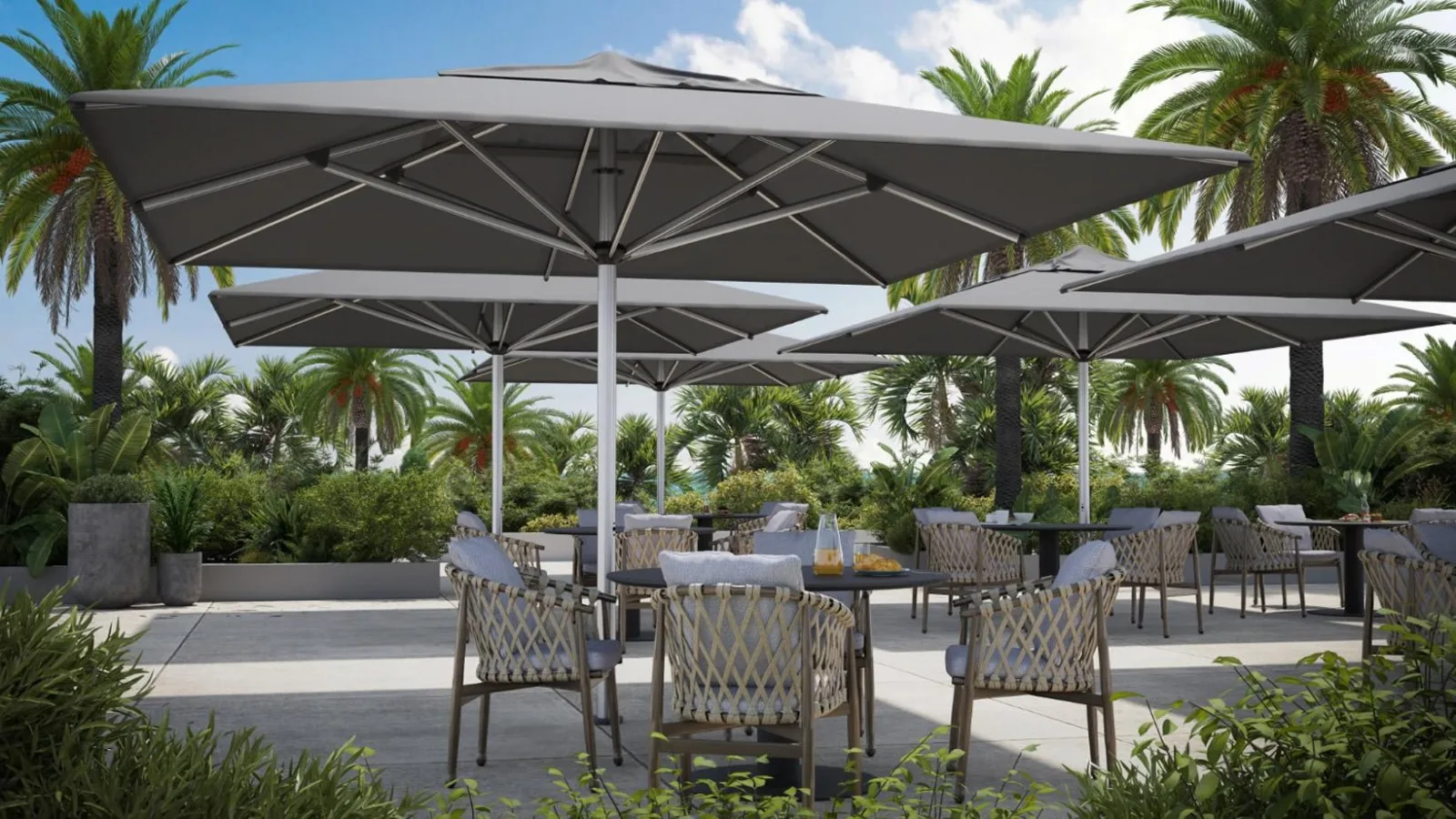
Outdoor umbrellas are often treated as simple accessories for gardens, patios, restaurants, and other open spaces. However, a large commercial umbrella has a more demanding job than providing shade on a sunny day. It must support a wide canopy, remain practical to operate, and be installed with suitable structural support. Wind exposure, repeated opening and closing, and long-term outdoor conditions can all influence how well an umbrella performs.
Ausbrella is an Australian-made range of outdoor market umbrellas developed by Awnet for residential and commercial environments. Its design focuses on reinforced pole construction, engineered frame components, secure canopy attachment, and an opening system that does not rely on conventional ropes or pulleys. The range includes two notable models: Storm 135 and Hurricane 160+.
These products are particularly relevant to buyers researching stronger outdoor shade solutions for cafés, restaurants, resorts, public spaces, and residential entertaining areas. Their published wind-performance figures also make them interesting to people comparing commercial-grade umbrellas with ordinary patio alternatives.
However, a high wind rating should not be interpreted as a guarantee that an umbrella can remain open during every storm. Installation quality, ground conditions, surrounding buildings, operating instructions, and weather exposure all matter. Understanding these details is essential before selecting a model.
This guide explains what Ausbrella is, who makes it, how its construction works, what distinguishes its models, and what buyers should consider before purchasing or installing one.
What Is Ausbrella?
Ausbrella is a range of premium outdoor market umbrellas manufactured by Australian company Awnet. Unlike small handheld umbrellas designed for personal protection from rain, these products are intended to provide shade over larger outdoor areas. Their design is aimed at locations where a conventional lightweight patio umbrella may not offer the construction or support required for regular use.
The range combines reinforced aluminium pole designs, supporting frame components, securely attached canopy fabric, and dedicated mounting options. Awnet presents the products as suitable for commercial environments and selected residential settings, including hospitality spaces, resorts, council areas, and outdoor entertaining areas.
One of the most noticeable aspects of Ausbrella is its focus on structural engineering. The manufacturer has developed different pole arrangements for its Storm and Hurricane models, with the latter featuring a more reinforced central structure. The products also use an opening mechanism that does not require conventional ropes or pulleys.
Ausbrella is therefore best understood as a specialised outdoor shade product rather than a general-purpose personal umbrella. Its intended applications, installation requirements, and wind-performance specifications should be considered when comparing it with other market umbrellas.
Ausbrella at a Glance
| Detail | Information |
|---|---|
| Product name | Ausbrella |
| Product type | Outdoor market umbrella range |
| Manufacturer | Awnet |
| Manufacturing country | Australia, according to the manufacturer |
| Associated creator | Chris Pierias, identified by Awnet |
| Main models | Storm 135 and Hurricane 160+ |
| Storm model wind figure | 135 km/h on its dedicated product page |
| Hurricane model wind figure | More than 160 km/h, according to Awnet |
| Main pole construction | Twin-skin aluminium |
| Hurricane pole construction | Double twin-skin design |
| Opening system | No conventional ropes or pulleys |
| Canopy cover | Acrylic canvas specified for the premium models |
| Advertised warranty | Five years on frame and acrylic canvas cover |
| Intended applications | Commercial and selected residential outdoor spaces |
The details above are based primarily on Awnet’s published product information. Specifications, availability, warranty conditions, and configurations should be confirmed directly with the manufacturer before making a purchase.
Who Makes Ausbrella?
Ausbrella is produced by Awnet, an Australian manufacturer specialising in market umbrellas, café barriers, and related outdoor products. The company identifies itself as an Australian-owned and family-owned business with a manufacturing operation in Melbourne, Victoria.
According to its published company history, Awnet was established in 1980. Its activities have included the development and production of outdoor shade products and commercial equipment for businesses. The company describes its manufacturing operation as an integrated process involving design, engineering, fabrication, textiles, printing, and assembly.
Awnet identifies Chris Pierias as the person behind the Ausbrella concept. The company explains that the product was developed in response to the need for stronger and safer outdoor market umbrellas. Rather than simply making a conventional umbrella larger, the design focused on improving the central pole, supporting frame, canopy attachment, and opening arrangement.
This background helps explain why Ausbrella is positioned differently from ordinary garden umbrellas. Its construction is intended for situations where larger canopies and regular commercial use make structural design particularly important.
For more company information, buyers can consult the official Awnet website and its company background page. These sources provide the manufacturer’s own description of its business, products, and Australian manufacturing activities.
How Does Ausbrella Work?
The design of a large outdoor umbrella must manage several forces and practical demands. Wind can place pressure on the canopy, supporting arms, central pole, and mounting structure. Regular operation also places demands on the opening mechanism and the connections between different components.
Ausbrella addresses these requirements through several construction features. The exact arrangement differs between models, but the overall design focuses on supporting the canopy, improving the central pole structure, and providing a practical opening system.
1. Reinforced Twin-Skin Aluminium Pole
One of the defining features of the Ausbrella range is its twin-skin aluminium centre pole. A central pole supports the open canopy and transfers loads towards the mounting structure. Its design is therefore important to the overall performance of a large market umbrella.
Awnet describes the twin-skin construction as a way to combine strength with manageable weight. The Storm 135 uses this arrangement, while the Hurricane 160+ features a double twin-skin pole design. These are manufacturer-described structural features, not independent proof that every installation will withstand the same conditions.
The pole should be considered as one part of a complete system. Supporting arms, joints, canopy attachments, mounting components, and the foundation all influence the performance of the finished installation. A strong pole alone cannot compensate for an unsuitable base or poorly prepared ground.
2. Eight Supporting Arms
Awnet’s product information describes an eight-arm supporting arrangement with an interlocking frame design. These components help support the fabric canopy and distribute the structural loads through the umbrella’s frame.
The connections between the arms and the central structure are important because a large canopy can experience uneven pressure when wind changes direction. A properly designed frame must manage these forces through its individual components rather than depending on one part alone.
The interlocking design is part of the manufacturer’s engineering approach. Buyers who need detailed technical information should request the current engineering documentation for the exact model and configuration they intend to purchase.
3. Securely Attached Canopy
The Ausbrella range uses a bolted fabric-cover attachment, according to Awnet. This arrangement is intended to provide a secure connection between the canopy and its supporting structure.
Canopy attachment matters because outdoor umbrellas have large fabric surfaces that are exposed to moving air. If the fabric is not properly secured, it can move excessively or place additional stress on the frame.
Awnet also identifies acrylic canvas covers for the premium models. The actual fabric specification, colour options, and available configurations should be confirmed with the supplier before ordering.
4. Opening Without Conventional Ropes or Pulleys
Another feature of Ausbrella is its opening system, which the manufacturer describes as operating without conventional ropes or pulleys. This design is intended to make everyday operation more straightforward than arrangements that depend on exposed rope-and-pulley mechanisms.
For commercial environments, ease of operation can be important. Restaurant staff, hotel teams, and venue operators may need to open and close outdoor umbrellas as part of their daily routine. A mechanism that suits the staff and the operating environment can make equipment easier to manage.
However, buyers should request a demonstration and read the operating instructions before use. The correct procedure can vary by model, and an umbrella should not be forced open or closed if its mechanism appears damaged or obstructed.
Ausbrella Models: Storm 135 vs Hurricane 160+
Awnet presents two principal models in the Ausbrella range: Storm 135 and Hurricane 160+. Both are designed as reinforced outdoor market umbrellas, but their central pole construction and published wind-performance figures differ.
The Storm 135 uses a twin-skin pole, while the Hurricane 160+ uses a double twin-skin arrangement. The Hurricane is presented as the more wind-focused option for locations with more demanding exposure.
Choosing between them should involve more than comparing the largest number. The intended location, foundation, canopy requirements, installation method, and manufacturer’s instructions all need to be considered.
Storm 135: A Reinforced Outdoor Shade Option
The Storm 135 is designed for outdoor areas that require a stronger market umbrella arrangement than many lightweight alternatives. Awnet’s dedicated product page lists a wind rating of 135 kilometres per hour and describes testing at the Monash University wind-tunnel facility at that speed.
Its main features include:
- Twin-skin aluminium centre pole.
- Eight supporting radial arms.
- Interlocking frame arrangement.
- Bolted fabric-cover attachment.
- Opening system without conventional ropes or pulleys.
- Matching stainless-steel in-ground socket.
- Five-year warranty on the frame and acrylic canvas cover, as advertised by Awnet.
The Storm model may be relevant to restaurants, cafés, outdoor dining spaces, and residential areas where a more substantial umbrella is required. Its suitability still depends on the exact site and the installation arrangement.
An important specification detail deserves attention. Awnet’s dedicated Storm 135 product page lists 135 km/h, while its broader Ausbrella range information has also mentioned 140 km/h for the Storm range. For model-specific information, buyers should request the latest technical documentation and confirm the figure that applies to the unit being quoted.
Hurricane 160+: Designed for More Demanding Conditions
The Hurricane 160+ is the higher wind-performance model in the range. Awnet states that it has been designed and wind-tunnel tested to withstand wind speeds exceeding 160 kilometres per hour. The company also describes a test at the Monash University wind tunnel’s maximum speed of approximately 161 km/h.
Its central structure uses a double twin-skin pole rather than the Storm model’s twin-skin arrangement. Awnet also identifies an engineered frame, bolted canopy attachment, rope-free opening mechanism, and matching stainless-steel in-ground socket.
The Hurricane is presented for locations where stronger wind exposure makes structural performance an important purchasing consideration. However, a published test figure should never be treated as permission to leave an umbrella open during all severe weather.
The correct mounting system, foundation, surrounding terrain, building exposure, and operating instructions remain essential. Commercial buyers should request the relevant engineering documents and confirm that the model is suitable for their particular site.
Storm 135 vs Hurricane 160+: Comparison Table
| Feature | Storm 135 | Hurricane 160+ |
|---|---|---|
| Pole design | Twin-skin | Double twin-skin |
| Published wind figure | 135 km/h on dedicated model page | More than 160 km/h |
| Wind-tunnel information | Awnet reports testing at 135 km/h | Awnet reports testing to approximately 161 km/h |
| Supporting frame | Eight-arm interlocking design | Eight-arm interlocking design |
| Canopy attachment | Bolted fabric cover | Bolted fabric cover |
| Opening arrangement | No conventional ropes or pulleys | No conventional ropes or pulleys |
| Mounting option | Matching stainless-steel in-ground socket | Matching stainless-steel in-ground socket |
| Advertised warranty | Five years on frame and acrylic canvas cover | Five years on frame and acrylic canvas cover |
These specifications are manufacturer-published information, not a guarantee of performance at every location. Buyers should confirm the current product documents and warranty conditions before purchasing.
For further details, visit the official Storm 135 product page and Hurricane 160+ product page.
Understanding Ausbrella Wind Ratings and Safety
Wind performance is one of the main reasons buyers investigate Ausbrella. A large outdoor umbrella can experience substantial pressure when exposed to strong winds, especially in open areas where there are few buildings or natural barriers. A product’s published wind figure can therefore be useful when comparing different designs.
However, it is important to understand what a wind rating actually tells a buyer. A manufacturer-reported wind-tunnel test describes performance under particular test conditions. It does not automatically establish that the umbrella is safe to operate in every real-world location at the same speed.
Outdoor environments can be unpredictable. Wind direction, sudden gusts, surrounding structures, terrain, canopy size, foundation design, and the condition of the equipment can all affect the forces acting on an umbrella.
What Does Wind-Tunnel Testing Show?
Wind-tunnel testing allows a product to be exposed to controlled airflow conditions. It can provide useful information about how a particular design responds to specified wind speeds and test arrangements.
Awnet reports that the Storm 135 was tested at 135 km/h at the Monash University wind-tunnel facility. It also reports that the Hurricane 160+ was tested beyond 160 km/h, with the cited test reaching approximately 161 km/h.
The manufacturer states that engineering certification and Monash University reports are available upon request. Buyers who need to make a technical purchasing decision should request these documents rather than relying only on a headline specification.
Why Real-World Conditions Are Different
A wind-tunnel result does not reproduce every outdoor environment. A restaurant terrace surrounded by buildings may experience different airflow from an open coastal property. Similarly, a rooftop installation can face different exposure from an umbrella placed in a sheltered courtyard.
Before choosing a model, consider:
- The location’s typical wind exposure.
- Whether the area is sheltered or open.
- The size and shape of the required canopy.
- The ground or supporting surface.
- The proposed foundation and mounting method.
- Nearby buildings, trees, walls, and other structures.
- The manufacturer’s operating and closing instructions.
No wind rating should be interpreted as an unconditional guarantee of storm safety. Owners should close, secure, or otherwise manage the umbrella according to the manufacturer’s instructions and changing weather conditions.
Installation and Anchoring Requirements
A strong outdoor umbrella still needs an appropriate installation. The mounting system connects the umbrella to the supporting surface, and its suitability can influence the safety and performance of the complete structure.
Awnet identifies matching stainless-steel in-ground sockets among the Ausbrella features. Such a socket provides a defined connection between the umbrella and its supporting structure, but the socket alone does not determine whether an installation is adequate.
The ground conditions, foundation dimensions, local requirements, and surrounding environment must also be considered. A mounting arrangement that works in one location may not be appropriate for another.
Why Foundation Planning Matters
Before installation, the site should be assessed to identify a suitable position and supporting structure. The foundation must be appropriate for the product, the local conditions, and the manufacturer’s instructions.
Commercial properties may also need to consider council requirements, access routes, outdoor seating arrangements, and the movement of customers and staff. Umbrellas should not obstruct entrances, accessible pathways, emergency routes, or other important circulation areas.
For exposed locations, a suitably qualified professional may need to assess the proposed installation. This is especially important where a large umbrella will be used in a public or commercial environment.
Installation Checklist
Before proceeding, buyers and property operators should confirm:
- The selected model is suitable for the intended location.
- The mounting system matches the manufacturer’s requirements.
- The supporting ground or structure is appropriate.
- The foundation dimensions and installation details have been confirmed.
- Relevant local permissions or requirements have been checked.
- The umbrella can be operated without obstructing walkways.
- Staff or users understand the correct opening and closing procedure.
- Inspection and maintenance arrangements are in place.
A professional installation should follow the manufacturer’s current instructions. Buyers should avoid improvising foundations or modifying structural components without appropriate approval.
Where Can Ausbrella Be Used?
Ausbrella is designed for outdoor spaces that need substantial shade and a more engineered market umbrella structure. Its potential applications include commercial hospitality settings, public areas, resorts, and selected residential properties.
The most suitable location depends on the model, available mounting options, canopy requirements, and the site’s exposure to wind and other environmental conditions.
Restaurants and Cafés
Outdoor dining areas often need shade that can accommodate several tables or a larger seating arrangement. A commercial market umbrella can help define an outdoor dining zone while giving customers a more comfortable place to sit.
For restaurant operators, practical considerations include the number of umbrellas required, the movement of staff, customer access, and the time needed to open or close each unit. The mounting position should also allow tables and chairs to be arranged without blocking pathways.
Hotels and Resorts
Hotels and resorts may use large umbrellas around outdoor dining spaces, poolside areas, courtyards, and recreational facilities. In these environments, the appearance of the shade structure can matter alongside its practical function.
Operators should consider the surrounding design, available space, maintenance access, and the conditions in which the umbrella will be used. Poolside installations also need careful attention to the ground surface, drainage, and safe movement around wet areas.
Council and Public Spaces
Public outdoor areas may require shade structures for gathering places, seating areas, and community facilities. These locations can involve additional planning because the equipment may be used by many people and may need to meet local requirements.
Councils and project managers should obtain the relevant technical documentation and confirm the installation method before selecting a model. Public access, maintenance responsibility, and safe operation should be part of the planning process.
Residential Patios and Gardens
Ausbrella may also be considered for larger residential outdoor areas. Homeowners with open patios, entertaining spaces, or exposed gardens may be interested in a more substantial umbrella than a lightweight domestic model.
However, the most engineered option is not automatically necessary for every home. A sheltered garden with modest shade requirements may be adequately served by a simpler product. Buyers should compare the actual site requirements with the cost and installation demands of the available options.
Canopy Materials, Durability and Maintenance
The canopy is an important part of an outdoor umbrella because it provides the shade and is continuously exposed to environmental conditions. Awnet identifies acrylic canvas covers for its premium Ausbrella models and advertises a five-year warranty on the frame and acrylic canvas cover.
Outdoor fabrics can be affected by sunlight, moisture, dirt, airborne pollutants, and repeated handling. Their condition over time depends on the material supplied, the environment, cleaning methods, and how the umbrella is stored or operated.
Awnet also describes its wider fabric range as including solution-dyed acrylic materials. Buyers should confirm the exact canopy specification, available colours, and any optional fabric choices for the model they are considering.
Practical Maintenance Tips
Regular inspection and sensible cleaning can help owners identify problems before they become more serious. The following practices provide a useful starting point, although the manufacturer’s care instructions should always take priority.
- Remove loose dirt and debris using a suitable soft cleaning method.
- Follow the fabric manufacturer’s guidance for cleaning solutions.
- Avoid harsh chemicals unless they are specifically approved.
- Allow the canopy to dry as recommended before storage.
- Check fabric attachment points for visible wear.
- Inspect frame connections and moving components.
- Look for corrosion, unusual movement, or damaged hardware.
- Arrange professional assessment if structural components appear damaged.
Owners should not force the opening mechanism or continue using an umbrella with damaged frame components. A damaged canopy, loose connection, or unstable mounting point should be assessed before the product is operated again.
Can Individual Parts Be Repaired?
Repair options depend on the component, the nature of the damage, and the manufacturer’s available services. Awnet’s wider business information describes repair and refurbishment capabilities for its products.
For commercial operators, the ability to maintain or replace certain components may be useful because it can reduce the need to replace an entire structure when a repair is possible. Buyers should ask which parts are serviceable, whether replacement fabric is available, and what maintenance support the manufacturer provides.
Ausbrella Warranty and Long-Term Value
Awnet advertises a five-year warranty on the frames and acrylic canvas covers of its Ausbrella Storm and Hurricane models. This is an important point for buyers comparing the range with other outdoor umbrellas, but the warranty period should not be considered the same as a promise that every part will remain damage-free for five years.
Warranty coverage depends on the written terms and conditions. Buyers should check what is covered, which exclusions apply, and whether installation or maintenance requirements affect eligibility.
The manufacturer’s general FAQ also distinguishes Ausbrella’s five-year frame-and-cover warranty from the three-year warranty it lists for certain other Awnet umbrella products. This makes it particularly important to check the exact product and current warranty document before ordering.
What Buyers Should Check
Before purchase, ask the supplier to confirm:
- The warranty period for the exact model.
- Which frame and canopy components are covered.
- Whether labour or replacement parts are included.
- Any exclusions relating to misuse or incorrect installation.
- The treatment of damage caused by exceptional weather.
- Maintenance requirements that may affect coverage.
- The process for submitting a warranty claim.
Looking Beyond the Initial Purchase Price
The price of an outdoor umbrella is only one part of its total ownership cost. Installation, foundations, delivery, maintenance, repairs, fabric replacement, and possible downtime can all influence the overall expense.
For a restaurant, a damaged outdoor umbrella may affect seating capacity or require an area to be closed temporarily. For a homeowner, the main concerns may be installation costs, cleaning, and replacement parts.
A sensible comparison considers the complete project rather than choosing solely on the lowest purchase price or highest wind rating.
How Much Does Ausbrella Cost?
A single fixed public price for the complete Ausbrella range is not clearly listed on the manufacturer’s product pages. Buyers are directed to contact Awnet for information about their requirements and the relevant product configuration.
The final quotation may depend on the selected model, canopy size, fabric, colour, custom branding, mounting arrangements, delivery, and installation requirements. A business ordering several umbrellas may also have different specifications from a homeowner purchasing one unit.
Because these factors can change the total price, it would be misleading to publish an estimated cost without a current supplier quotation. Prospective buyers should request written pricing that clearly identifies the product and all additional work.
What Should a Quotation Include?
A useful quotation should make it clear whether the price covers:
- The selected Ausbrella model.
- Canopy dimensions and fabric specification.
- Frame and structural components.
- Mounting socket or other approved fixing arrangement.
- Custom colours or branding, if requested.
- Delivery and handling.
- Installation and foundation work, if included.
- Warranty documentation.
- Any optional accessories or additional services.
Comparing quotations with the same scope of work makes it easier to understand the actual difference between suppliers or product configurations.
How to Choose the Right Ausbrella Model
Selecting between Storm 135 and Hurricane 160+ should begin with the conditions of the proposed installation. The highest published wind figure is not automatically the best choice for every site, and an unsuitable mounting arrangement can undermine the performance of even a highly engineered product.
A buyer should first identify the amount of shade required and the typical exposure of the location. A sheltered courtyard may have different requirements from an open coastal terrace or a rooftop hospitality area.
Next, the supporting surface and installation method should be assessed. The model, canopy size, mounting system, and foundation need to work together. Where technical requirements are unclear, buyers should request guidance from the manufacturer or an appropriate professional.
Questions to Ask Before Buying
- What level of wind exposure does the site experience?
- Is the area sheltered, partially exposed, or fully open?
- Which model is suitable for the location?
- What canopy size will provide the required coverage?
- What foundation or mounting system is recommended?
- Are engineering certificates and wind-tunnel reports available?
- What is included in the current warranty?
- Are replacement covers or repair services available?
- What is the full installed cost?
- What operating procedures should staff or household members follow?
Taking time to answer these questions can help buyers avoid selecting a product based only on advertising language. A suitable model, correctly installed and maintained, is more useful than a high specification that does not match the actual site.
Ausbrella vs Ordinary Patio Umbrellas: What Is the Difference?
Ordinary patio umbrellas are available in many sizes and designs. They may be suitable for sheltered gardens, small balconies, and occasional residential use. Commercial-grade market umbrellas, on the other hand, are generally selected for larger coverage requirements and more regular operation.
Ausbrella differs from many basic alternatives through its manufacturer-described pole construction, engineered frame, bolted canopy attachment, rope-free opening mechanism, and model-specific wind-performance information.
This does not mean every conventional patio umbrella is unsuitable or that Ausbrella is automatically the best option for every property. A smaller umbrella may be more practical where the space is sheltered and the shade requirement is limited.
The comparison should consider the intended use rather than relying on product labels alone.
| Buying consideration | Basic patio umbrella | Ausbrella range |
|---|---|---|
| Typical use | Domestic patios and gardens | Commercial and selected residential spaces |
| Structural design | Varies by product | Reinforced pole and engineered frame features |
| Pole construction | Varies by model | Twin-skin or double twin-skin aluminium |
| Opening mechanism | Varies by design | No conventional ropes or pulleys |
| Wind information | Depends on manufacturer | Published model-specific wind figures |
| Installation | Depends on size and base | Matching in-ground socket identified by Awnet |
| Warranty | Varies by manufacturer | Five-year frame-and-cover warranty advertised |
The table is a broad comparison, not a claim that every patio umbrella has the same construction or limitations. Buyers should compare actual product specifications before making a decision.
Common Mistakes to Avoid When Buying an Outdoor Market Umbrella
A large umbrella can become a significant part of an outdoor space, so selecting one without checking its requirements may lead to avoidable problems. Some buyers focus only on appearance or the advertised wind figure and overlook installation, operation, and maintenance.
The following mistakes are worth avoiding.
Choosing Only by the Highest Wind Rating
A high wind figure may attract attention, but it does not establish that a product is suitable for every site. The local environment, foundation, canopy dimensions, and operating instructions all influence the final installation.
Ignoring the Mounting System
The umbrella and its supporting foundation must be considered together. A suitable frame cannot compensate for an unsuitable fixing arrangement or poorly prepared supporting surface.
Failing to Check Technical Documents
Marketing descriptions provide an overview, but buyers making commercial or safety-related decisions should request the current specifications, engineering information, and relevant test reports.
Overlooking the Warranty Conditions
A five-year warranty does not automatically cover every type of damage or every component. Read the written terms and confirm exclusions before placing an order.
Forgetting Routine Maintenance
Outdoor equipment needs inspection and care. Loose connections, fabric deterioration, damaged parts, and mounting issues should be identified before they become more serious.
Buying More Than the Site Requires
A high-specification commercial umbrella may be unnecessary for a small, sheltered garden. Match the product to the actual space, usage pattern, and budget rather than assuming the most expensive option is always the most suitable.
Frequently Asked Questions About Ausbrella
1. What is Ausbrella?
Ausbrella is an Australian-made range of outdoor market umbrellas produced by Awnet. The products are designed for larger residential and commercial outdoor spaces where reinforced construction and substantial shade coverage are important considerations.
2. Who manufactures Ausbrella?
Awnet manufactures the Ausbrella range. The company is based in Australia and specialises in market umbrellas, café barriers, and related outdoor shade products. Awnet identifies Chris Pierias as the creator associated with the Ausbrella concept.
3. Where is Ausbrella made?
Awnet states that its Ausbrella products are made in Australia. The company describes its manufacturing operation as being in the Melbourne area of Victoria. Buyers should confirm the manufacturing and delivery details for their particular order directly with the supplier.
4. What is the difference between Storm 135 and Hurricane 160+?
Storm 135 uses a twin-skin aluminium pole and has a published wind rating of 135 km/h on its dedicated product page. Hurricane 160+ uses a double twin-skin pole and is reported by Awnet to have been tested beyond 160 km/h. Both models have other shared construction features, including bolted canopy attachment and a rope-free opening system.
5. Is Ausbrella suitable for commercial use?
Awnet presents Ausbrella for commercial environments such as restaurants, cafés, resorts, and public outdoor areas. Its suitability depends on the specific location, installation requirements, canopy size, and model selected. Businesses should request the relevant technical documents before ordering.
6. Can Ausbrella be used in a residential garden?
Yes. Awnet also identifies residential outdoor areas as possible applications for its umbrella range. However, a smaller or sheltered garden may not require the same level of engineering as an exposed commercial terrace. Homeowners should compare the product’s size, installation needs, and cost with their actual requirements.
7. How wind-resistant is Ausbrella?
Awnet publishes a 135 km/h wind figure for Storm 135 and reports testing beyond 160 km/h for Hurricane 160+. These are manufacturer-reported specifications. Actual suitability depends on installation, site exposure, operating instructions, and other environmental conditions.
8. Has Ausbrella been tested in a wind tunnel?
Yes. Awnet reports that Storm 135 was tested at 135 km/h at the Monash University wind-tunnel facility. It also reports that Hurricane 160+ was tested at speeds exceeding 160 km/h, reaching approximately 161 km/h in the cited test. The company states that engineering certification and the relevant reports are available upon request.
9. Does Ausbrella use ropes and pulleys?
Awnet describes the Ausbrella opening system as operating without conventional ropes or pulleys. This is one of the product range’s stated design features. Buyers should request a demonstration and follow the instructions supplied with the specific model.
10. What material is used for the Ausbrella canopy?
Awnet specifies acrylic canvas covers for its premium Ausbrella models. The exact fabric, colour, and configuration should be confirmed with the manufacturer when requesting a quotation.
11. Does Ausbrella come with a warranty?
Awnet advertises a five-year warranty on the frames and acrylic canvas covers of the Storm and Hurricane models. The full written warranty conditions should be checked before purchase because coverage and exclusions are determined by the applicable terms.
12. How much does Ausbrella cost?
A single fixed public price for the full range is not clearly listed on Awnet’s product pages. The cost may depend on the selected model, size, fabric, mounting arrangement, custom options, delivery, and installation. Buyers should contact Awnet for a current quotation.
13. Can Ausbrella remain open during a storm?
A wind-performance figure should not be treated as permission to leave an umbrella open during every storm. Actual conditions can differ from controlled testing, and installation, gusts, terrain, and surrounding structures matter. Owners should follow the manufacturer’s operating instructions and close or secure the umbrella when required.
14. Does Ausbrella require professional installation?
The appropriate installation method depends on the model and site. Because large market umbrellas require suitable support and anchoring, buyers should follow Awnet’s installation requirements and obtain professional assessment where necessary. Commercial and exposed locations may need additional technical review.
15. Is Ausbrella better than a standard patio umbrella?
It may be more suitable for locations that need a larger, more engineered outdoor shade structure. However, a standard patio umbrella can be more practical for a small and sheltered residential space. The best option depends on the intended use, site conditions, budget, and installation requirements.
Final Thoughts
Ausbrella is a specialised outdoor market umbrella range developed by Australian manufacturer Awnet. Its design focuses on reinforced aluminium pole construction, engineered supporting components, secure canopy attachment, and an opening mechanism that does not rely on conventional ropes or pulleys. These features distinguish it from many basic patio umbrellas and make it relevant to buyers researching commercial-grade outdoor shade.
The two main models, Storm 135 and Hurricane 160+, have different pole arrangements and published wind-performance figures. Storm 135 uses a twin-skin pole and has a dedicated model specification of 135 km/h, while Hurricane 160+ uses a double twin-skin pole and is reported by Awnet to have been tested beyond 160 km/h.
Those figures are useful starting points, but they should not replace a proper site assessment. Foundation design, mounting, surrounding conditions, maintenance, and responsible operation remain essential parts of a safe installation. Buyers should also request current technical documents, confirm warranty conditions, and obtain a written quotation before committing to a project.
For restaurants, resorts, public spaces, and selected residential properties, Ausbrella may be worth investigating when a more substantial outdoor shade solution is required. The best purchasing decision is not simply the model with the largest advertised number. It is the product that matches the location, installation requirements, intended use, and long-term maintenance plan.
For more practical guides and useful information on products, services, and businesses, explore Zents Magazine.