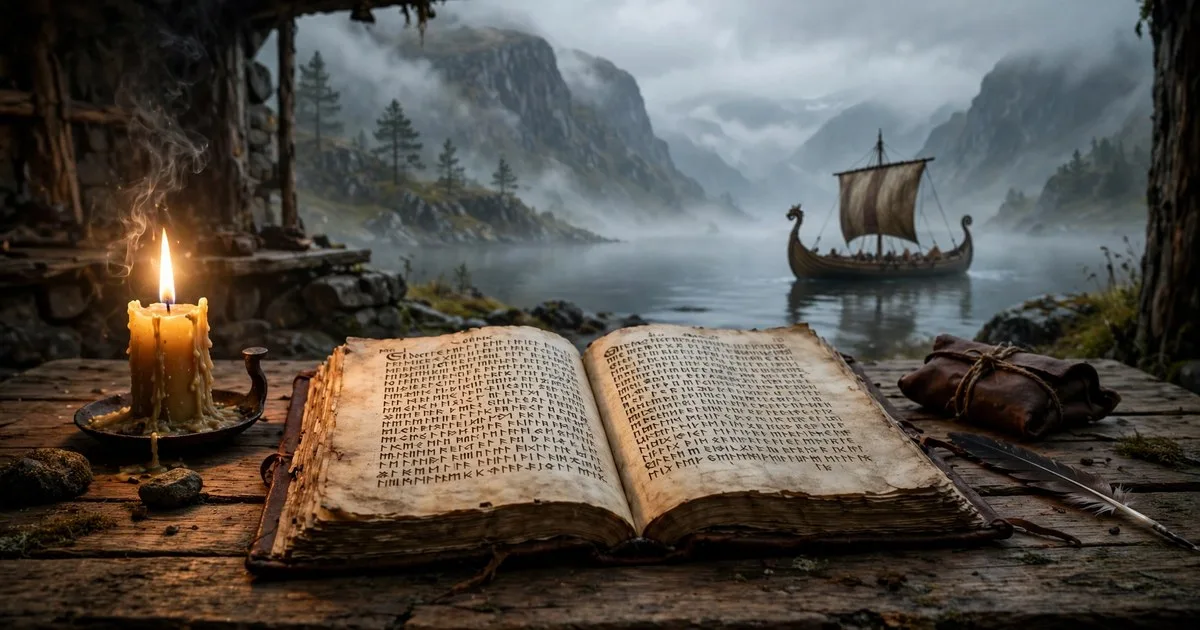
Some words turn up online and nobody can quite agree on what they mean. Sagerne is one of those words. You might have seen it in a search result, in a comment thread, or on a page that promised a definition and then gave you three different ones. Turns out, the real answer is older and far more interesting than most of those pages let on. The word comes from Danish, and it points straight at one of the greatest storytelling traditions Europe ever produced.
The short version is simple enough. Sagerne is the definite plural of the Danish word sag, which means a case, a matter, or a story. In the Norse sense, though, it reaches much further than that. It connects to the sagas, the long prose tales written down in medieval Iceland about Vikings, kings, feuds, and families. This guide walks through what sagerne really means, where the word comes from, what the sagas actually are, and why people still read them hundreds of years after they were written.
What Sagerne Actually Means
Before anything else, it helps pin the word down. Sagerne is not a standard English dictionary word, and you will not find it in most English dictionaries. It is Danish, and it works the way Danish grammar works. The base word is sag, and adding the ending ne turns it into the definite plural form. So sagerne literally means the cases, the matters, or the stories, depending on the context in which it is used.
In everyday Danish, the word shows up in ordinary settings. A lawyer might talk about sagerne when they mean the cases on their desk. A news report might use it for the matters under discussion. A teacher might use it for the stories in a book. The meaning shifts with the setting, and that is normal for the word. It is a general word in Danish, not a technical term with one fixed meaning.
Online, though, the word has picked up a second life. Some websites present sagerne as if it were a brand, a platform, or a special concept with a hidden meaning. Those claims do not hold up. There is no well known company, app, or movement by that name, and no reliable source backs up those grander definitions. What the evidence actually supports is far simpler. The word is Danish, it means the stories or the cases, and its most interesting connection is to sagerne of the North.
That honesty matters, because the internet is full of pages that dress up an obscure word with invented meanings. Sagerne does not need that treatment. The real story behind it, the medieval sagas of Iceland and Norway, is rich enough on its own. Once you know what the sagas are, the word stops being a puzzle and starts being a doorway into a whole world of old stories.
Where the Word Comes From
The roots of sagerne go back a long way, further than Danish itself. The word sag comes from the Old Norse word saga, which meant a story, a tale, or a history. That same root gave English the word saga, which we still use today for a long, involved story about a family or a series of events. The connection is direct, and it is one of those cases where the history of a word tells you the history of a culture.
Old Norse was the language of the Vikings and of medieval Iceland and Norway. In that language, a saga was not just any story. It was a prose narrative, usually long, about people and events that mattered to the community. The word carried weight. When someone said they would tell a saga, the listeners knew they were in for something serious, something that might take an evening or several evenings to finish.
Danish, Norwegian, Swedish, and Icelandic all grew out of Old Norse, and each of them kept some form of the word. In modern Danish, sag is the everyday version, used for cases and matters as much as for stories. In Icelandic, saga kept its older, more literary sense. The English word saga came into the language from Old Norse through the Icelandic tradition, which is why it still feels literary and a little bit epic when we use it today.
So when you see sagerne, you are looking at a Danish plural with a Viking age ancestor. The word has travelled from the oral tales of Norse storytellers, through centuries of Danish speech, and onto the modern internet. That journey is part of what makes it interesting. It is a small word, but it carries a thousand years of storytelling inside it.
The Family Sagas
The most famous group of sagas, and the one most people mean when they talk about the sagas, is the family sagas. In Icelandic they are called Islendingasogur, which means sagas of Icelanders. These are long prose stories about the families who settled Iceland in the late ninth century and their descendants over the next two hundred years or so. They deal with farms, marriages, feuds, lawsuits, and the slow grind of honour in a society with no king and no standing army.
What makes the family sagas so striking is how plain their style is. The writers rarely tell you what a character is feeling. They show you what the character does, and they let you work out the rest. A man might be insulted at a feast, and the saga will simply record that he went home in silence. Three chapters later, that silence turns into a killing. The effect is powerful because the reader has to do the emotional work themselves, and the story stays with you longer that way.
The best known of all the family sagas is Njals Saga, also called Njala or the Story of Burnt Njal. It was written down in the thirteenth century, most likely between 1270 and 1290, and it describes events set between about 960 and 1020. The story follows two friends, Njal Thorgeirsson, a wise lawyer, and Gunnar Hamundarson, a great warrior who hates killing. A chain of small insults and bad marriages pulls their families into a feud that ends with Njal and his household burned alive in their farmhouse. It is the longest of the family sagas and often called the greatest of them.
Other family sagas are just as worth your time. Egils Saga tells the life of Egil Skallagrimsson, a poet, warrior, and troublemaker who could write a beautiful verse and start a fight in the same breath. Laxdaela Saga follows a family in western Iceland across several generations, with love affairs, drownings, and a famous sword that brings bad luck to everyone who owns it. Eyrbyggja Saga is full of ghosts, hauntings, and strange happenings on a single peninsula. Each one has its own flavour, but they all share that same flat, factual style that makes the drama hit harder.
The family sagas were not written down when the events happened. They were passed along by word of mouth for generations first, then written down in the thirteenth and fourteenth centuries by writers whose names are mostly lost to us. That gap matters. The sagas are not history in the modern sense, even though they are built around real people and real places. They are stories shaped by memory, by the needs of the storyteller, and by the audience sitting around the fire.
Kings Sagas and Snorri Sturluson
The second great group of sagas tells the lives of the kings of Norway. These are called the kings sagas, or Konungasogur in Old Norse, and they were written from the twelfth century onwards. They mix history, legend, and poetry in a way that can be confusing at first, but they are the main source we have for the early history of Norway. Without them, we would know far less about the kings who shaped Scandinavia.
The central figure in this tradition is Snorri Sturluson, an Icelandic chieftain, historian, and poet who lived from 1179 to 1241. He was one of the most powerful men in Iceland, and one of its greatest writers. He was also murdered in his own cell at his home in Reykholt, a reminder that the violent world of the sagas was not just a story for him. He was living in it.
Snorri is best known for two works. The first is the Prose Edda, sometimes called the Younger Edda, which he wrote around 1220 as a handbook for poets. It explains the old myths, the gods, and the complicated poetic language of the skalds, the court poets of the North. The second is Heimskringla, a history of the Norwegian kings that starts with legendary material and runs through to the late twelfth century. Both works are still read today, and both are essential reading for anyone who wants to understand Norse mythology and history.
Heimskringla is remarkable for how Snorri handles his sources. He quotes old poems, weighs conflicting accounts, and sometimes admits that he is not sure what really happened. That kind of honesty was rare in medieval writing. He also had a theory that the Norse gods had originally been human kings and war leaders whose burial places became places of worship over time. Modern scholars call this idea euhemerism, and Snorri laid it out centuries before it had a name. His work shaped how later generations understood the Norse past, and it still shapes it now.
Snorri is also often credited, on stylistic grounds, with writing Egils Saga, though the evidence is not conclusive. Whether he wrote it or not, the connection shows how central he is to the whole tradition. He was the man who took the old stories, the myths, and the histories, and gave them a written form that could survive. Without him, much of what we know about the Norse world would simply be gone.
The Legendary Sagas
The third group is the legendary sagas, called Fornaldarsogur in Old Norse. These are set in a misty, ancient past, long before the settlement of Iceland, and they are full of dragons, magic swords, cursed rings, and heroes who fight monsters. They are the most entertaining of the sagas, and the least concerned with historical accuracy. Their aim was to thrill the audience, not to teach them history.
The most famous of them is Volsunga Saga, the story of Sigurd the dragon slayer and the cursed treasure of the Nibelungs. It is one of the sources for the great German epic, the Nibelungenlied, and for Richard Wagner’s Ring cycle. Reading it gives you a sense of how deep the roots of European storytelling go.
Scholars used to look down on the legendary sagas a little, treating them as cheap entertainment next to the serious family sagas. That view has changed. Modern readers and scholars take them seriously as literature, and they recognise that the legendary sagas kept alive the oldest layers of Norse myth and storytelling. They are the bridge between the gods of the Eddas and the heroes of later European romance, and they deserve a place at the centre of any guide to sagerne.
The Eddas: The Gods and the Poets
No guide to sagerne is complete without the Eddas. There are two of them, and they sit alongside the sagas as the other great body of Norse literature. The Poetic Edda is a collection of old poems about the gods and heroes, gathered in a single thirteenth century manuscript called the Codex Regius. Nobody knows who put it together, and nobody knows exactly when all the poems were composed. Some of them are very old indeed.
The Poetic Edda contains stories that have become famous far beyond Iceland. There is the Voluspa, the prophecy of a seeress who describes the creation of the world and its destruction in fire. There is Havamal, a collection of wise sayings attributed to Odin, about how to behave at a feast, how to treat a guest, and how not to get yourself killed. There are the lays of Sigurd, the hero of the dragon story that later turns up in the legendary sagas. Reading these poems feels like stepping into a world where gods walk among men and fate is something you argue with, not something you accept.
The Prose Edda is Snorri Sturluson’s handbook, and it is the more orderly of the two. Snorri wrote it to explain the myths to younger poets who no longer understood the old references. He tells the stories of the gods in plain prose: Odin and Thor and Loki, the building of Asgard, the death of Baldr, the coming of Ragnarok. Where the Poetic Edda is wild and fragmentary, Snorri is clear and systematic. The two books work together, and together they are the reason we know as much as we do about Norse mythology today.
One of the most useful parts of the Prose Edda is a section called Skaldskaparmal, which deals with the language of poetry. The old poets used elaborate metaphors called kennings, and Skaldskaparmal explains how they work. A ship might be called a horse of the sea. Gold might be called the fire of the water. Blood might be called the dew of wounds. Learning to read these is like learning a second language, and it is part of what makes Norse poetry so rewarding once you get into it.
How the Sagas Were Written Down
The sagas began as spoken stories. For more than two hundred years after the events they describe, they were told and retold in halls and farmhouses, passed from one generation to the next. Storytellers memorised them, changed them, improved them. The written versions we have are the end point of a long process, not the beginning.
The writing itself happened mostly in the thirteenth century, though some sagas were written later and a few were earlier. Iceland by then was a Christian society with a strong literary culture. Monasteries and wealthy households kept manuscripts, and scribes copied them by hand. The oldest surviving manuscripts are beautiful objects, written in a clear hand on vellum made from calfskin. Some of them are still in Iceland today, kept in the Arni Magnusson Institute in Reykjavik. Others are in Copenhagen, in the collection that bears the same scholar’s name.
Arni Magnusson was an Icelandic scholar who lived from 1663 to 1730 and spent much of his life collecting old manuscripts. Without him, many sagas might have been lost altogether. He gathered them from farms all over Iceland, sometimes rescuing them from damp cellars and from being cut up to make shoe patterns. His collection, the Arnamagnaean collection, is the foundation of modern saga scholarship, and it is one of the reasons the sagas survived to be read today.
That survival is worth thinking about. The sagas were written in a small country, in a language spoken by very few people, on a material that rots if you store it badly. They survived because people kept copying them, kept telling them, and kept believing they were worth keeping. That chain of care, from the storytellers of the thirteenth century to the scholars of today, is the reason sagerne still means something now.
What Makes Saga Storytelling Different
The sagas feel different from most stories written today, and the difference comes down to style. The saga writers had a rule that modern writers would do well to remember: show what happens, do not explain what it means. A character is angry, and the saga shows him swinging an axe. A character is in love, and the saga shows her sending a secret message. The reader is trusted to understand, and that trust is part of what makes the stories so gripping.
Another difference is the way the sagas treat violence. In modern fiction, violence is often the climax of a story. In the sagas, violence is part of the furniture. People kill each other over insults, over land, over a badly worded joke at a feast. The saga does not stop to moralise about it. It simply records that it happened, and the consequences follow, sometimes for generations. That flatness makes the violence feel more real, and more disturbing, than a modern thriller ever manages.
There is also the way the sagas treat the supernatural. Ghosts appear, dreams come true, a dead man sits up and talks. But the saga never pauses to explain how this is possible. A haunting is reported the same way as a sheep count, in the same plain sentences, and the reader is left to accept it as part of the world. That matter of fact tone is one of the things that makes the sagas feel so strange and so modern at the same time.
Finally, the sagas are honest about the fact that cleverness matters more than strength. The heroes who survive are not always the strongest fighters. They are the ones who can talk their way out of trouble, who can read a room, who know when to make a joke and when to keep quiet. Njal, the wise lawyer, is one of the greatest characters in all of medieval literature precisely because he wins his battles with words and law, not with a sword. The sagas understood, long before modern writers did, that the most interesting battles happen in conversation.
Why Sagerne Still Matter Today
You might wonder why a word about medieval stories matters in 2026. The answer is that the sagas are still alive. They are read in schools in Iceland, translated into dozens of languages, and adapted into films, games, and television series. The television show Vikings took its inspiration from saga material. The film The Northman, which came out in 2022, was based directly on a story from the sagas, the tale of Amleth, which later became Shakespeare’s Hamlet. The sagas have never really gone away.
They also offer something that modern storytelling sometimes forgets. The sagas are long stories about consequences. A small decision in one chapter can shape the fate of a family for three generations. That sense of time, of actions rippling outwards, is rare in modern media, where stories tend to reset every episode. The sagas make you think about the long term, about honour, about family, and about the price of revenge.
For readers who want to explore them, there are good translations available. The Penguin Classics editions of the sagas are a fine place to start. The translations by Jesse Byock, by Bernard Scudder, and by Jackson Crawford are also excellent. Online, there are free translations of the Poetic Edda and the Prose Edda available through the Internet Sacred Text Archive, and the Icelandic Saga Database lets you read the sagas in the original Old Norse alongside English translations.
Visiting the places of the sagas is also possible. Iceland’s saga sites are marked with information boards, and there are museums and exhibitions about the saga age in Reykjavik, in Hvolsvollur, and elsewhere. You can find them in travel guides that cover faraway places and old landscapes, and there are guided tours that take you from one saga site to the next. Standing on a hillside where a saga battle happened, with the wind coming off the sea, you can feel why these stories lasted. They were written about real places, by people who knew them, and that connection between story and landscape is something the sagas do better than almost any other literature in the world.
Frequently Asked Questions
Here are the questions people ask most often about sagerne, answered in plain language.
What does sagerne mean?
Sagerne is the definite plural of the Danish word sag, which means a case, a matter, or a story. On this page, we use it in the Norse sense, to point to the sagas and the storytelling tradition behind them.
Is sagerne a real word or a made up term?
It is a real word in Danish, where it is the definite plural form of sag. It is not a standard English dictionary word, and the grander meanings some websites give it are not supported by any reliable source.
Where should I start reading the sagas?
Start with Njals Saga, because it is the most complete and best known of the family sagas. Then try Egils Saga and Laxdaela Saga. Modern translations in Penguin Classics are readable and affordable, and the blogs that share stories here can point you towards more reading once you have caught the saga bug.
What is the sword in the tree story?
It comes from Volsunga Saga. A stranger walks into a hall during a feast and drives a sword into the tree that grows through the middle of the building, saying that whoever can pull it out may keep it. Only Sigurd, the story’s hero, can do it, and the sword becomes his. The story is one of the oldest in the tradition, and it has been retold in many forms, from medieval German poetry to Wagner’s operas.
Who wrote the sagas?
We do not know the names of most saga writers. The sagas were written down in the thirteenth and fourteenth centuries, mostly in Iceland, by writers whose names have been lost. Snorri Sturluson is the famous exception, and even he is only known to have written some of the most important works. The sagas are a shared literature, passed down by storytellers and scribes.
Are the sagas true stories?
Some of the people and places are real, and archaeology has confirmed parts of the settings. But the sagas are stories, not histories. The writers shaped the material to make a good story, and they changed details when it suited them. They are best read as literature with a historical setting, not as a record of exactly what happened.
Can I visit the places where the sagas happened?
Yes, and Iceland is the best place to do it. Many saga sites are real places you can still visit, in fact. Some are marked with information boards, others are just farms and fields where the story happened. The travel guides on this site are a good example of the kind of reading that helps a trip like that come alive.
Why is the word sagerne spelled with an e at the end?
It is the Danish definite plural ending. Danish adds -ene to make the definite plural of many nouns, and sag becomes sagerne. It is a regular part of the language, like adding the to the end of a word, which is how the Danish definite article works.
Final Words
Sagerne is a small Danish word with a very large story behind it. It means the cases, the matters, or the stories, and its most interesting use is as a doorway into the world of the Norse sagas. Once you know that, the rest follows naturally. The sagas are there waiting, in good translations, in free online editions, and in a tradition that has lasted for a thousand years. You do not need a dictionary to enjoy them. You just need to start reading.
So the next time you see the word sagerne, you will know what it means and where it comes from. It is a reminder that words carry history with them, and that the best stories are the ones that last. What has lasted, in the end, is not the word sagerne itself, but the saga tradition it points towards, and that tradition is one of the great gifts of the medieval North. Read the sagas, and you will see why.



One thought on “Sagerne Explained: The Norse Sagas and Their Stories”