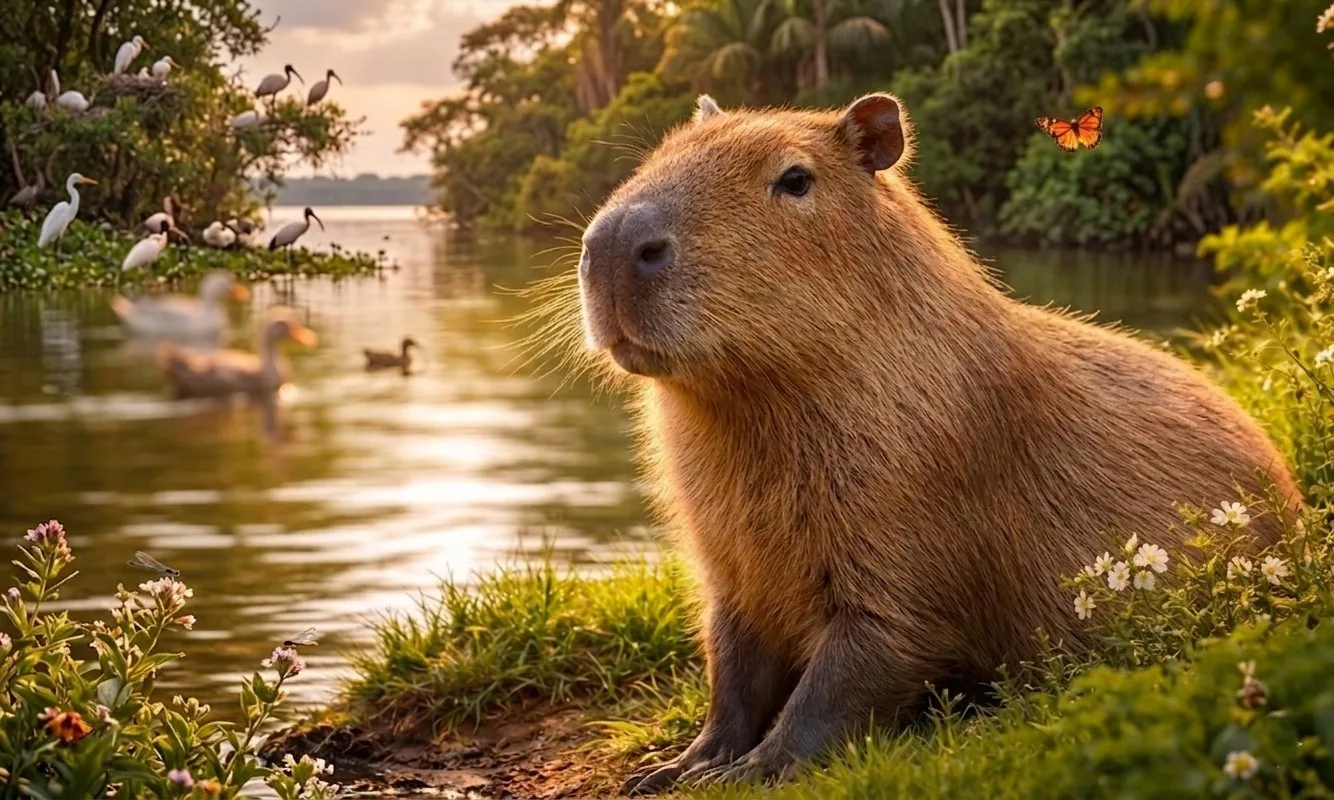
Picture this. A 65-kilogram animal sits perfectly still at the edge of a river. A little bird lands on its back, pecks around for insects, and leaves.
A few capuchin monkeys climb over its legs. The animal does not flinch, bark, or move. It just blinks slowly, like a creature that has genuinely figured out something the rest of us haven’t.
That animal is the cadibara , the popular online name for the capybara, scientifically known as Hydrochoerus hydrochaeris. It is the largest living rodent on Earth.
It is native to South America. And in 2026, it is one of the most searched, most admired, and most memed wild animals on the internet.
This guide covers everything: its biology, its wild home, its diet, its social intelligence, its conservation status, and the real story behind its viral internet fame.
Quick Facts: Cadibara at a Glance
| Feature | Detail |
| Common Name | Cadibara / Capybara |
| Scientific Name | Hydrochoerus hydrochaeris |
| Classification | Mammalia, Rodentia, Caviidae |
| Adult Weight | 35 to 66 kg (females often heavier) |
| Body Length | 106 to 134 cm |
| Shoulder Height | Up to 62 cm |
| Lifespan (Wild) | 6 to 10 years |
| Lifespan (Captivity) | Up to 12 years |
| Diet | Strictly herbivorous |
| Habitat | Wetlands, riverbanks, marshes |
| Native Range | Venezuela, Brazil, Colombia, Argentina, Paraguay, Peru, Bolivia |
| IUCN Status | Least Concern |
| Gestation Period | Least Concern |
| Litter Size | 2 to 8 pups |
What Is a Cadibara? The Name, the Animal, and the Confusion
The cadibara is not a separate species. It is the same animal most biologists and wildlife organizations call the capybara.
The word “cadibara” spread through social media platforms, particularly TikTok and Reddit, around 2021 and 2022, as users began tagging videos and fan art with the alternate spelling.
By 2025, search volume for “cadibara” had grown significantly enough that dozens of content sites began covering it as its own keyword.
The actual name “capybara” has roots in the Tupi language, one of the indigenous languages of Brazil. It roughly translates to “master of the grasses” or “one who eats slender leaves.”
The Guaraní people of South America knew this animal long before any European naturalist documented it. They respected it as a food source, and in some oral traditions, the capybara-like figure appeared as a rain messenger.
When Swedish botanist Carl Linnaeus formally classified the species in 1766 under his system of binomial nomenclature, he assigned it the name Hydrochoerus hydrochaeris, meaning “water pig” in Greek.
The genus Hydrochoerus contains two recognized species: the common capybara (H. hydrochaeris) and the lesser capybara (H. isthmius), found in Panama and northwestern Colombia.
So when someone searches for “cadibara,” they want to know about the capybara , and this article gives them every answer worth having.
Where Does the Cadibara Live? Habitat and Geographic Range
The Countries That Are Home to This Giant Rodent
The cadibara occupies a vast range across South America. It thrives in Venezuela, Brazil, Colombia, Argentina, Paraguay, Peru, and Bolivia.
Brazil holds the largest population by far, particularly in the Pantanal , the world’s largest tropical wetland, which spans roughly 150,000 to 195,000 square kilometres across Brazil, Bolivia, and Paraguay.
The llanos of Venezuela are another stronghold. These seasonally flooded grasslands provide exactly what the cadibara needs: water access, dense grass, and a warm climate year-round.
Why Wetlands Are Non-Negotiable
The cadibara does not simply prefer water. It depends on it for survival. Wetlands provide three things that no dry environment can replace:
- Thermoregulation: South American temperatures regularly exceed 35°C. Submersion in water cools the animal’s core temperature instantly.
- Predator escape: Jaguars (Panthera onca), green anacondas (Eunectes murinus), and caimans (Caiman spp.) all hunt this animal. The cadibara’s first and most reliable defense is water.
- Food density: Aquatic grasses, sedges, and reeds grow thickest along riverbanks. A group of cadibaras can access enormous quantities of food without wandering far.
During the dry season, groups of cadibaras sometimes gather in numbers exceeding 100 individuals near permanent water sources.
This temporary crowding is unusual for them , they normally live in groups of 10 to 30 , but it shows how tightly their survival is tied to water availability.
Cadibara Body and Physical Adaptations

Built Like a Barrel, Designed for Water
The cadibara’s body looks almost comically round from the side. Its barrel-shaped torso, short limbs, and nearly non-existent tail give it a silhouette quite unlike most mammals its size. But every physical feature serves a purpose.
Adult males typically weigh between 49 and 55 kg, while females run slightly heavier, often reaching 58 to 66 kg.
The largest documented individual weighed approximately 91 kg and was recorded in Brazil. Body length reaches up to 134 cm, making it genuinely larger than many medium-sized dog breeds.
Eyes, Ears, and Nostrils: The Periscope Head
The capybara’s eyes, ears, and nose are on top of its head. This placement is not accidental. It allows the animal to remain almost entirely submerged while still monitoring its environment.
A cadibara floating in a river with just its topknot above water looks deceptively relaxed , it is actually scanning for threats from multiple directions simultaneously.
Webbed Feet and Swimming Ability
Each foot has partially webbed toes. On land, this causes a slightly splayed gait. In water, it provides efficient propulsion. The cadibara swims with a smooth, unhurried stroke and can hold its breath for up to five minutes underwater.
Researchers studying population movement in the Venezuelan llanos observed individuals crossing rivers more than 500 metres wide without apparent difficulty.
The Teeth That Never Stop Growing
Like all rodents, the cadibara has incisors that grow continuously throughout its life. These bright orange-yellow front teeth are stained by iron compounds in the enamel, which strengthen them considerably.
The animal keeps them worn down through constant grazing. A cadibara that cannot access enough fibrous vegetation would eventually suffer serious dental problems , another reason habitat quality matters so much.
What Does the Cadibara Eat? Diet and Digestion
A Day of Eating
The cadibara is a strict herbivore. Its daily menu centers on grasses, particularly water grasses and reeds growing along riverbanks.
It supplements this with aquatic plants, fruit, bark, and occasionally dried or hay-like vegetation when fresh plants are scarce.
A single adult cadibara consumes approximately 3 to 3.5 kg of vegetation per day. That sounds like a lot, but grass is nutritionally thin. Getting enough calories from grass alone requires high volume and very efficient digestion.
Coprophagy: The Clever Recycling System
Here is where the cadibara’s digestive strategy gets genuinely fascinating. It practices coprophagy , the deliberate consumption of its own feces. This is not a sign of poor health. It is a highly evolved nutrient extraction system.
The cadibara’s hindgut ferments plant fiber using gut bacteria, producing volatile fatty acids and vitamin B12 among other nutrients.
By re-ingesting specific fecal pellets (distinct from its regular waste), the animal puts those nutrients back through the digestive system a second time.
Many caviomorph rodents share this behavior, including guinea pigs and chinchillas. It allows the cadibara to thrive on food sources that would leave most mammals malnourished.
Grazing Patterns Through the Day
Cadibaras graze most actively at dawn and in the late afternoon. During the hottest midday hours, they wade into water or rest in mud at the water’s edge.
This behavioral pattern reduces heat stress and energy expenditure. It also makes early morning the best time to observe them in the wild , a detail worth knowing if you ever visit the Pantanal or the Llanos de Venezuela on an ecotourism trip.
Cadibara Social Life: The Smartest Part of This Animal’s Story
Group Structure and Dominance
The cadibara’s social organization is sophisticated. Groups typically consist of one dominant male, several adult females, subordinate males, and juveniles of both sexes.
The dominant male does not maintain his position through constant aggression. He uses scent marking, posture, and subtle vocal signals far more than physical fighting.
Subordinate males often stay on the periphery of the group. They contribute to group vigilance , watching for threats from directions the dominant male cannot monitor.
This distributed attention system makes the group collectively safer than any individual could be alone.
Grooming and Social Bonding
Group members groom each other regularly. They use their incisors to comb through fur, removing parasites and debris.
This behavior serves hygiene, but more importantly, it reinforces social bonds. An animal that spends time grooming another is communicating trust and affiliation.
This matters for survival. Groups with stronger social bonds respond faster to alarm signals and suffer lower predation rates.
A 2017 study published in Behavioural Ecology found that capybara groups with higher rates of affiliative behavior showed significantly quicker coordinated responses to predator-simulating stimuli compared to groups with lower social cohesion.
Communication: More Complex Than It Looks
The cadibara communicates with a surprisingly rich vocabulary of sounds.
- Barks: Short, sharp warning calls that alert the group to immediate danger
- Whistles: Used between mothers and young, and between group members moving through dense vegetation
- Chirps: High-frequency sounds often associated with excitement or mild distress
- Purring: A low rumble made during calm social contact, especially during grooming
- Teeth chattering: A mild threat display between competing males
Scent marking adds another layer. Both sexes use specialized scent glands near the nose (the morillo gland, more prominent in males) and around the anal region to mark territory and communicate reproductive status.
Dominant males mark conspicuously and frequently , it is one of the clearest behavioral signals of their status.
The Cadibara and Other Species: Nature’s Most Sociable Neighbor
Cross-Species Coexistence
No other large wild mammal tolerates the presence of unrelated species as gracefully as the cadibara. In the wild, yellow-headed caracaras (Milvago chimachima) land on their backs and hunt ticks and flies from their fur.
The cadibara barely reacts. This mutualistic relationship benefits both: the bird gets an easy meal, and the cadibara gets external parasite removal.
Squirrel monkeys and capuchin monkeys frequently use resting cadibaras as a vantage point or simply sit beside them. Ducks, herons, and giant river otters share the same riverbanks without incident.
This tolerance is not passivity , it is a sophisticated, low-cost social strategy. Allowing harmless species to stay close creates a multi-species alarm network. When a heron startles and flies, the cadibara registers that signal immediately.
The Symbol of Cross-Species Peace
This behavior made the cadibara a minor internet celebrity before the big viral wave arrived. Nature documentary producers noticed it first.
By 2019 and 2020, clips of cadibaras serving as unwitting platforms for various birds, reptiles, and mammals were circulating widely on YouTube. The comment sections consistently said the same thing: this animal radiates calm.
Cadibara Reproduction and the Life Cycle
Breeding Season and Gestation
Cadibara breeding peaks during the rainy season, which varies by region but generally falls between April and July in Venezuela and Brazil.
This timing ensures that pups are born into a period of abundant food and stable water levels.
Females carry their young for approximately 130 to 150 days , a relatively long gestation period for a rodent, reflecting the high developmental maturity of newborns. A litter contains two to eight pups, with four or five being most common.
Pups That Hit the Ground Running
Cadibara pups are precocial, meaning they are born in an advanced state of development. They arrive with eyes open, a full coat of fur, and functioning limbs.
Within hours of birth, they can walk. Within days, they can swim. Within a week, they are grazing alongside adults.
This rapid development is critical. In environments where jaguars and caimans patrol the riverbanks, a helpless newborn phase would be devastatingly costly. Evolution has compressed vulnerability to the absolute minimum.
The entire group participates in raising young. Females nurse each other’s pups , a behavior called allosuckling.
Juveniles form nursery clusters that adult females monitor collectively. This cooperative parenting dramatically improves pup survival rates compared to solitary species of similar size.
Cadibara Predators: What Hunts the Giant Rodent
The cadibara faces serious pressure from several apex predators. The jaguar is its most dangerous land-based threat.
A fully grown male jaguar in the Pantanal or Venezuelan llanos can take down an adult cadibara with a single bite to the skull or neck. Jaguars often ambush cadibaras at the water’s edge during peak grazing hours.
Green anacondas target cadibaras near water, particularly juveniles and smaller females. Spectacled caimans (Caiman crocodilus) prey on cadibaras that enter the water without adequate vigilance. Juvenile cadibaras face additional threats from harpy eagles (Harpia harpyja) and ocelots (Leopardus pardalis).
The cadibara’s primary defense remains social vigilance combined with rapid retreat into water. A submerged cadibara is almost impossible for a land predator to reach and is far harder for a caiman to secure than one standing at the bank.
Cadibara Conservation Status: Where Things Stand in 2026
IUCN Classification and Population Trends
The International Union for Conservation of Nature (IUCN) classifies the cadibara as “Least Concern” on its Red List.
The overall population is large, geographically widespread, and stable in most of its native range. This is genuinely good news in a conservation landscape full of grim reports.
However, “Least Concern” does not mean “no concern.” Several localized populations face real pressure:
- Wetland drainage for agriculture in the Cerrado region of Brazil has reduced habitat quality significantly since the 1980s.
- Hunting for meat and leather remains legal in some countries and unregulated in parts of Venezuela and Colombia.
- Urban expansion around São Paulo and Bogotá has pushed some cadibara populations into increasingly fragmented patches of habitat.
Organizations Working to Protect This Species
The Pantanal Conservation Area, a UNESCO World Heritage Site designated in 2000, provides formal protection to a critical portion of the cadibara’s most important habitat.
The World Wildlife Fund (WWF) includes capybara population monitoring as part of its broader Pantanal conservation program.
Brasil’s Instituto Chico Mendes de Conservação da Biodiversidade (ICMBio) manages protected areas where cadibaras are among the most visible and ecologically important species.
The Ecological Role Nobody Talks About Enough
The cadibara is not just a passive resident of its ecosystem. It functions as an ecological actor in several important ways.
Its heavy grazing maintains open grassland areas along riverbanks, which supports the plant diversity that other species depend on. Its droppings fertilize aquatic and riparian vegetation.
And its wallowing behavior , churning mud near water , creates shallow pools that serve as habitat for amphibians, insects, and small fish during dry seasons. The cadibara is, in ecological terms, a keystone species in many of the wetland systems it inhabits.
Cadibara Internet Fame: How a South American Rodent Conquered Social Media
The Japanese Hot Spring Moment
The cadibara’s journey to global internet fame had an unlikely early catalyst: Japanese zoos. Several zoological parks in Japan began a tradition of placing capybaras into outdoor hot springs (onsen) during winter months, starting in the 1980s at Izu Shaboten Zoo in Shizuoka Prefecture.
Images of these round, steam-surrounded animals sitting in bubbling water with serene expressions spread across Japanese television and print media for decades.
When social media made global content sharing instantaneous, those images reached new audiences. By 2016, capybara hot spring videos were circulating widely in the English-speaking internet. By 2021, they had accumulated tens of millions of views across YouTube and TikTok.
TikTok, Reddit, and the Spelling Drift
The word “cadibara” as a search term grew in popularity partly because casual social media users heard the name spoken rather than reading it.
Phonetic misspellings propagated quickly through comment sections, fan communities, and meme pages. The “cadibara” hashtag on TikTok has accumulated hundreds of millions of views as of early 2026.
Reddit communities like r/capybara and r/aww regularly feature cadibara content, and the animal has generated an entire cottage industry of plush toys, enamel pins, sticker packs, and clothing.
Brands in the UK, South Korea, and the United States began releasing capybara-themed merchandise in 2022 and 2023, responding to measurable consumer demand.
Why Humans Are Drawn to This Animal
Psychologists who study human-animal interaction point to a concept called “cute aggression” , the overwhelming positive response humans have to certain animal features.
Rounded bodies, large eyes relative to face size, and slow, unhurried movements all trigger strong positive emotional responses in human observers.
The cadibara has all of these. But it adds something even more unusual: genuine interspecies tolerance.
Watching a bird land on the caribara without any reaction taps into something deeper than cuteness. It looks like peace. In a world of constant speed and noise, that image carries real emotional weight.
Can You Keep a Cadibara as a Pet?
The Reality Behind the Fantasy
After viral videos, many people genuinely want a cadibara as a companion animal. The impulse is understandable but complicated.
In the United States, cadibara ownership is legal in some states, including Texas and Pennsylvania, but illegal in California, Georgia, and several others.
In the United Kingdom, keeping a cadibara requires a Dangerous Wild Animals licence under the Dangerous Wild Animals Act 1976 , a process that involves veterinary inspection and local authority approval.
Beyond legality, the practical demands are serious. The cadibara needs:
- Daily access to a large body of water (a standard garden pond is generally insufficient)
- A warm climate or heated indoor and outdoor space year-round
- The company of at least one other candidate , solitary individuals show significant signs of stress
- A diet of fresh grass and aquatic vegetation, not commercially available pet food
For the overwhelming majority of people, responsible candibara appreciation means watching wildlife documentaries, supporting conservation organizations, and visiting reputable zoos and wildlife sanctuaries where these animals live in appropriate conditions.
The Cadibara as a Cultural Symbol
The cadibara has moved beyond wildlife documentary subject into something closer to a cultural icon. In South America, particularly in Brazil and Venezuela, the animal has long been a familiar presence in regional folklore and rural life.
Indigenous communities of the Gran Chaco and the Amazon basin incorporated capybara imagery into oral tradition for centuries.
In contemporary culture, the cadibara’s association with radical calmness has made it a reference point in conversations about mindfulness and stress management.
In 2023, several mental health content creators on YouTube and Instagram explicitly used the cadibara’s behavioral reputation to illustrate the concept of equanimity , the practice of maintaining inner calm regardless of external events.
The animal’s cross-species tolerance has also made it a popular symbol in discussions of coexistence, community building, and non-aggression.
That a single wild rodent from the wetlands of South America has achieved this level of symbolic resonance says something striking about what people are looking for right now.
(FAQs)
What is the difference between a cadibara and a capybara?
There is no biological difference. A cadibara and a capybara are the same animal: Hydrochoerus hydrochaeris. “Cadibara” is an alternate spelling that spread through social media, particularly on TikTok and Reddit, as users encountered the name phonetically rather than in writing. Both terms refer to the world’s largest living rodent.
How large does an adult cadibara get?
Adult cadibaras typically weigh between 35 and 66 kilograms. Body length ranges from 106 to 134 centimetres, with shoulder height reaching up to 62 centimetres.
Females tend to be slightly heavier than males. The largest documented wild specimen weighed approximately 91 kilograms.
Where does the cadibara live in the wild?
The cadibara is native to South America and found across Venezuela, Brazil, Colombia, Argentina, Paraguay, Peru, and Bolivia.
It lives exclusively in habitats with reliable water access: riverbanks, wetlands, marshes, flooded grasslands, and the edges of lakes and ponds.
What does the cadibara eat every day?
The cadibara is a strict herbivore. It eats primarily grasses, supplemented with aquatic plants, sedges, reeds, fruit, and occasionally bark.
An adult consumes roughly 3 to 3.5 kilograms of vegetation per day. It also practices coprophagy , re-ingesting specific fecal pellets to extract additional nutrients from its food.
How long can a cadibara stay underwater?
A cadibara can remain submerged for up to five minutes. It uses this ability to evade predators, cool its body temperature, and navigate across wide rivers. Its partially webbed feet make it a strong and efficient swimmer.
Why do birds sit on the cadibara without being chased away?
This behavior represents a genuine mutualistic relationship. Birds like the yellow-headed caracara feed on ticks, flies, and other parasites found in the cadibara’s thick fur.
The cadibara tolerates the birds because they provide a parasitic cleaning service. It is not passivity , it is a mutually beneficial arrangement that has evolved over a very long time.
Is the cadibara endangered?
No. The cadibara is classified as “Least Concern” by the International Union for Conservation of Nature (IUCN). Its population is large and stable across most of its range.
However, localized populations face pressure from wetland destruction, hunting, and habitat fragmentation caused by agricultural expansion.
How do cadibaras communicate with each other?
Cadibaras use a range of vocalizations including barks (warning calls), whistles (contact calls between individuals), chirps (mild distress or excitement), and purring (during calm social contact).
They also communicate through scent marking using nasal and anal glands, and through body posture and positioning within the group.
How many babies does a cadibara have at once?
A cadibara female gives birth to two to eight pups per litter, with four or five being most typical. Pups are born precocial , eyes open, mobile, and capable of swimming within days. The entire social group participates in caring for the young.
Can the cadibara be kept as a pet?
It is legal in some jurisdictions, including certain U.S. states, but the practical requirements make it unsuitable for most households. Cadibaras need large water access, warm climates, the company of other cadibaras, and specialized diets.
In the UK, ownership requires a Dangerous Wild Animals licence. For most people, supporting cadibara conservation is a more responsible way to engage with this animal.
Why did the cadibara become so popular online?
The cadibara’s extreme tolerance of other species, its visibly calm demeanor, and its photogenic appearance made it ideal social media content.
Japanese zoo hot spring videos, TikTok compilations, and Reddit communities all amplified its profile from 2016 onward. By 2025 and 2026, it had become one of the most recognizable wild animals among younger audiences globally.
Conclusion
The cadibara is not famous by accident. It earned its place in the global imagination by being genuinely extraordinary. It is the largest rodent alive, a semi-aquatic specialist perfectly engineered for life between land and water, and a social animal with behavioral complexity that rewards careful observation.
Its tolerance of other species is not a quirk. It is a sophisticated ecological strategy that has served this animal’s lineage well for millions of years.
Understanding the cadibara properly means seeing past the memes and the hot spring videos to the real animal underneath: a creature shaped by evolution to thrive in one of the world’s most demanding environments, the tropical wetlands of South America. Every physical feature, every behavioral habit, every social arrangement exists because it works.
In 2026, when anxiety and speed define so much of daily life, there is something genuinely meaningful about an animal that holds perfectly still while the world moves around it.
That stillness is not emptiness. It is the product of a deep biological confidence , the confidence of an animal that knows exactly where it belongs and exactly what it needs.
Protecting the cadibara’s wetland home is not just good conservation. It is preserving one of the clearest demonstrations nature has ever produced of how calm, community, and adaptation can make an entire species thrive.
For those wanting to explore the full biological classification and evolutionary history of the capybara family, a detailed overview is available on Wikipedia.