
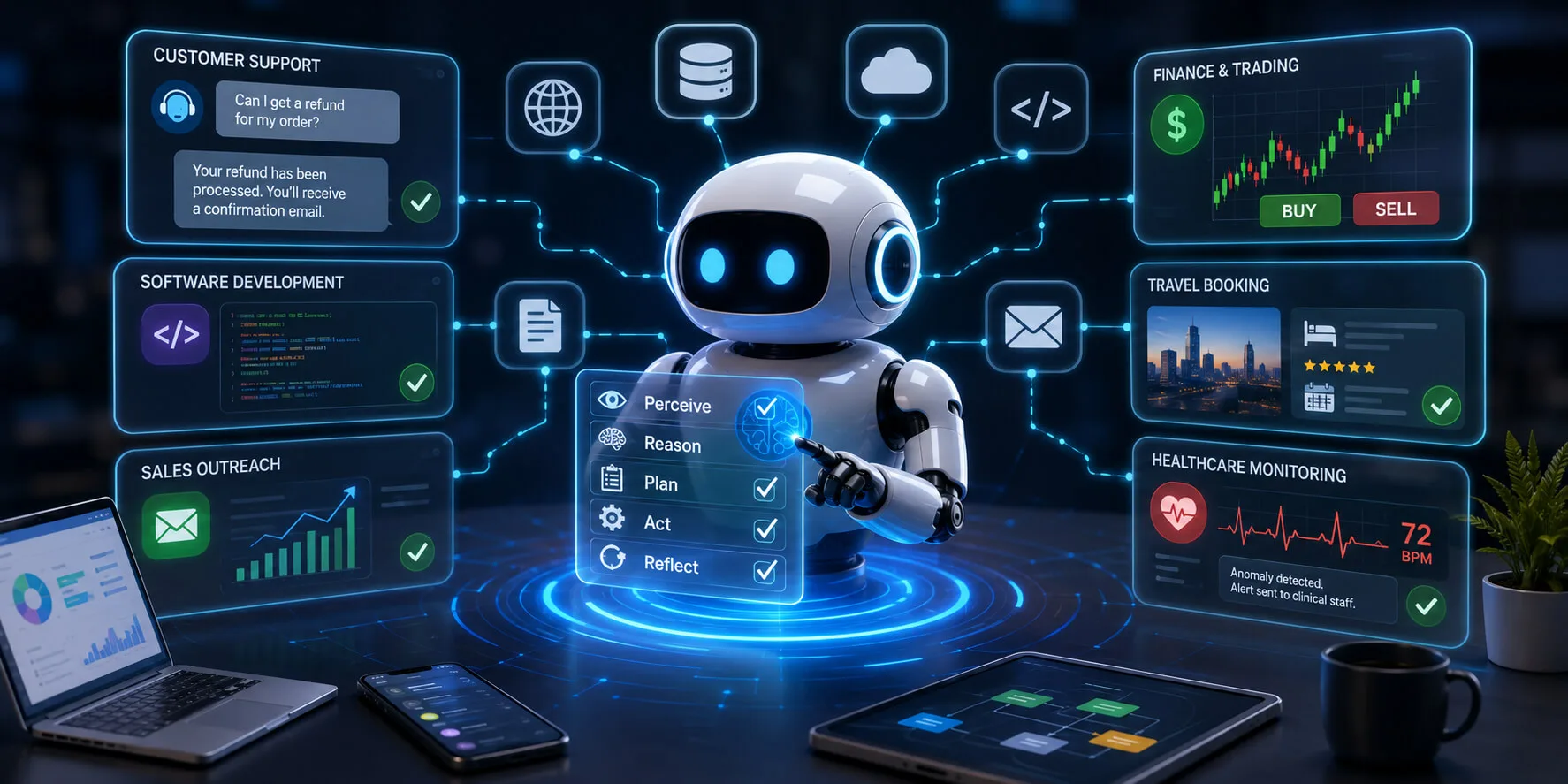
An AI agent works by looping through four steps: perceive, reason, act, and learn. It takes in data, uses a language model to decide what to do, calls tools or APIs to take action, and stores the result so it can adjust its next move.
In researching this piece, I spent time comparing how different vendors describe their agent stacks, and the pattern that keeps showing up is a loop, not a single clever prompt. That distinction matters because it explains why some agents feel reliable and others feel like they are guessing. This article walks through that loop piece by piece, using how AI agents work as the throughline.
Key Takeaways
- An AI agent is a loop of perceiving, reasoning, acting, and learning, not a one-shot response.
- The reasoning engine is almost always a large language model that plans and decides.
- Memory lets an agent keep context within a session and recall facts across sessions.
- Tool access is what turns a chatbot into an agent that can actually do things.
- Most enterprises are still piloting agents, and a large share of pilots get cancelled.
What Is An AI Agent
An AI agent is software that can perceive information, decide on an action, and carry it out on its own. Unlike a basic chatbot, it does not just answer a question and stop. It keeps working through a task, checking its own progress, and adjusting until the goal is met.
AI agents are autonomous systems that perceive, reason, and take real world actions to reach a goal without approval at every step. That is different from a script that follows one fixed path. Instead of answering once, an agent cycles through planning, acting, observing, and adapting until it finishes the job.
How Do AI Agents Work Step By Step
Every production AI agent runs on a small set of connected parts. These typically include perception and input processing, a reasoning engine built on a large language model, memory systems, a tool integration layer, an orchestration layer, and safety guardrails. Strip away the marketing language and it comes down to four repeating moves.
First, the agent perceives. Perception turns raw input, whether that is text, voice, an API call, or sensor data, into a structured format the reasoning engine can use. Without this step the model has nothing solid to reason about.
Second, the agent reasons. The reasoning layer is the model that interprets input, plans a sequence of actions, and decides what to do next, though it is only the thinking part of a larger system. This is where goals get broken into smaller, doable steps.
Third, the agent acts. It calls a tool, hits an API, queries a database, or writes to a file. This is the step that separates an agent from a plain chatbot that only produces text.
Fourth, the agent learns and adjusts. It stores what happened, checks whether the result matches the goal, and updates its next move. Then the loop starts again with fresh perception.
The Core Components Behind Every AI Agent
Different vendors label these pieces differently, but the substance overlaps a lot. Below is a simple breakdown of what each part actually does.
| Component | What It Does | Plain Example |
| Perception | Converts raw input into structured data | Reading a support ticket into fields |
| Reasoning engine | Plans steps and makes decisions | Deciding to check inventory before replying |
| Memory | Holds context and past facts | Remembering a customer’s order history |
| Tool layer | Connects to APIs and external systems | Calling a shipping API to get a tracking number |
| Orchestration | Sequences tasks, handles retries | Retrying a failed API call automatically |
| Guardrails | Blocks unsafe or out of bounds actions | Requiring human approval for refunds over a limit |

The memory and data layer stores short term context within a session, retrieves long term knowledge across sessions, and gives the agent access to enterprise data through retrieval augmented generation. That last part, retrieval augmented generation, is why agents can answer questions using a company’s own documents instead of only general knowledge.
Why Does Orchestration Matter So Much
Orchestration is the part people underestimate the most. It manages control flow, sequences tasks, handles retries and errors, enforces limits, and coordinates between the reasoning engine and everything else. Without it, a reasoning engine has good ideas but no reliable way to execute them.
Think of orchestration as a project manager sitting on top of a smart but easily distracted employee. The employee, the language model, proposes what to do next. The project manager checks the plan against the rules, sequences the steps, and makes sure nothing gets skipped.
What Role Does Human Oversight Play
Agents that act on their own still need checkpoints, especially for anything costly or risky. Production systems benefit from behavioral observability, meaning teams understand what an agent decided and why, not just how fast it responded. Microsoft’s own architecture guidance treats this as a core design requirement rather than an afterthought.
High stakes decisions typically call for human approval gates, full audit trails, and clear paths for oversight. Support for a human to step in and review a decision matters for use cases like clinical trial monitoring. The safest agent designs build these checkpoints in from the start instead of bolting them on later.
Are Companies Actually Using AI Agents In 2026
The short answer is yes, but adoption is uneven. 80 percent of enterprise applications shipped or updated in the first quarter of 2026 include at least one AI agent, according to Gartner, up from 33 percent in 2024. That is a steep jump, but shipping a feature is not the same as running it at full scale.
31 percent of enterprises have at least one AI agent in production, per S&P Global Market Intelligence and McKinsey, with banking and insurance leading at 47 percent while healthcare and government trail at 18 and 14 percent. Payback time also varies a lot by function. Median time to value across functions sits at 5.1 months, with sales development agents paying back in 3.4 months and finance or operations agents taking 8.9 months.
Not every project succeeds, and it is worth being honest about that. Gartner has predicted that 40 percent of agentic AI projects will be cancelled by the end of 2027. The gap between piloting an agent and scaling one safely is still the main bottleneck for most teams.
Where Are AI Agents Being Used Right Now
Some industries have moved faster than others because their workflows are structured and repetitive. Here are the areas seeing the most real deployment right now.
- Financial services, for fraud detection, trading support, and compliance checks
- Healthcare, for treatment planning support, diagnostics assistance, and patient coordination
- Manufacturing, for supply chain optimization and predictive maintenance
- Retail, for personalized shopping and inventory management
- Software development, for code review, testing, and pull request generation
- Professional services, for research, document processing, and client management
These sectors are considered early adopters, and analysts expect meaningful expansion into physical operations and logistics by 2027. Notice the pattern, each of these workflows has clear inputs, a measurable outcome, and a short feedback loop.
What Makes A Good AI Agent Different From A Bad One
A well built agent has clear guardrails, honest logging, and a narrow enough scope that failures are easy to catch. A poorly built one tries to do too much at once and hides its reasoning from the people relying on it. The difference usually shows up long before launch, during the design phase.
Teams that succeed tend to start small, with one workflow and a clear success metric. They add autonomy gradually, only after the agent has proven it handles edge cases well. Teams that struggle often skip straight to full autonomy and find out too late that the guardrails were never built.
FAQs
What is the difference between an AI agent and a chatbot?
A chatbot mainly answers questions in a single exchange, while an agent perceives a goal, plans steps, and takes actions across a longer task. Agents can call tools, check their own progress, and keep working until the goal is met. A chatbot typically cannot do any of that on its own.
Do AI agents need a large language model to work?
Yes, in almost every current design the reasoning engine is a large language model. It interprets the goal, plans the next step, and decides what tool to call. Some systems add rule based logic around the model, but the core thinking still comes from the model itself.
How do AI agents remember past information?
Agents use a memory layer that holds short term context during a session and stores longer term facts for future sessions. Many also pull in outside data through retrieval augmented generation, which lets them reference documents they were not originally trained on. This combination lets an agent stay consistent across a long task.
Are AI agents safe to use without human oversight?
For low stakes, repetitive tasks many agents run with minimal oversight. For high stakes decisions, most well designed systems still include human approval gates and full audit trails. As of 2026, most enterprise deployments keep a human checkpoint somewhere in the loop for anything costly or hard to reverse.
Why do so many AI agent projects get cancelled?
Common reasons include unclear return on investment, weak risk controls, and scope that grew faster than the guardrails could keep up with. Analysts expect a notable share of current agentic AI projects to be shut down over the next couple of years. Starting with a narrow, well measured use case tends to reduce this risk.
What industries are adopting AI agents fastest right now?
Banking, insurance, and software development currently show the highest production use. Healthcare and government sectors are adopting more slowly due to compliance and risk requirements. Manufacturing and retail sit in between, with strong early use in specific workflows.
What are the 5 types of agents in AI?
The five common types are simple reflex agents, model based agents, goal based agents, utility based agents, and learning agents. Each type reacts to its environment in a different way. Simple reflex agents act on current input alone, while learning agents improve their performance over time.
Is ChatGPT an agent or LLM?
ChatGPT is built on a large language model, not an agent by itself. An LLM generates text based on patterns in data. An AI agent uses an LLM along with tools, memory, and planning to complete tasks on its own.
What are the 4 pillars of AI agents?
The four pillars are perception, reasoning, memory, and action. Perception lets the agent read its environment or input. Reasoning helps it plan a response, memory stores past context, and action carries out the chosen task.
How do you build an AI agent?
Building an AI agent starts with defining its goal and the tasks it should handle. Next, connect it to an LLM, add memory, and give it access to relevant tools or APIs. Testing and refining its responses comes last, since real usage often reveals gaps in logic.
What is the best AI agent to use in 2026?
There is no single best AI agent, since the right choice depends on the task. Coding agents, research agents, and customer support agents each suit different needs. Comparing a few options against your specific use case gives a clearer answer than any general ranking.
What does AI agent automation mean?
AI agent automation refers to agents handling repetitive or multi step tasks without constant human input. This can include scheduling, data entry, customer replies, or research summaries. The agent follows set rules or learned patterns to complete the work.
Do I need a website to use an AI agent?
No, many AI agents run through apps, browser extensions, or chat interfaces without needing a dedicated website. Some businesses do build a website around their agent to offer it as a product or service. It depends on how the agent is meant to be used.
What tools do AI agents use?
AI agents commonly use tools like web search, calendars, code execution, and third party APIs. These tools let the agent go beyond text generation and take real actions. The exact tools depend on the agent’s purpose and the platform it runs on.
Is there a course to learn AI agents?
Yes, several online platforms now offer courses focused on building and using AI agents. These usually cover LLM basics, tool integration, and agent frameworks. Picking a course that includes hands on projects tends to give a better grasp of the topic.
Conclusion
In covering agent architecture across several industries, one thing stands out, the teams that succeed treat the loop of perception, reason, act, and learning as the whole product, not a feature bolted onto a chatbot. That mindset, more than any single tool or framework, is what separates a working agent from an expensive pilot. You can read more background on autonomous software agents on Wikipedia, and see Gartner’s original research on agent adoption through its newsroom coverage.
For a deeper technical dive, the Wikipedia page on intelligent agents remains a solid starting point for the underlying concept.
Read More: AI Agents vs Chatbots: What’s the Real Difference in 2026


Nội dung hay và thực tế. Letco là đơn vị du học Hàn Quốc giàu kinh nghiệm, đồng hành cùng học viên từ A-Z. Ghé letco.vn để được tư vấn miễn phí.