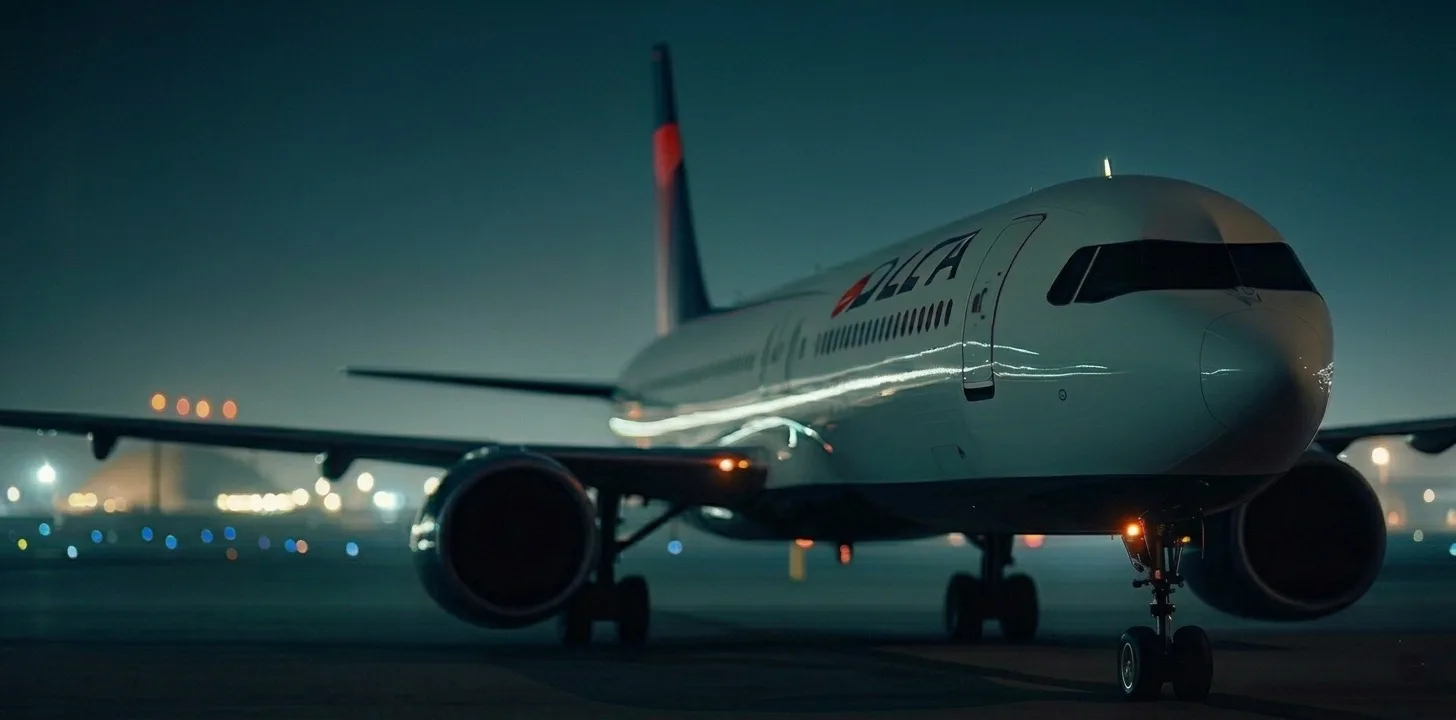
You board a plane in Detroit expecting to wake up in Tokyo. Thirteen hours of ocean, a few films, some broken sleep. Standard. Then, somewhere over the North Pacific in the dead of night, the flight map on your screen shows the plane banking south. Hard. Not towards Japan. Towards Los Angeles. That is what happened when delta flight dl275 diverted lax on the night of 27 May 2025, in one of the most discussed aviation incidents of that year.
No one was hurt. No emergency was declared. The aircraft landed safely, the passengers were rebooked, and the plane returned to service the next day. But the story behind that sudden turn reveals how modern aviation safety actually works at 38,000 feet over one of the loneliest stretches of ocean on Earth, and it also reveals how quickly a real event can be distorted online. Several pages published in 2026 present this May 2025 diversion as though it were new, add invented costs, and invent a second diversion that never happened. This article, an update of our earlier post, sets out what is verified, what is not, and what the confusion tells us about reading aviation news.
What Is Delta Flight DL275?
Delta flight DL275, the flight at the centre of the story of delta flight dl275 diverted lax, is Delta Air Lines’ scheduled daily nonstop passenger service from Detroit Metropolitan Wayne County Airport, known as DTW, to Tokyo Haneda Airport, known as HND, in Japan. The operator is Delta Air Lines, a founding member of the SkyTeam alliance, headquartered in Atlanta. The flight still operates daily. FlightAware’s live tracking, checked in November 2026, shows DL275 scheduled with the Airbus A350-900, departing Detroit in the evening and arriving at Haneda the following morning. The typical scheduled duration is around 13 hours and 10 minutes to 13 hours and 35 minutes, over a distance of about 10,323 kilometres.
The aircraft on the diverted flight was an Airbus A350-900, registration N508DN, powered by Rolls-Royce Trent XWB engines. According to Simple Flying, reporting on 27 May 2025 from Flightradar24 and ch-aviation data, N508DN first flew in February 2018 and was delivered in March 2018 on a ferry flight from Toulouse to Atlanta. It was about seven years old at the time, and one of 37 A350 aircraft in Delta’s fleet then. Delta flies the A350-900 in a 306-seat layout, with 32 Delta One suites, 48 Premium Select seats, 36 Comfort+ seats, and 190 Main Cabin seats, and also in a 275-seat layout on some routes. The Trent XWB is the only engine type fitted to the A350.

The Aircraft Behind the Flight
The A350-900 is a long-range wide-body twinjet, built for exactly this kind of route. It carries enough fuel to cross the Pacific with reserves, and it is certified to fly long stretches far from any airport, under rules explained later in this article. The Trent XWB engines are large, efficient turbofans, and the anti-ice system at the centre of this story is part of the engine’s inlet design. Understanding that system is the key to understanding why the crew turned back, because the fault was not in the engine’s power. It was in the system that keeps ice off the engine’s front end.
When Delta Flight DL275 Diverted LAX: What Happened on 27 May 2025
The flight at the centre of the delta flight dl275 diverted lax story began late. DL275 was scheduled to depart Detroit at 14:05 local time on 27 May 2025. The inbound aircraft, operating DL133 from Amsterdam, landed at 13:19, only 46 minutes before the scheduled departure, and the turnaround ran long. The aircraft finally left Detroit at 15:53 local time, almost two hours behind schedule. That delay matters, because it pushed the whole flight later into the night and set up the timing that confused later reports.
The flight crossed the United States and Canada, then headed out over the North Pacific towards Japan. While cruising at 38,000 feet, about 620 nautical miles southwest of Anchorage, Alaska, over the North Pacific and the Bering Sea, the crew detected a fault in an engine anti-ice system. The crew made the decision to turn the aircraft around and divert. The turn took the aircraft back across the Pacific and down the west coast of North America, a journey of about five and a half hours from the decision point to landing.
The aircraft landed safely on Runway 06R at Los Angeles International Airport at 01:08 Pacific time on 28 May 2025, after 12 hours and 15 minutes in the air, and reached the gate at about 01:13. No injuries were reported. The remainder of the flight to Tokyo was cancelled, and the passengers were rebooked on alternative flights. The aircraft stayed on the ground at Los Angeles for about 18 and a half hours before returning to service. Those are the verified core facts, and they are agreed by every serious source that covered the event.
The Real Cause: Why Delta Flight DL275 Diverted LAX
The cause of delta flight dl275 diverted lax was a fault in the engine anti-ice system of a Rolls-Royce Trent XWB engine. That sentence needs unpacking, because it is the sentence most often misreported. It was not an engine failure. The engine kept running. It was not a fire, and it was not a medical emergency. Some early and garbled reports mentioned a medical emergency, and that version is explicitly wrong. The fault was in a protective system, and the crew treated it as a reason to land, not as a reason to panic.
What the Engine Anti-Ice System Actually Does
Jet engines use hot bleed air, taken from the high-pressure compressor and routed to the engine inlet and the lip of the nacelle, to prevent ice forming on the inlet, the fan blades, and the guide vanes. Ice on those surfaces can restrict airflow, and if it breaks off it can damage rotating blades. The system either prevents ice from forming, which is called anti-icing, or melts ice that has already formed, which is called de-icing. A fault in this system over cold oceanic airspace is treated seriously, because the aircraft would continue into icing conditions with degraded protection. The crew cannot simply ignore it and press on to Tokyo. The safe course is to divert to an airport where the aircraft can be inspected and repaired.
Why This Warning Cannot Be Ignored
Over the Pacific, the margin for error is thin. The aircraft was hours from land in every direction, and the weather ahead included the cold, moist air where icing is a real risk. A fault in the anti-ice system does not mean the engine will fail. It means one layer of protection is gone, and the crew cannot be sure the next layer will hold for the remaining hours of the flight. Aviation safety is built on exactly this logic. A single fault is a reason to land. Waiting for a second fault is not an option the system allows.
Why the Crew Chose LAX for Delta Flight DL275 Diverted LAX
Anchorage was geographically closer to the diversion point than Los Angeles, and readers often ask why the crew in the delta flight dl275 diverted lax incident flew past it. Seattle was closer too. Readers often ask why the crew flew past both and continued for hours to LAX, and the answer is a matter of standard operational logic, not a mystery. No source quotes Delta’s actual reasoning for this decision, so what follows is the standard reasoning, labelled as such, not a statement from the airline.
Los Angeles is a major Delta hub, with A350 maintenance capability, spare parts, and engineers who work on the type every day. Anchorage has a runway and a terminal, but it does not have Delta’s A350 maintenance base or the same depth of spare parts. Los Angeles also has many onward connections to Tokyo, which matters when hundreds of passengers need rebooking. A diversion is not only about landing safely. It is about what happens next: getting the aircraft fixed, and getting the passengers to their destination. From a hub, both are far easier. The crew flew five and a half hours to Los Angeles because Los Angeles could solve the problem, and a closer airport might only have postponed it.
The Flight Path Back to LAX
The return journey took the aircraft back across the North Pacific, then down the west coast, arriving over Los Angeles in the early hours of the morning. Emergency services were positioned at the airport as a standard precaution, which is normal for any diversion of a wide-body aircraft and does not mean an emergency was declared. The landing on Runway 06R was uneventful. The aircraft taxied to the gate, the passengers disembarked, and the flight to Tokyo was cancelled rather than delayed, because the aircraft needed inspection and the crew needed rest. Passengers were rebooked on alternative flights to Tokyo.
Complete Timeline: Delta Flight DL275 Diverted LAX
The timeline of delta flight dl275 diverted lax below is drawn from the contemporaneous reporting, principally Simple Flying on 27 May 2025, using Flightradar24 data, and Aviation A2Z on 29 May 2025, citing the Aviation Herald. The flight crossed time zones and the international date line, which is why some later pages get the dates wrong. The dates used here are the local dates at each point.
On 27 May 2025, the inbound aircraft from Amsterdam landed in Detroit at 13:19 local time, 46 minutes before the scheduled 14:05 departure. DL275 actually departed Detroit at 15:53 Eastern time, almost two hours late. The aircraft climbed to its cruising altitude and headed northwest over Canada and out over the Pacific. At about 38,000 feet, roughly 620 nautical miles southwest of Anchorage, the crew detected the engine anti-ice system fault and decided to divert. The aircraft turned south and flew for about five and a half hours towards Los Angeles. It landed on Runway 06R at LAX at 01:08 Pacific time on 28 May 2025, after 12 hours and 15 minutes airborne, and reached the gate at about 01:13. The Tokyo leg was cancelled, passengers were rebooked, and the aircraft remained on the ground for about 18 and a half hours before returning to service.
Two details in that timeline are worth flagging, because other pages get them wrong. The first is the date. One blog, mytravaly.com, says the flight took off at 15:53 on 26 May and landed on 27 May. That is a one-day slip, almost certainly a time-zone and date-line error. The contemporaneous Simple Flying report was published on 27 May 2025 and describes the diversion as having happened “last night”, and Aviation A2Z, published on 29 May 2025, dates the diversion to 28 May. This article uses 27 May for departure and 28 May for landing. The second detail is the landing time. Simple Flying, Aviation A2Z, and other tracking-based reports say 01:08 Pacific time. Two lower-authority blogs say 01:38. The 01:08 figure comes from flight-tracking data in a contemporary report, and it is the better-supported one.
What Passengers Experienced When Delta Flight DL275 Diverted LAX
Honesty requires saying what is not known here about delta flight dl275 diverted lax. No passenger accounts of this flight were found during the research for this update. No interviews, no social media threads, and no first-hand descriptions of the cabin announcement or the mood on board were published in any source checked. This article does not invent what passengers felt, what the captain said, or which hotels they stayed in, because none of that was found.
What is known is the shape of the experience. The passengers boarded in Detroit expecting a thirteen-hour flight to Tokyo. They flew for twelve hours and fifteen minutes and landed in Los Angeles, the city they had left behind hours earlier in a different sense, since Los Angeles was behind them on the map and ahead of them only because the aircraft turned back. The Tokyo leg was cancelled, and the passengers were rebooked on alternative flights. No injuries were reported, which is the fact that matters most.
What Delta Offered Passengers After Landing
Delta’s specific offers to these passengers were not published in any source found, and this article does not invent them. What can be stated is the general legal position, which is verified. Under United States Department of Transportation rules, in force since late 2024, if an airline cancels a flight or makes a significant change, defined as three or more hours for a domestic flight and six or more hours for an international flight, and the passenger chooses not to accept the rebooking or a travel credit, the passenger is entitled to an automatic full cash refund to the original payment method, even on a non-refundable ticket, within seven business days for card payments or twenty days for other payment methods. United States law does not require cash compensation for delays as such. Meals and hotels depend on the airline’s own customer-service plan and the commitments published on the Department of Transportation dashboard. The major United States airlines commit to meals for controllable delays of three or more hours and hotels for controllable overnight delays. European Union Regulation 261 does not apply to a United States domestic diversion, and it does not apply here.
The True Cost of the Delta Flight DL275 Diverted LAX Incident
Several blogs give precise cost figures for delta flight dl275 diverted lax, and every one of them is unsourced. One site claims a breakdown of 332,000 dollars in direct costs, 176,000 dollars in passenger costs, and 1.98 million dollars for the lost Tokyo leg, totalling about 2.3 million dollars. Another says industry estimates place the total cost between 2.0 and 2.3 million dollars. A third says the diversion likely cost Delta over 2 million dollars. No source for any of these numbers is named. None of them comes from Delta, and none of them is presented with a method or a document. They are blog estimates, and this article does not present any dollar figure as a verified fact.
A diversion of a wide-body aircraft is certainly expensive. Fuel is burned on a flight that goes nowhere, a crew times out, an aircraft sits on the ground, and hundreds of passengers need rebooking and accommodation. But the size of that cost cannot be stated from the sources available, and a precise figure with no source is worse than no figure at all. It looks like knowledge and it is not. Readers should treat any exact cost attached to this incident as invented until a named source produces it.
Was Delta Flight DL275 Diverted LAX an Emergency Landing? Setting the Record Straight
No. This is the most important correction in this update about delta flight dl275 diverted lax, because several pages describe the event as an emergency landing, and that phrase implies something that did not happen. Multiple sources agree that no Mayday call was made. The diversion was precautionary, not a declared emergency. Emergency services were positioned at Los Angeles as a standard precaution, which is routine for a wide-body diversion and does not change the classification.
The distinction matters. An engine failure is a different event from an anti-ice system fault. A Mayday is a different call from a precautionary diversion. A medical emergency is a different cause from a technical fault. The reports identify an anti-ice system fault, not a complete engine failure, and they are explicit about that distinction. The flight was not in danger of falling from the sky. It was an aircraft with a degraded protective system, flown by a crew who followed procedure and landed at the best available airport. That is a story about a safety system working, not about a disaster narrowly avoided.
How the Aviation Safety System Worked for Delta Flight DL275 Diverted LAX
The safety system that handled delta flight dl275 diverted lax has several layers, and each one worked. The first layer is the aircraft’s own warning system, which detected the anti-ice fault and told the crew. The second layer is the crew’s training, which told them to divert rather than continue. The third layer is the regulatory framework that allows a twin-engine aircraft to be hours from land in the first place, and that framework is called ETOPS.
ETOPS stands for Extended Operations, and it is the Federal Aviation Administration framework, under 14 CFR 121.161 and Appendix P to Part 121, that governs how far a twin-engine airliner may fly from a suitable diversion airport. The default limit is 60 minutes of single-engine flying time. ETOPS approvals extend this to 120, 180, 207, 240, or 330 minutes, depending on the aircraft, the engines, and the operator. The A350 operates transpacific routes under ETOPS-180 or higher approvals. Every point on the flight plan must stay within the approved diversion time of an adequate airport. The system is designed so that a single fault, such as the one on this flight, never leaves the aircraft with nowhere to go. The crew’s decision to turn back was the system working, not the system failing.
The fourth layer is the airport and the airline. Los Angeles had the runway, the maintenance base, the parts, and the onward flights. The aircraft was inspected, repaired, and returned to service after about 18 and a half hours. The passengers were rebooked. No one was hurt. That is what a functioning safety system looks like from the inside: unremarkable, procedural, and safe.
Is Delta Flight DL275 Still Flying? Status as of 2026
Yes. DL275 continues to operate daily between Detroit and Tokyo Haneda in 2026, and the delta flight dl275 diverted lax incident has not changed that. FlightAware’s live tracking, checked in November 2026, shows the flight scheduled with the A350-900, and tracking data shows the same aircraft, N508DN, operating DL275 again later in 2026, including on 26 July 2026. The aircraft returned to normal service after the diversion, and the flight number was not retired. Airlines do not retire flight numbers after safe diversions, and there was no reason to retire this one.
That continuity is part of why the 2026 confusion matters. Several low-authority pages published in 2026 present the May 2025 event as though it were recent or new, and some add invented 2026 follow-ups: a “manufacturing flaw” in anti-ice valves, artificial intelligence predictive maintenance, and a “full Delta and Airbus investigation”. None of this is sourced. One site even claims a second DL275 diversion to Anchorage in March 2026. That claim appears in only one low-authority source, with no date, registration, cause, or corroborating source, and AirNav Radar’s DL275 history for March 2026 shows normal landings on 11, 12, 15, 17, 18, 20, and 26 March and a cancellation on 19 March, with no Anchorage diversion. This article treats the March 2026 Anchorage diversion as unverified and does not present it as fact. It may be a garbled echo of the May 2025 position detail, 620 nautical miles southwest of Anchorage.
What to Do If Your Flight Is Ever Diverted Like Delta Flight DL275 Diverted LAX
Most passengers will never experience a diversion like delta flight dl275 diverted lax, but the advice is simple and worth knowing. First, stay seated and follow crew instructions. The crew has a plan, and the plan is to land at the best available airport. Second, do not assume the worst. A diversion is a routine safety tool, and technical issues are a common cause. Third, once on the ground, listen for the airline’s rebooking instructions before making your own arrangements, because the airline’s rebooking is usually faster than anything a passenger can arrange alone in the first hour.
Fourth, know your rights. If the flight is cancelled and you choose not to accept the rebooking, you are entitled to an automatic full cash refund under the United States Department of Transportation rule described above. Keep your boarding pass and any receipts, and keep the airline’s messages. Fifth, track the flight yourself. FlightAware and Flightradar24 show diversions in real time, and seeing the flight path on a map is often more reassuring than speculation in the cabin. Finally, remember that a diversion is not a sign of a crash. It is a sign that the system noticed a problem early and dealt with it.
Frequently Asked Questions
What caused delta flight dl275 diverted lax?
An engine anti-ice system fault on a Rolls-Royce Trent XWB engine, detected while the Airbus A350-900 was cruising at 38,000 feet about 620 nautical miles southwest of Anchorage. It was a precautionary diversion. It was not an engine failure, not a Mayday, and not a medical emergency.
When did delta flight dl275 diverted lax happen?
The flight departed Detroit on 27 May 2025 and landed at Los Angeles at 01:08 Pacific time on 28 May 2025, after 12 hours and 15 minutes in the air. Some blogs give the dates as 26 and 27 May, which is a one-day error caused by time zones and the international date line.
How many passengers were on DL275 when it diverted?
No verified passenger count has been published. Several blogs say “over 300 passengers”, but the A350-900 in Delta’s 306-seat configuration can carry at most 306 passengers, so that figure can only be an approximation of a near-full load, not a counted number. This article does not state an exact number of people on board.
Was the DL275 diversion a real emergency?
No. No Mayday call was made, and the diversion was precautionary. Emergency services were positioned at Los Angeles as a standard precaution, which is routine for a wide-body diversion. The safety system worked as designed, and no injuries were reported.
Why did the pilots choose LAX over Anchorage?
Anchorage was geographically closer, but Los Angeles is a major Delta hub with A350 maintenance capability, spare parts, and many onward connections to Tokyo. No source quotes Delta’s actual reasoning, so this is presented as standard operational logic, not as the airline’s stated reason. A diversion is about what happens after landing as well as the landing itself.
How much did the diversion cost Delta Air Lines?
No verified figure exists. Blogs quote figures between 2 million and 2.3 million dollars, with one site giving a precise breakdown, but no source is named for any of them. They are unsourced estimates, and this article does not present any dollar figure as fact.
Is delta flight dl275 diverted lax still happening in 2026?
No. The diversion happened in May 2025. DL275 continues to operate daily between Detroit and Tokyo Haneda in 2026. Several 2026-dated pages repackage the 2025 event as though it were new, and one site claims a second diversion to Anchorage in March 2026, which is unverified and contradicted by tracking data.
Can passengers track a flight diversion in real time?
Yes. FlightAware and Flightradar24 show live flight paths, and the DL275 diversion was first reported from Flightradar24 data on the day it happened. Watching the flight path on a map is often more informative than waiting for announcements.
Final Words
Delta flight DL275 diverted lax on a May night in 2025 because a protective system failed and a crew followed procedure. The aircraft landed safely, the passengers were rebooked, and the plane was back in service within a day. That is the whole story, and it is a good story, because it is a story about a safety system that noticed a problem early and dealt with it. The confusion that grew around it, the 2026 dates, the invented costs, the invented second diversion, and the invented passenger counts, is a second story, about how quickly a real event can be distorted by pages that copy each other without checking.
The useful lesson is to date the event, name the source, and refuse the detail that has none. A diversion is not a disaster. A precautionary landing is not an emergency. And a precise number with no source behind it is not a fact. Learn more about how aviation safety standards are set and maintained by visiting the ETOPS and long-range operations framework on Wikipedia. Read More: Kotora Melnkalne: The Complete Guide to Kotor, Montenegro’s Most Captivating Destination