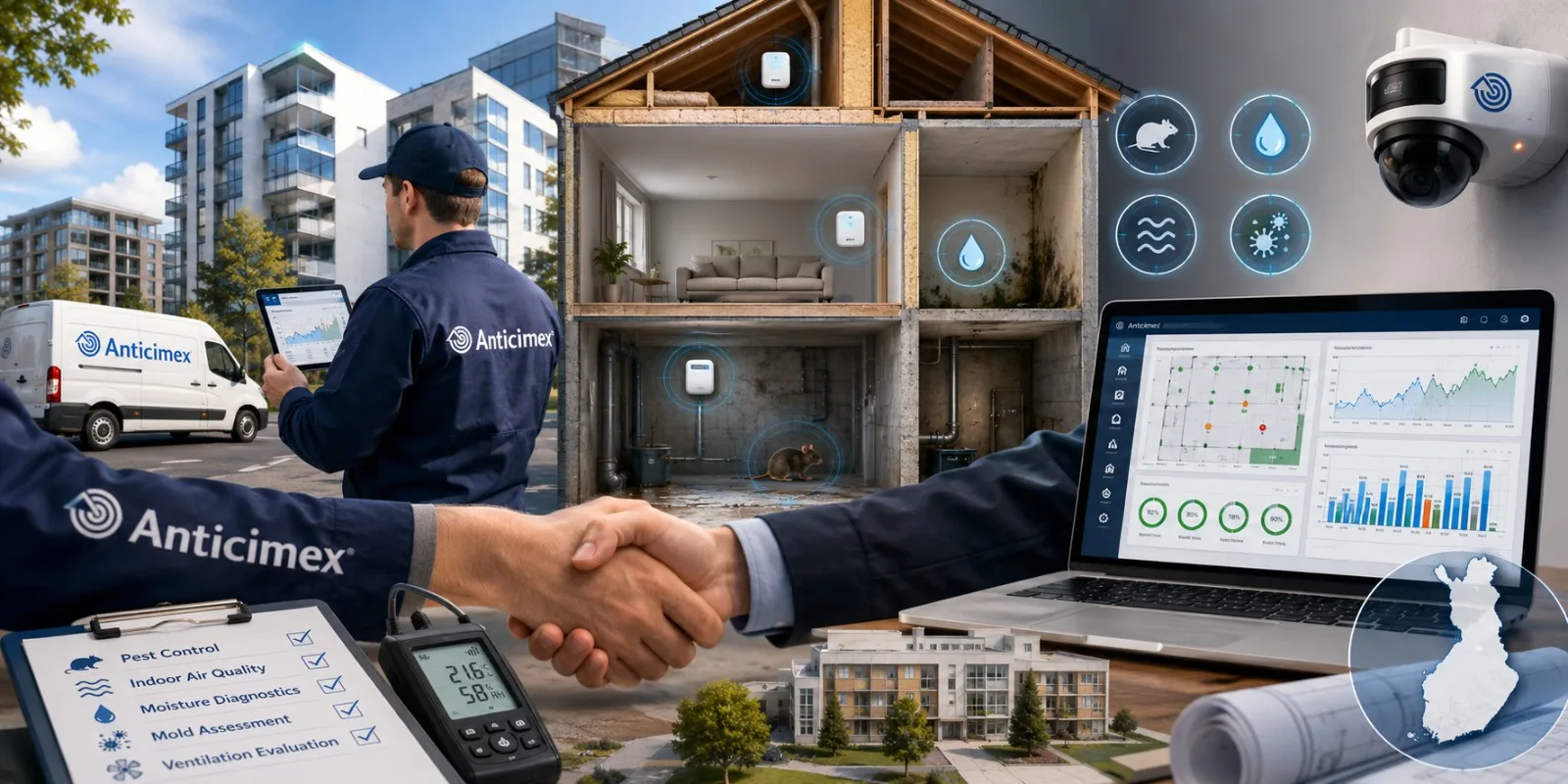
If you manage a building in Finland, one acquisition changed your service market in a way that still shapes it today. On March 1, 2016, Anticimex Oy completed the purchase of Indoor Quality Service Oy, known widely as IQS, and that single deal, the Anticimex Oy Indoor Quality Service Oy Yritysostot, created Finland’s most integrated building health operator overnight.
Before this deal, property managers juggled separate pest control companies, air quality surveyors, and moisture specialists. Three contracts, three sets of reports, and no shared accountability sat between a manager and a healthy building. In this guide, you will see what the Anticimex Oy Indoor Quality Service Oy Yritysostot actually delivered, and how to use its lessons when you choose a provider today.
Why the Anticimex Oy Indoor Quality Service Oy Yritysostot Matters to You
Most property managers hear about corporate acquisitions and move on, and that is fair enough when the deal changes nothing on the ground. This one deserves your attention, because it reshaped the whole Finnish building health market in ways that still affect every property contract signed today.
Finland’s indoor environment rules are among the strictest in Northern Europe, and building owners must show active compliance with indoor air quality standards, not simply claim their buildings are safe. The Finnish Institute for Health and Welfare, known as THL, publishes guidance that public buildings, schools, and healthcare facilities must meet and document, and that pressure has only grown stronger since 2016.
What makes the Anticimex Oy Indoor Quality Service Oy Yritysostot worth studying is the timing, because it arrived just as that demand was rising and answered it with integration rather than fragmentation.
Fact 1: The Anticimex Oy Indoor Quality Service Oy Yritysostot Is a Real, Verified, Dated Transaction
Some corporate stories are vague, with no date and no clear outcome, and that vagueness makes them useless for a manager who needs facts. This one is different, because it has a precise date, a verifiable target, and documented outcomes that you can check.
The Exact Deal Details
Anticimex Oy announced and completed the full acquisition of Indoor Quality Service Oy on March 1, 2016. All ten IQS employees transferred directly to Anticimex on that date, and all operations, client relationships, and service capabilities moved across immediately, with no phased handover stretching over months.
At the time, IQS was the third largest pest control company in Finland. Founded in 2005, it had spent eleven years building a strong reputation, above all among public sector organisations, housing associations, and commercial property operators across the Helsinki metropolitan area and southern Finland. That reputation was built on indoor air quality work, not just on pest control, and that is what made the target so valuable.
Why Anticimex Chose This Specific Target
Anticimex Oy is the Finnish arm of Anticimex Group, founded in Sweden in 1934 and headquartered in Stockholm. Its 2025 report puts the group at 22 countries with more than 12,000 employees and revenue of SEK 17.1 billion in 2025. In Finland, the group’s base sits in Vantaa, and at the time of the deal it ran 13 service points and carried out around 50,000 customer visits per year.
Behind that growth sits a clear owner. EQT VI acquired 100 percent of Anticimex Group in 2012 from the Swedish listed firm Ratos, for about SEK 2.7 billion, and EQT has remained the majority shareholder since. Under EQT, the group has completed more than 350 acquisitions worldwide using a disciplined buy and build model.
Turns out, the Anticimex Oy Indoor Quality Service Oy Yritysostot targeted IQS for its deep expertise in indoor air quality assessment, mold diagnostics, ventilation evaluation, and moisture measurement, capabilities Anticimex could not have built on its own without years of investment.
What the Buy-and-Build Model Means for Property Managers
The buy and build model works in four stages. First, Anticimex finds a target with a strong local reputation and capabilities that fit its own gaps. Second, careful due diligence checks the finances, the workforce, and how hard integration will be. Third, integration starts gently, so IQS kept working in a familiar way and client trust was preserved. Fourth, Anticimex extends its SMART digital monitoring across the acquired company’s network.
For property managers, this model matters because it means every Anticimex acquisition adds service depth you can actually use, not just size on a balance sheet. The buy and build approach has kept going since 2016, with the group entering Texas in 2025 and Environmental Pest Management in Ohio joining Anticimex in October 2026, so the pattern that started with IQS is still the group’s main way of growing.
Fact 2: The Anticimex Oy Indoor Quality Service Oy Yritysostot Solved a Problem Most Property Managers Do Not Know They Have
Here is the fact that changes how you think about building health, and it is the heart of the whole deal. The Anticimex Oy Indoor Quality Service Oy Yritysostot was strategically powerful because it connected two problems that most property managers treat as completely separate, and they are not.

The Root Cause Most Managers Miss
Pest infestations and poor indoor air quality share identical root causes in Finnish buildings, and those causes are easy to name. Excess moisture, poor ventilation, and structural dampness sit behind both problems, and when these conditions exist inside a building, three problems develop at the same time.
- Mold grows on cold surfaces where condensation collects
- Indoor air quality falls as mold spores and volatile organic compounds move through ventilation systems
- Pest activity rises because rodents, cockroaches, and insects are drawn to moisture, warmth, and the structural decay that dampness speeds up
A manager who calls a pest control company and a separate air quality surveyor treats two symptoms of one problem. The exterminator removes the infestation, the surveyor finds the air quality failure, and neither fixes the moisture source driving both, so the problems come back.
Why Finnish Buildings Face This Problem at Scale
Finland’s climate creates building health conditions few other European markets face at the same intensity. Long cold winters demand tightly sealed building envelopes, and that sealing cuts natural air exchange sharply. Moisture from cooking, bathing, breathing, and groundwater then gathers inside the building fabric with nowhere to escape.
Finnish buildings built before 2000 carry a particularly high moisture risk, and energy efficiency retrofits have made it worse in many cases, by sealing older buildings more tightly without upgrading ventilation to match. What looks like a saving on heating can turn into a bill for mold repair.
How IQS Expertise Addressed the Root Cause
Indoor Quality Service Oy specialised in exactly this root cause analysis, and that is what made the acquisition so valuable. IQS technicians were trained to assess ventilation performance, measure structural moisture content, find condensation risk zones, and trace the origin of air quality failures, rather than just treating what was visible.
When the Anticimex Oy Indoor Quality Service Oy Yritysostot brought this expertise into Anticimex, the company gained the ability to approach buildings as complete systems. The same team investigating a rodent problem could also check whether the moisture attracting those rodents was harming indoor air quality, and fixing that root cause once costs far less than treating symptoms again and again.
Fact 3: The Anticimex Oy Indoor Quality Service Oy Yritysostot Replaced 3 Separate Contracts With 1 Integrated Service
Before the Anticimex Oy Indoor Quality Service Oy Yritysostot changed the Finnish market in March 2016, property managers in Finland handled building health through three separate service providers, one for pest control, one for indoor air quality surveys, and one for moisture and mold inspections. This was justified because the problems were genuinely different, but it was also deeply inefficient.
The Fragmented Market Before 2016
Picture a housing association managing a residential block in Espoo. Moisture appears in the basement wall. The manager must call a pest control company for the cockroaches that appear shortly after, an air quality surveyor for the complaints from residents about headaches and musty odours, and a moisture specialist to find the source of the dampness. Three phone calls, three site visits, three reports, and three invoices that all address a single underlying problem.
Three contracts meant three call out fees, three different report formats, and three technicians who never spoke to each other. The manager acted as an unpaid coordinator between companies, trying to reconcile conflicting recommendations from providers working in isolation.
What Integration Delivers in Practice
Integration changed that picture in practical ways. Instead of three providers, there is one integrated service backed by a nationwide network, and the comparison is clear.
- One integrated contract replaces three separate service providers
- One unified building health report replaces three disconnected inspection reports
- A single site visit covers all assessments, instead of duplicate call out fees per visit
- Findings are cross referenced across all disciplines, instead of no shared diagnostic information
- One named contact is responsible for the complete outcome, instead of no single accountability for the outcome
- Preventive monitoring catches problems before they develop, instead of reactive treatment after damage is already done
The saving in coordination costs is easy to measure, but the more important benefit is diagnostic, because a single integrated team can connect conditions across disciplines in ways that separate providers simply cannot.
Who Benefits Most From This Integration
Housing associations managing several residential blocks gain consistent reporting across their whole portfolio, instead of different reports from different providers for every building. That consistency makes insurance claims easier to support and gives boards clear numbers for capital planning decisions.
Commercial property managers gain bundled service contracts with outcome based guarantees rather than separate contracts that only cover individual services. Office buildings, retail centres, and industrial properties all benefit from a single point of accountability and a unified reporting format.
Fact 4: The Anticimex Oy Indoor Quality Service Oy Yritysostot Accelerated a Technology Shift That Was Already Coming
When the Anticimex Oy Indoor Quality Service Oy Yritysostot brought IQS expertise into Anticimex, the timing lined up with a bigger industry change that was already under way, and the deal moved it forward faster. The shift was from reactive pest control to continuous digital monitoring, and understanding it helps you judge what a modern provider can actually deliver.

Understanding the SMART System
SMART is Anticimex Group’s proprietary continuous monitoring system, and its core idea is simple, place sensors where pests and moisture cause trouble, let them watch day and night, and act when the data changes. The system uses sensors, a digital platform, and remote monitoring that sends alerts directly to a technician so a problem can be addressed before it becomes visible damage.
Traditional pest management was entirely reactive. A problem appeared, someone noticed it, they called a technician, and the damage had usually already happened. A fixed service visit every quarter arrived on schedule whether anything was wrong or not, and between those visits no one was checking the building at all, which was more a system of checking dates than of managing risk.
SMART turns this model around. Sensors detect early signals, such as temperature anomalies and humidity spikes, and raise alerts the same day rather than months later. That means a technician can investigate at the earliest sign of a problem, when the intervention is cheapest and the impact smallest, rather than after a full blown infestation.
Much of the hardware comes from WiseCon, the Danish specialist in smart pest monitoring whose technology powers the SMART system. Anticimex acquired WiseCon in 2019, and the acquisition strengthened Anticimex expertise in digital hardware design and sensor based pest detection across Europe, while local teams in Denmark, Spain, and the UK extend its reach.
How IQS Knowledge Made SMART More Powerful
Before the Anticimex Oy Indoor Quality Service Oy Yritysostot, SMART monitoring focused mainly on pest activity, but the acquisition added indoor air quality expertise that made the data far richer. IQS knowledge meant sensors could be placed not only close to likely pest entry points but also near ventilation systems, moisture prone areas, and occupancy patterns, so early warnings reached managers before a problem had time to spread.
The combination created a monitoring system that gives integrated early warnings, such as a zone showing a humidity spike alongside an increase in pest movement alerts, which tells a technician that a moisture source is developing without a need to guess. That diagnostic precision is only possible when pest control and indoor air knowledge are combined inside a single platform, and the Anticimex Oy Indoor Quality Service Oy Yritysostot is what made that combination possible.
What This Means for Your Daily Building Management
Property managers with Anticimex contracts access live building health data rather than waiting for quarterly reports, and that changes the role from reacting to events to shaping decisions. Instead of choosing between pest control, indoor air assessment, and moisture monitoring, managers see one dashboard that integrates all three with a single contract, a single invoice, and a single point of contact.
This shifts the manager’s role from reactive problem solver to preventive decision maker. Instead of copying three providers’ reports into a single spreadsheet each quarter, managers compare trends over time and track building performance with automatic records of what was inspected, found, and fixed which supports compliance with Finland’s strict documentation requirements and makes the manager’s job much easier.
Fact 5: The Anticimex Oy Indoor Quality Service Oy Yritysostot Created Automatic Compliance Documentation
Of all five facts covered here, this one carries the most immediate legal and financial weight for people who manage buildings. While Fact 1 proved this deal happened and Fact 3 showed the cost benefit, Fact 5 shows the paperwork advantage that turns integration into protection.
Finland’s Regulatory Demands Are Not Optional
Finnish property law requires building owners to show active compliance with indoor environment standards, and documented evidence has become a requirement, not an option. THL publishes detailed guidance on healthy indoor environments, and any property owner providing an indoor environment for people must be able to show compliance in a documented form.
Managers who cannot produce documented evidence of monitoring, assessment, and remediation face real consequences. Municipal health inspectors can demand improvement, tenants can start a legal challenge, and insurers may adjust terms or refuse coverage. The ability to show records is not a nice extra, it is a basic protection for a building owner.
How Integration Solved the Documentation Problem
Before the Anticimex Oy Indoor Quality Service Oy Yritysostot, building a complete compliance trail meant gathering records from separate companies and combining them by hand. The pest control report arrived separately from the indoor air quality assessment, and the moisture inspection report added a third set of dates, formats, and terminology. A manager trying to show a complete picture typically had missing records, conflicting timelines, and incomplete data for a formal file.
The integrated model removes that burden. Because pest management, air quality monitoring, mold assessment, and moisture monitoring sit within one service and one digital system, every record goes into the same platform automatically, creating a unified trail that covers the whole building health activity without manual collation.
The 3 Compliance Advantages That Matter Most
- Audit ready records: Digital monitoring data logs automatically with timestamps, creating audit ready records that a health inspector can check without difficulty.
- Regulatory credibility: A single certified provider covering pest control and indoor environment work gives an inspector confidence in the quality of the records supplied, because a single company is accountable for the full picture.
- Insurance risk reduction: Documented preventive monitoring supports negotiations with property insurers, showing a clear system for maintaining indoor environment standards, which helps keep insurance terms stable.
The Competitive Landscape the Anticimex Oy Indoor Quality Service Oy Yritysostot Changed
To understand the Anticimex Oy Indoor Quality Service Oy Yritysostot, you need to see the market around it. Before the deal, the Finnish pest control sector was fragmented and price led, and no established provider had combined deep pest control expertise with indoor air quality knowledge at scale. The deal changed that and set the standard for what a major provider could offer in other countries too.
The main competitors in the Finnish market include Antitec Oy and Pest1 Oy among domestic operators, alongside the global Anticimex Group itself. Antitec focuses on pest control and indoor environment services, while Pest1 positions itself through competitive pricing and fast response. The arrival of the integrated Anticimex model raised the bar that both now have to reach, because a customer comparing a single provider against a combined solution finds it hard to justify fragmentation.
For property managers, this consolidation brings clear benefits, because a market with a credible integrated provider makes it easier to find what you need, to hold one company accountable for building health outcomes, and to plan facility budgets with confidence because service costs become easier to predict when bundled under one contract.
What Every Property Manager Should Do With This Information
Knowing about the Anticimex Oy Indoor Quality Service Oy Yritysostot is useful, and acting on it is better. Here are the specific steps every property manager can take, whether the building is a single apartment block or a portfolio of commercial properties.
Review your current service contracts. If you hold separate contracts for pest control, air quality assessment, moisture monitoring, and mold inspection, map the combined cost and the coordination time you spend because you are the unpaid link between them.
Demand unified documentation. Ask what compliance documentation your provider produces and whether pest management, indoor air, and moisture records arrive in one system with consistent dates and formats. If your provider cannot produce that, it is not meeting the modern standard.
Assess your building’s moisture profile. Finnish buildings built before 2000 carry higher moisture risks, and energy retrofits can make them worse. A moisture assessment today is cheaper than a mold remediation tomorrow.
Understand your specific regulatory obligations. If you manage a school, healthcare facility, or other public building, the indoor environment requirements are stricter and documentation is more closely checked. Knowing your obligations now prevents a compliance failure later.
What the Anticimex Oy Indoor Quality Service Oy Yritysostot Tells Us About the Future of Building Health
The Anticimex Oy Indoor Quality Service Oy Yritysostot was completed in 2016, but its implications are still unfolding, because the trends it accelerated by integrating pest control with indoor air quality are continuing. A smart integrated service model is becoming the industry standard, not a niche experiment, and property managers who catch up now will benefit from cheaper monitoring, faster detection, and a single point of accountability.
The five facts in this article point to one reality. Managers who protect their buildings best stop treating pest control and indoor air as separate problems. They now see the same root cause sitting behind both, they recognise that a single integrated system protects better than three separate providers, and they measure their providers by the quality of the records they produce, not by how low their prices look.
What makes the Anticimex Oy Indoor Quality Service Oy Yritysostot a lasting reference point is not the size of the deal, but the logic behind it. It proved that treating buildings as integrated systems rather than collections of isolated problems gives managers better protection at lower total cost, and that principle applies to every property manager, whether the portfolio is one apartment block or a commercial portfolio spanning all of Finland.
Frequently Asked Questions
Here are the questions property managers ask most about this deal.
What exactly is the Anticimex Oy Indoor Quality Service Oy Yritysostot?
It is the acquisition of Indoor Quality Service Oy by Anticimex Oy, completed on March 1, 2016. You can verify the date and the details in Anticimex official announcements and the Finnish trade register, which lists the company transfer as completed on that day. Ten employees, all operations, and all client contracts moved to Anticimex on the same date.
Why should property managers care about this 2016 corporate deal?
The Anticimex Oy Indoor Quality Service Oy Yritysostot directly changed who provides what services in Finland. Before the deal, managers had to coordinate separate contracts for pest control, indoor air, and moisture monitoring, and none of them talked to each other. Integration means one owner of building health, plus documented evidence that makes regulators, insurers, and tenants easier to satisfy.
What was Indoor Quality Service Oy before the acquisition?
IQS was founded in 2005 and grew to become the third largest pest control company in Finland by 2016. Its real strength lay in indoor air quality expertise, including ventilation evaluation, moisture measurement, and mold diagnostics, developed for public sector and housing association clients across southern Finland. Anticimex acquired the company specifically to add this expertise to its own offerings.
How many employees did Anticimex gain through this deal?
Ten IQS employees joined Anticimex directly on March 1, 2016. These were experienced technicians and assessors whose skills in indoor air quality and moisture measurement gave Anticimex a strong team overnight, avoiding the need to recruit and train new staff, establish new processes, or build capabilities on its own.
Does an integrated service model cost more than using separate providers?
Not necessarily. Once you add up call out fees, report charges, and coordination time across separate providers, the total often comes out higher than one integrated contract. Managers report saving time, reducing paperwork, and avoiding duplicate inspection fees, which makes the model financially attractive even when the single contract looks more expensive on the surface.
How does this acquisition affect compliance documentation for property managers?
The Anticimex Oy Indoor Quality Service Oy Yritysostot created an integrated platform where all activities sit in one digital system, so monitoring, inspection, and remediation records appear in a unified format automatically. That makes compliance documentation much easier to supply than gathering separate reports from three companies with different dates and formats.
Who are Anticimex’s main competitors in the Finnish market?
The main competitors include Antitec Oy and Pest1 Oy among domestic operators, alongside the global Anticimex Group itself. Antitec focuses on pest control and indoor environment services, while Pest1 positions itself through competitive pricing and fast response. The integrated Anticimex model has set the standard both must reach.
Is Anticimex’s acquisition strategy continuing beyond this deal?
Yes. Anticimex Group has completed more than 350 acquisitions globally since EQT became its majority shareholder in 2012, including 35 new acquisitions in 2025 alone. The group entered Texas in 2025, and Environmental Pest Management in Ohio joined Anticimex in October 2026. The buy and build approach remains the group’s core growth strategy.
What Finnish regulations are most relevant to indoor environment management?
The Health Protection Act, Terveydensuojelulaki, sets health based housing requirements, and THL guidance translates those requirements into practical indoor air quality standards. Municipal health inspectors use these standards when they assess buildings, so managers need documented evidence of compliance if they want to avoid improvement orders and legal action.
What should a property manager do first after reading this?
Review your contracts and check whether you have separate providers for pest control, air quality, and moisture monitoring. If so, map the combined cost and the coordination time you spend between them, and consider whether one integrated provider would deliver better outcomes at lower total cost. Then check that provider’s documentation quality and monitoring capabilities, because the details matter when you need to defend your building health record.
A Final Word for Property Managers
The Anticimex Oy Indoor Quality Service Oy Yritysostot is more than a business case study, it is a lesson in how companies grow by solving problems users actually have. Anticimex did not buy a competitor to eliminate it, it bought a capability that made its own offer stronger, and that logic has rippled through the Finnish building health market for a decade.
The acquisition of Indoor Quality Service Oy by Anticimex gave Finnish property managers access to integrated pest control and indoor air quality, automatic compliance documentation, and data driven preventive building management, all of which simply did not exist in the market before March 2016. The deal proved that a single point of accountability produces better outcomes than three separate providers working independently.
Learn more about corporate acquisition strategy through the mergers and acquisitions entry on Wikipedia.



One thought on “Anticimex Oy Indoor Quality Service Oy Yritysostot: 5 Powerful Facts Every Property Manager Must Know”