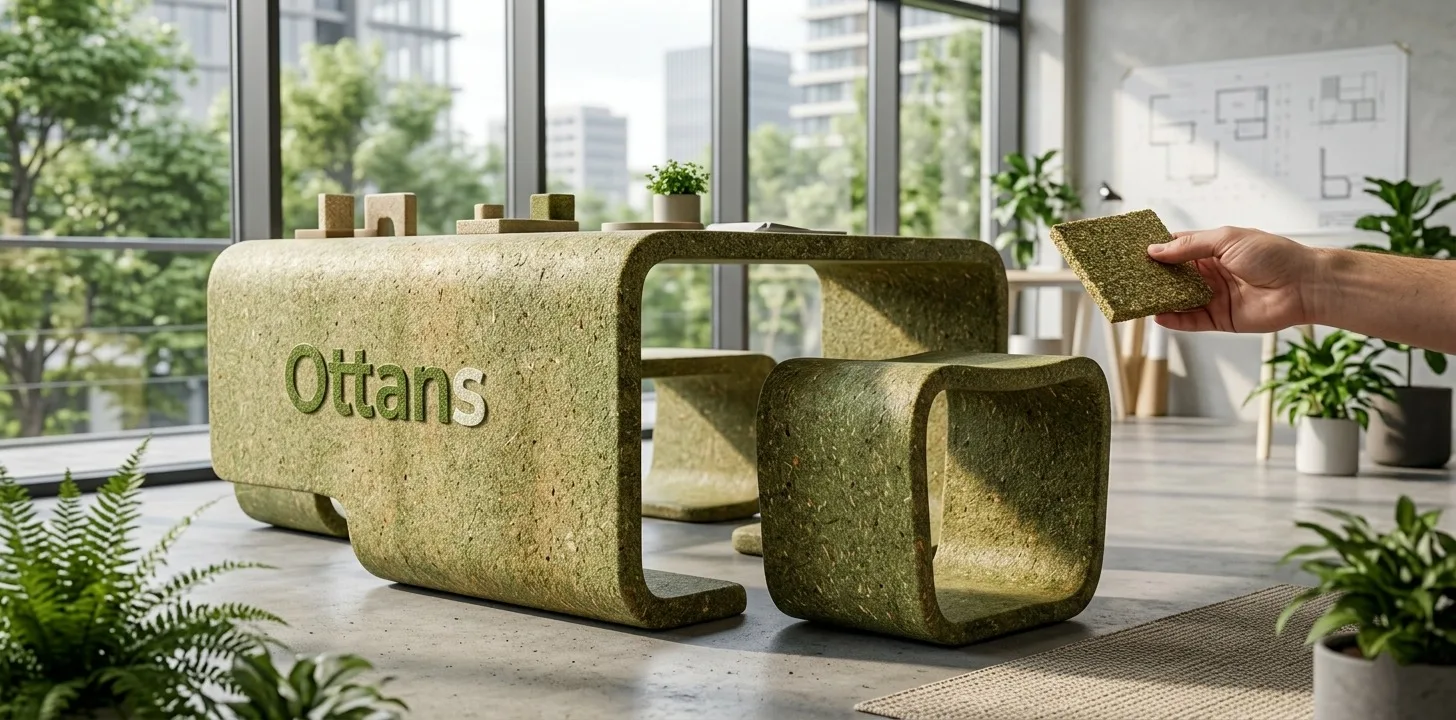
Every few years, a material comes along that quietly changes how designers think. In 2026, that material is Ottans. It starts with waste , eggshells, hazelnut skins, orange peels, expired lentils , and ends up as a polished architectural surface that Porsche, Nestlé, and Google have already trusted inside their spaces. If you’ve heard the word “Ottans” and wondered what it really means, here is the full story. And if you haven’t heard it yet, you’re about to understand why you will.
What Are Ottans? The Clear Answer in Under 60 Words
Ottans refers to the sustainable bio-composite materials produced by Ottan Studio, a green-tech startup founded in 2018 in Istanbul, Turkey. The company upcycles food and agricultural waste , including eggshells, pistachio shells, hazelnut shells, expired rice, orange peels, and coffee pulp , into durable, visually striking surfaces used for furniture, wall cladding, countertops, and architectural interiors. It is a circular design in its most practical and beautiful form.
The Origin Story: How a Tangerine Peel Changed Everything
A Student’s Frustration That Became a Movement
Ayşe Yılmaz was studying Industrial Product Design at Istanbul Technical University when she hit a wall most design students know well. The materials available for her projects felt wrong. They came from forests that were shrinking. They were made with chemicals she couldn’t stand behind. They felt disconnected from the natural world she loved.
So she started experimenting at home. She collected fallen leaves, flower petals, fruit peels, and mango skins. She pressed them. She mixed them. One day, while working with mandarin peels, something clicked. The material she held in her hands was strong, smooth, and beautiful. More importantly, it was made from something that would have been thrown away.
That discovery did not stay in her apartment. By 2018, Yılmaz had turned it into Ottan Studio, an Istanbul-based green-tech company with a mission to replace wood, stone, and plastic with bio-composite materials made from waste. Her co-founder Saadet joined the company around 2020, and together the two women have built Ottans into one of the most talked-about sustainable material brands in the design world.
The Problem That Made Ottans Necessary
The numbers behind Ottans are not invented for drama. They are real and alarming. According to Yılmaz, the world currently extracts natural resources at a rate 75% higher than the Earth can sustainably replenish. The housing and construction industry alone accounts for 40% of all material extraction globally. Meanwhile, roughly 1.3 billion tonnes of food go to waste every year , equal to one-third of total global food production.
At the same time, an area equivalent to 40 football fields of woodland is destroyed every single minute due to timber demand from the furniture and construction sectors. Experts warn that at current rates, all forests could disappear within the next 100 years. Ottans is a direct, material response to these facts.
The Founder: Ayşe Yılmaz
| Detail | Information |
| Full Name | Ayşe Yılmaz |
| Role | Founder and CEO, Ottan Studio |
| Education | Industrial Product Design, Istanbul Technical University |
| Company Founded | 2018, Istanbul, Turkey |
| Co-founder | Saadet (joined circa 2020) |
| Notable Awards | Women in Innovation Award; Global ESG Award; UK Women in Green Business Awards 2024 finalist (Clean Technology Innovator of the Year) |
| Notable Collaborators | Nestlé, Google, Hilton, Porsche, Emaar, Migros |
| Headquarters | Muellif Sok. 8/4, Sishane, Istanbul, Turkey |
Yılmaz has spoken at Global PropTech Online, been nominated for the BIG SEE Product Design Perspective Award in 2025, and is widely cited as a leading voice in circular materials and bio-based design. She lectures internationally and describes her core inspiration as biophilia , the human instinct to stay connected to living nature.
How Ottans Materials Are Actually Made
Step 1: Collecting the Right Waste
The Ottans process starts at the source. Yılmaz and her team source raw waste directly from food producers, agricultural companies, and municipalities across Turkey. They have also established a social enterprise partnership that handles waste transport from food producers nationwide, ensuring a reliable supply of more than two dozen different waste types.
The materials they collect include:
- Hazelnut, pistachio, and walnut shells
- Eggshells
- Expired rice, lentils (yellow, red, and kidney), and beans
- Orange and coffee pulp
- Fallen palm and autumn leaves
- Carrot peels and purple carrot dye extract
Each source material has its own mechanical and visual properties. Walnut shells produce a dark, durable surface ideal for flooring. Eggshells create a creamy, almost ceramic-like panel. Hazelnut shells result in a rich brown material with a warm grain. Orange peels, when burned and combined with expired rice, create RBOL , one of Ottans’ most striking signature materials.
Step 2: Processing and Binding
Once collected, the waste is cleaned, dried, and ground into fine particles. These particles are then combined with green resins , eco-friendly, low-toxicity binders , and injected or pressed into molds. The heat and pressure applied during this stage transform what was once garbage into solid, smooth, technically precise surfaces.
Step 3: Shaping Into Final Products
The finished Ottans sheets can be cut, polished, routed, or bent into almost any shape. This flexibility is what makes Ottans so attractive to architects and designers. It can behave like stone on a countertop, like wood on a shelf, or like ceramic on a wall. Each sheet is unique because no two batches of organic waste look exactly the same.
The 9 Signature Ottans Materials You Should Know
Understanding the Ottans range helps explain why so many global brands have adopted it. Each material has a name that reflects its source.
| Material Name | Source Waste | Key Properties | Best Applications |
| Nutty | Hazelnut shells | Rich brown, opaque, waterproof | Wall coverings, countertops, furniture |
| Eggy | Eggshells | Cream/white, opaque, waterproof | Bathroom surfaces, wall panels, tabletops |
| RBOL | Orange peels + expired rice | Warm amber, luminous finish | Statement panels, decorative surfaces |
| Autumn Leaf | Fallen palm/seasonal leaves | Green-toned, organic texture | Accent walls, decorative objects |
| Bean Peel | Legume husks and skins | Speckled, earthy tones | Shelving, interior furniture |
| Coffee Ground | Coffee pulp and spent grounds | Dark brown, matte | Office interiors, hospitality surfaces |
| Pistachio | Pistachio shells | Pale green and ivory tones | Feature walls, cladding |
| Carrot Dye | Purple carrot extract | Deep violet pigmentation | Decorative and accent applications |
| Grass Panel | Mowed seasonal grass | Soft, acoustic properties | Acoustic wall panels, office spaces |
Ottans in Real-World Projects: The Names Speak for Themselves
One of the most common questions people ask about Ottans is whether it actually works at scale. The answer is documented in some of the world’s most recognisable brand projects.
Nestlé and Pistachio Bookshelves
Nestlé’s Damak brand , famous for its pistachio chocolate , produces significant quantities of pistachio shell waste. Ottan Studio partnered with Nestlé to collect those shells, turn them into bookshelves, and donate the finished products to schools in Turkey. This single project captured what Ottans does at its best: it takes industrial waste that a corporation would otherwise discard, gives it a second life, and creates social value in the process.
Ottolenghi’s Test Kitchen by StudioMama
StudioMama, one of the UK’s most respected design studios, specified Ottans materials for the Test Kitchen project commissioned by the celebrated chef Yotam Ottolenghi. The natural colours and textures of Ottans surfaces fit the kitchen’s identity perfectly. The project was nominated and awarded by Dezeen, one of the world’s leading architecture and design publications, bringing Ottans global recognition in the design community.
Nespresso’s “Local Touch” Coffee Corner
Nespresso HQ commissioned a coffee corner designed entirely from Ottans materials, built around the theme of “Local Touch.” The project demonstrated that Ottans can deliver a cohesive, branded interior environment at a global brand’s headquarters.
Porsche’s 2030 Automotive Line
Perhaps the most striking validation of Ottans’ technical credibility came from Porsche. The German automaker selected Ottans bio-composite materials , derived from coffee pulp, eggshells, walnut shells, lentils, and purple carrot dye , for the interiors of its 2030 automotive line. By replacing conventional plastics, veneers, and composites, Ottans proved it can meet the durability, performance, and luxury standards of the automotive industry. This milestone positions Ottans not just as a design curiosity but as a serious industrial material.
Why Ottans Outperforms Traditional Materials on Every Important Axis

Environmental Performance
Wood requires 30 years to grow. A tree produces new leaves every single year. Ottans uses those leaves instead of the tree itself. For every product sold, Ottan Studio also plants 70 new tree saplings. Yılmaz has stated that if just one in four trees were processed this way rather than being cut down for timber, deforestation could theoretically be reversed within a decade.
Traditional materials like MDF, acrylic solid surface, and synthetic laminates depend on petrochemicals, involve energy-intensive manufacturing, and often release volatile organic compounds inside buildings. Ottans uses zero virgin raw materials and significantly lower processing energy.
Aesthetic Distinction
Synthetic surfaces are uniform. That is their selling point and their weakness. They look the same everywhere. Ottans looks like nothing else in the world because no two batches of organic waste are identical. A hazelnut panel from one batch will have slightly different grain, colour depth, and speckle pattern than the next. For designers and clients who want authenticity, this variation is not a flaw. It is the product.
Health and Indoor Air Quality
Because Ottans uses no synthetic chemicals beyond green-binding resins, it contributes to healthier indoor air quality. This matters enormously in 2026. The World Health Organization has highlighted indoor air pollution as a significant public health concern, with off-gassing from conventional furniture and building materials identified as a contributing factor. Ottans addresses this directly.
Ottans and the Architecture of a Circular Future
What the Circular Economy Actually Means for Buildings
The term “circular economy” gets used loosely, but in the context of building materials it has a specific meaning. In a circular model, materials are never discarded , they are reused, repurposed, or broken back down into their constituent parts. Traditional construction is the opposite of this. Buildings are built with materials that cannot be recovered, and demolished with materials that go straight to landfill.
Ottans fits directly into circular economy logic. When an Ottans panel reaches the end of its useful life, its organic composition makes it far more compatible with biodegradation or composting than a synthetic alternative. The materials were waste at the start and will be manageable waste at the end.
Ottan Studio aligns its work explicitly with the United Nations Sustainable Development Goals and Agenda 2030. Their production model demonstrates how a single company can simultaneously address food waste, deforestation, plastic reduction, and resource overconsumption with one product line.
Ottans in Green-Certified Buildings
Architects working toward LEED, BREEAM, or WELL certification increasingly need to demonstrate that the materials they specify are low-emission, sustainably sourced, and responsibly manufactured. Ottans checks each of these boxes in a way that synthetic alternatives cannot. As green building standards tighten globally, materials like Ottans shift from being “interesting choices” to being the obvious, compliant ones.
Ottans Across Industries: Where It Is Already Being Used
Architecture and Interior Design
Wall cladding, ceiling panels, decorative surfaces, reception desk tops, stairwell accents , Ottans works across every interior plane. Architects at firms including DT Design Studio, Barn Architecture, and Studiomama have all used Ottans in client projects. The material lends itself particularly well to hospitality spaces like hotels and restaurants, where uniqueness of finish communicates brand character.
Furniture Manufacturing
Tables, stools, shelving units, cabinets, and bed frames made with Ottans surfaces offer the warmth and visual depth of natural stone or wood without the environmental cost. The material is solid enough to function as a load-bearing surface and tactile enough to create a real sensory experience.
Automotive
The Porsche partnership marks the clearest evidence yet that Ottans can meet the rigorous demands of the automotive sector. As car manufacturers accelerate toward sustainability commitments for their 2025 to 2035 vehicle lines, interior materials are a visible and marketable proof point. Ottans delivers luxury aesthetics with circular credentials.
Electronics and Consumer Products
Ottans has been tested in electronics casings, jewellery, toys, and small consumer goods. The material’s machinability and range of surface finishes make it viable wherever plastic or acrylic solid surfaces are currently used.
Challenges Facing Ottans and the Biomaterials Sector
No honest account of Ottans would leave out the challenges. Yılmaz has spoken openly about the difficulty of changing the mindset around waste in the construction and furniture industries in Turkey. Many designers and procurement managers default to conventional materials because the supply chains are established and the pricing models are familiar.
Scaling production is another real obstacle. Ottan Studio began as a boutique research and production firm, and while they have moved toward factory-scale contract manufacturing to increase capacity significantly, achieving competitive cost-per-square-metre pricing against entrenched synthetic material manufacturers requires sustained investment and volume.
Consumer education is a third barrier. Most people still do not know that a material made from eggshells can be as durable and beautiful as marble. Changing that perception takes time, visible projects, and media coverage , all of which Ottans is now accumulating.
(FAQs) About Ottans
What is Ottans made from?
Ottans bio-composite materials are made from upcycled food and agricultural waste including eggshells, hazelnut shells, pistachio shells, walnut shells, expired rice, lentils, orange peels, coffee pulp, fallen leaves, and purple carrot dye. These organic sources are cleaned, dried, ground, and bound together using green resins before being pressed into solid sheets.
Who founded Ottans?
Ottans was founded by Ayşe Yılmaz, an award-winning designer and entrepreneur who studied Industrial Product Design at Istanbul Technical University. She established Ottan Studio in 2018 in Istanbul, Turkey. Her co-founder Saadet joined the company around 2020.
Is Ottans strong enough for everyday use?
Yes. Ottans materials are technically comparable to acrylic solid surfaces and stone alternatives. They are waterproof, opaque, and durable enough to be used in countertops, wall cladding, flooring accents, and automotive interiors. Porsche’s selection of Ottans for its 2030 automotive line is the clearest proof of this.
What makes Ottans better for the environment than wood or plastic?
Wood requires decades to grow and its extraction destroys forest ecosystems at scale. Plastic relies on fossil fuel-derived petrochemicals and does not biodegrade. Ottans uses waste materials that already exist, requires no virgin resource extraction, uses lower processing energy than conventional materials, and produces surfaces that are far more compatible with end-of-life composting or recovery.
Has Ottans been used by any major global brands?
Yes. Confirmed brand partnerships include Nestlé (Damak pistachio chocolate waste), Nespresso, Porsche, Google, Hilton, Emaar, and Arçelik. The Ottolenghi Test Kitchen project designed by StudioMama also featured Ottans materials and was recognised by Dezeen.
Can Ottans be used in bathrooms or wet areas?
Yes. Materials in the Ottans range such as Eggy (eggshell-based) and Nutty (hazelnut shell-based) are specifically described as waterproof and suitable for bathroom surfaces, countertops, and wet-area applications.
Is Ottans available outside Turkey?
Ottan Studio is based in Istanbul but has collaborated with international design firms and global brands. Yılmaz has spoken internationally and has described ambitions to scale production to serve global markets. As of 2025 and 2026, the company is moving toward factory-scale manufacturing to support larger-volume international orders.
How does Ottans contribute to reducing food waste?
By sourcing expired and surplus food materials , including rice, lentils, beans, and coffee grounds , directly from food producers, Ottans creates commercial value for materials that would otherwise be sent to landfill or incinerated. This diverts organic waste from disposal while simultaneously reducing the demand for virgin natural materials.
Can architects specify Ottans for LEED or BREEAM certified projects?
Ottans’ bio-based, low-emission composition makes it highly compatible with green building certification requirements. Architects working toward LEED, BREEAM, or WELL standards can specify Ottans as a material that supports credits related to responsible sourcing, low VOC emissions, and circular economy principles.
What is the future of Ottans as a material?
The trajectory is strongly positive. Growing pressure on the construction and furniture industries to decarbonise, tightening global sustainability regulations, and rising consumer demand for authentic natural materials all favour Ottans’ expansion. The Porsche partnership signals that Ottans is moving from niche design circles into mainstream industrial applications. Experts in circular materials expect bio-composites like Ottans to become standard specifications in sustainable architecture by the early 2030s.
The Conclusion: Ottans Is Not a Trend. It Is a Direction.
The furniture and construction industries have been extracting from the earth for centuries without accounting for what they take. The Ottans model does not ask anyone to compromise on beauty, durability, or performance to achieve sustainability. It simply redirects the materials that are already there , in food factories, on autumn streets, in café bins , and gives them a second life that is actually more beautiful than their first. Ayşe Yılmaz started with a mandarin peel in her Istanbul apartment.
By 2026, the material she developed from that experiment was inside Porsche vehicles, Nestlé offices, and Ottolenghi’s kitchen. That is not a niche story. That is what the future of design looks like when it stops pretending waste is worthless. Ottans proves that the most responsible choice and the most beautiful choice can be the same choice. In a world urgently looking for that kind of evidence, that matters more than almost anything else a material can do.
For a deeper background on bio-composite materials and circular economy theory, you can read more on Wikipedia.
Read More: 03316303180: 7 Alarming Facts You Must Know Before You Answer This Call