Pyjamaspapper sounds like a joke, and in a way it is one. The word means pajama paper, and it started life as a nickname that Swedish office workers gave to the striped paper feeding through their printers. It was never a brand, never a fashion label, and never a product you could buy in a shop. It was simply what people called the paper because the stripes on it looked like the stripes on a pair of pajamas.
That simple answer is the honest one, but it is not the whole story. In recent years the same word has been picked up by blogs and trend sites and turned into something else entirely, a sleepwear concept and a lifestyle idea. This article sorts out what pyjamaspapper really is, where the paper came from, why it vanished from offices, and how the internet gave an old printer paper a second life it never asked for.
What Pyjamaspapper Actually Means
The first thing to get straight is the meaning that can be checked. Pyjamaspapper is a Swedish compound word, built from pyjamas and papper, the Swedish word for paper. Put together, it translates into English as pajama paper. The name was a nickname, not a formal product name, and it described one very specific thing: the striped continuous feed paper that ran through dot matrix printers and line printers in offices.
Several online sources describe the same origin, and they agree on the details. The paper had alternating coloured stripes, usually green and white, sometimes blue and white. When Swedish office workers looked at those stripes, they thought of striped pajamas, and the nickname stuck. That is the verifiable core of pyjamaspapper, and everything else written about the word should be measured against it.
Breaking the Word Apart: Pyjamas Plus Papper
Every part of pyjamaspapper has its own history, and the two halves come from very different places. The second half is the easy one. Papper is the ordinary Swedish word for paper, used the same way in everyday speech as the English word. There is nothing strange or special about it, and it appears in countless Swedish compound words.
The first half travelled much further to reach Sweden. The word pyjama comes from Hindustani, borrowed from the Persian pay-jama, which means leg garment. Pay means leg or foot, and jama means clothing or garment. The Oxford English Dictionary records the earliest English evidence for pyjamas in 1801, and British colonists and soldiers in India adopted both the garment and the word during the 18th and 19th centuries. Pyjamas only became common sleepwear for men in Britain during the Victorian period, from about 1870, when they began to replace the nightshirt. So the word pyjamaspapper joins a Persian garment, an English spelling, and a Swedish noun for paper, which is a lot of travelling for one office joke.
The Paper Behind the Nickname: Continuous Stationery
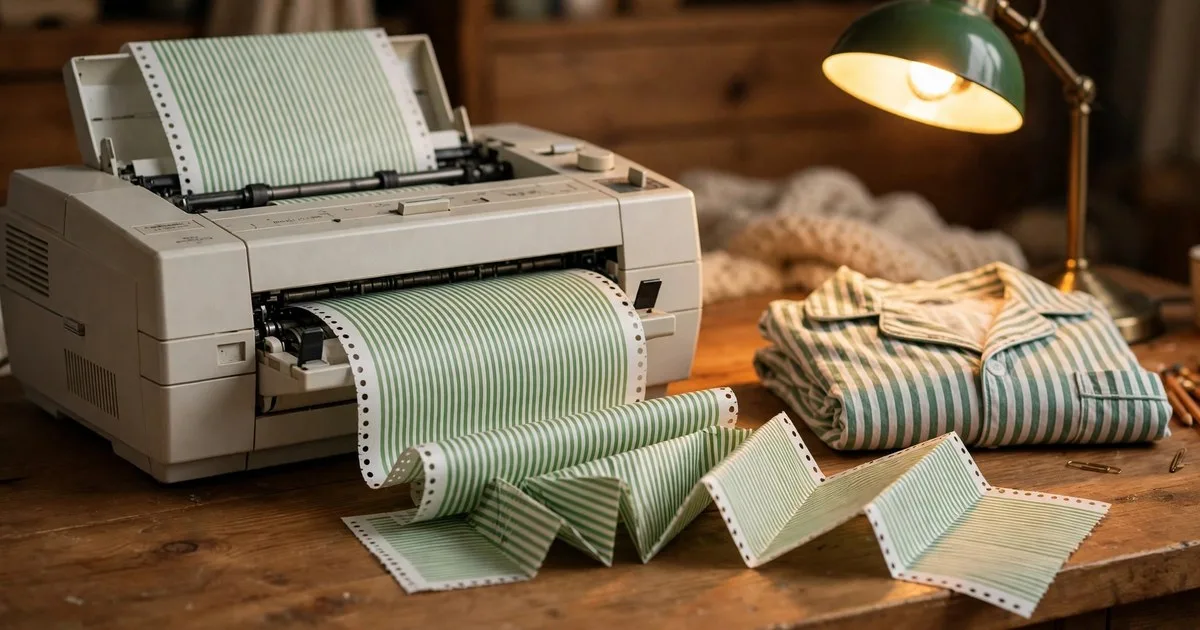
The paper that earned the nickname is properly called continuous stationery, or continuous form paper. It is a long strip of paper made for dot matrix and line printers, with sprocket holes punched down both edges so the printer can pull it through. The sheets are joined together and folded back and forth in a zigzag, which is why it is also called fanfold paper. Other names for the same thing include tractor feed paper, pin feed paper, sprocket feed paper, and green bar paper.
Each sheet is separated from the next by a line of perforations, so the paper can be torn apart after printing. A machine called a burster could split a long print run into individual sheets, and the strips of sprocket holes could be torn off the sides. The paper often came in wide sizes, with 80 column and 132 column widths common in offices, and because it was one continuous strip, a printer could run for hours without anyone loading a new sheet. That was the whole point of it, and it is why the paper ruled offices for decades.
Why the Stripes Looked Like Pajamas
The stripes were not decoration. They were there to help people read long printouts. Continuous stationery was often printed with alternating bands of colour, usually pale green and white, so that each line of text sat on a different shade from the one above and below it. When you were reading a list of hundreds of numbers, the bands stopped your eye from slipping onto the wrong line.
The effect was exactly like a pair of striped pajamas, and that is the joke that made the nickname work. Classic pajamas have horizontal stripes, and so did the paper. Anyone who has ever tried to read a long computer listing on green bar paper knows how the bands guide the eye, and anyone who has seen a striped pajama set knows the same pattern. Swedish office workers put the two pictures together, and pyjamaspapper was the result. The name tells you how the paper looked, not what it was for.
A Short History of Continuous Feed Paper
The paper itself is much older than the computers it is remembered for. Continuous form paper was first developed for autographic registers around 1910, and tabulating machines began using it in the 1920s. Its use grew with the arrival of commercial computers in the 1950s, and by the 1980s it was everywhere, because microcomputers and cheap dot matrix printers had put a printer on almost every office desk.
For a whole generation of office workers, the sound of a printer chewing through a box of fanfold paper was the sound of work getting done. Printouts piled up on desks and floors, program listings were stored in binders, and invoices, pay slips, and reports all came off the same green striped sheets. The paper was cheap, it could print several copies at once with carbon or carbonless sheets, and it never needed anyone to stand beside the printer feeding in single pages. Then, in the 1990s, desktop publishing and WYSIWYG word processing made single sheet printing the normal way of working, and the long striped sheets began to disappear from ordinary offices.
The Dot Matrix Era: When Pyjamaspapper Ran the Office
Pyjamaspapper belongs to the dot matrix era, and that era lasted longer than most people remember. Dot matrix printers print by striking an ink soaked ribbon against the paper with a row of tiny pins, much like a typewriter. The first dot matrix printers appeared around 1970, with models like the LA30 from Digital Equipment Corporation and the Centronics 101, and the LA36 followed in 1974 and became a standard office terminal. The Epson MX-80 later made the technology cheap enough for home computers, and until the 1990s the dot matrix printer was by far the most common printer in homes and small offices.
The reason was simple. A dot matrix printer could print on continuous paper, it could make carbon copies in one pass, and it cost very little to run. The LA36, for example, could print on forms up to 132 columns wide on standard green bar fanfold paper, which made it a fixture in offices that printed wide reports. A laser printer, which reached offices with the HP LaserJet in 1984, was faster and quieter and produced far better quality, but it was expensive, and it needed single sheets. For printing invoices, stock lists, and pay runs, the noisy dot matrix machine and its striped paper were good enough, and businesses kept them for years after better printers existed. Even today, dot matrix printers survive in cash registers, ATMs, bank counters, and auto repair shops, anywhere a multi part form or a receipt on tractor feed paper is still needed.
Why the Paper Disappeared
The decline of pyjamaspapper was not caused by one single change. It was the result of several changes arriving at the same time. Laser printers became cheaper and faster, inkjet printers brought colour printing into homes, and word processing software let anyone lay out a document on screen exactly as it would look on the page. Once a printer could take a stack of plain white sheets, there was no reason to keep a box of folded striped paper under the desk.
Offices changed too. Email replaced printed memos, documents started living on screens instead of in filing cabinets, and the long printout became a thing people associated with the past. The paper did not vanish overnight, and it never fully vanished at all, but it stopped being something ordinary people saw every day. By the end of the 1990s, a young office worker could spend a whole career without ever tearing a sheet off a fanfold stack, and the nickname pyjamaspapper began to fade along with the paper it described.
Where Continuous Paper Still Works Today
The paper is not extinct. Continuous stationery is still made and sold, and it still does jobs that single sheet printers handle badly. Dot matrix printers are still used to print multi part forms, delivery notes, warehouse labels, and logs, because the impact mechanism can press through several layers of carbonless paper at once. Utilities and phone companies have used large printers on continuous forms to print bills, and data logging equipment still records on tractor feed paper.
Paper starts with trees, and the mills that fed the dot matrix era consumed whole forests of them, but the paper that survives today is mostly a specialist product rather than an everyday one. As of 2021, continuous form paper was still available in the United States from large office supply retailers such as OfficeMax and Staples. It is a quiet corner of the paper trade now, kept alive by the machines that still need it, and by the people who remember how useful a box of fanfold paper could be.
The Second Life: How the Internet Reinvented Pyjamaspapper
Here is where the story takes a strange turn. Long after the paper had faded from offices, the word pyjamaspapper started appearing on blogs and trend sites, and it started meaning something completely different. Instead of striped printer paper, it was now described as a sleepwear concept, a lifestyle, and a fashion idea. The new version blended the comfort of pajamas with the creativity of paper, and presented pyjamaspapper as cozy, expressive loungewear with artistic prints.
The honest truth is that this second meaning was invented on the internet, not inherited from Sweden. No standard dictionary records pyjamaspapper as a clothing term, and no major fashion text uses it. At least one of the blogs writing about it admits this openly, noting that there is no record of the word in historical dictionaries or major fashion texts, and that its meaning is speculative and still evolving. Different blogs define it in different ways, which is exactly what you would expect from a word that was made up recently rather than passed down. Within a few years the word had gone global, and the new meaning began to outrank the old one in search results.
Pyjamaspapper as Sleepwear: What the Blogs Get Wrong and Right
The sleepwear version of pyjamaspapper is not all wrong, and that is what makes it confusing. The blogs are right that the word combines pyjamas and papper, and they are right that papper is the Swedish word for paper. They are right that the name sounds soft and playful, and that it fits the current fashion for comfortable, relaxed clothing. What they get wrong is the history. They present pyjamaspapper as a Swedish clothing tradition, when the Swedish meaning was always about printer paper, and they treat a recent blog invention as if it were an old word.
Some of the claims attached to the sleepwear version do not stand up at all. One blog says pyjamaspapper refers to a fabric washed many times until it feels paper thin, another says it is a specific kind of packaging paper for pajama brands, and a third says it is a philosophy of cozy creativity. These cannot all be true at once, and none of them is backed by a dictionary, a fashion house, or a Swedish source. The safest way to read the sleepwear meaning is as a piece of internet folklore, a nice idea that people liked and repeated until it started to look like a fact.
How to Tell the Two Meanings Apart
If you meet the word pyjamaspapper online, a few simple checks will tell you which meaning you are looking at. The first check is the date. Anything that talks about the word as a Swedish nickname for striped printer paper is describing the older, verifiable meaning. Anything that talks about it as sleepwear or a lifestyle is almost certainly from 2025 or later, when the blog trend began.
The second check is the evidence. The printer paper meaning can be traced to a real object, continuous stationery, with a documented history going back to 1910. The sleepwear meaning has no product, no designer, and no dictionary entry behind it, only blog posts quoting other blog posts. The third check is the tone. Articles about the paper talk about printers, offices, and stripes. Articles about the sleepwear talk about comfort, self expression, and identity. Once you know what to look for, the two meanings are easy to separate, and the confusion disappears.
Why a Funny Nickname Stuck
There is a reason pyjamaspapper survived long after the paper itself had gone. Funny nicknames stick in a way that formal names never do. Continuous stationery is a dull phrase, and fanfold paper is only slightly better, but pajama paper makes people smile, and a smile is hard to forget. The nickname also works in any language, because everyone knows what striped pajamas look like, and the picture it creates is instant.
Odd words travel fast online, and pyjamaspapper proved it, turning up in travel guides, lifestyle blogs, and trend roundups far from any Swedish office. That is the real lesson of the word. A joke made by office workers about their printer paper outlived the printers, the paper, and the offices themselves, and it is still being talked about today. The paper is mostly gone, the printers are mostly silent, but the nickname is still going strong.
FAQs
What does pyjamaspapper mean in English?
Pyjamaspapper translates from Swedish as pajama paper. It was a playful Swedish nickname for striped continuous feed printer paper, because the alternating green and white stripes looked like striped pajamas.
Is pyjamaspapper a real Swedish word?
Yes, in the sense that Swedish speakers used it as a nickname for striped printer paper, and the two parts of the word are real Swedish words. It is not a formal dictionary term for a product, and it does not appear in standard English dictionaries.
Is pyjamaspapper a type of pajamas?
No. Pyjamaspapper has nothing to do with pajamas as clothing. The connection is only visual: the stripes on the paper resembled the stripes on pajamas. The idea that it is a kind of sleepwear is a recent internet invention from blog posts, not a Swedish tradition.
What is continuous feed paper?
Continuous feed paper, also called continuous stationery or fanfold paper, is a long strip of paper with sprocket holes down both edges, made for dot matrix and line printers. The sheets are joined together, folded in a zigzag, and separated by perforations after printing.
Why was the paper striped green and white?
The alternating bands of colour helped people read long printouts. Each line of text sat on a different shade from the line above and below it, so the eye did not slip onto the wrong row when reading lists of numbers.
When did people stop using pyjamaspapper?
Its decline started in the early 1990s, when laser printers, inkjet printers, and desktop publishing made single sheet printing normal. The paper never fully disappeared, and it is still used for multi part forms and data logging, but it stopped being an everyday sight in offices.
Can you still buy continuous feed paper today?
Yes. Continuous stationery is still made and sold for specialist uses, and as of 2021 it was still available in the United States from large office supply retailers such as OfficeMax and Staples. Dot matrix printers that use it are still found in cash registers, ATMs, and repair shops.
Where did the sleepwear meaning come from?
The sleepwear meaning comes from blog posts and trend sites, mostly from 2025 onwards. They took the word apart, kept the pajamas half, and rebuilt it as a comfort and fashion concept. No dictionary or fashion authority backs this meaning, and different blogs define it in different ways.
Is pyjamaspapper in the dictionary?
No. There is no record of pyjamaspapper in standard English dictionaries, and the blogs writing about it admit that there is no standard definition in academic or fashion lexicons. The word lives in blogs and search results, not in reference books.
What should I search for if I want the paper?
Search for continuous stationery, fanfold paper, tractor feed paper, or green bar paper. Those are the real product names, and they will find suppliers and information about the paper itself, rather than the sleepwear blogs that now dominate the pyjamaspapper results.
Final Words
Pyjamaspapper is a small word with two lives, and only one of them is real in the way that matters. The real one is a Swedish office joke about striped printer paper, a nickname that described exactly what people saw in front of them. The second life is an internet invention, a sleepwear concept built from a word that bloggers liked the sound of. Both versions are worth knowing about, but they should not be confused with each other.
The next time you see the word, remember the paper. Remember the green and white stripes, the noisy dot matrix printer, and the office workers who looked at a printout and saw a pair of pajamas. That is where pyjamaspapper came from, and that is the story worth keeping. The fashion version may fade, but the joke, and the paper behind it, have already lasted far longer than anyone expected.