
You typed something. The language switched. And suddenly you were staring at the word cbybxrf on the screen, wondering what on earth you just created. Or maybe you found it online, buried in a forum comment or a search result, and you needed to know what it meant.
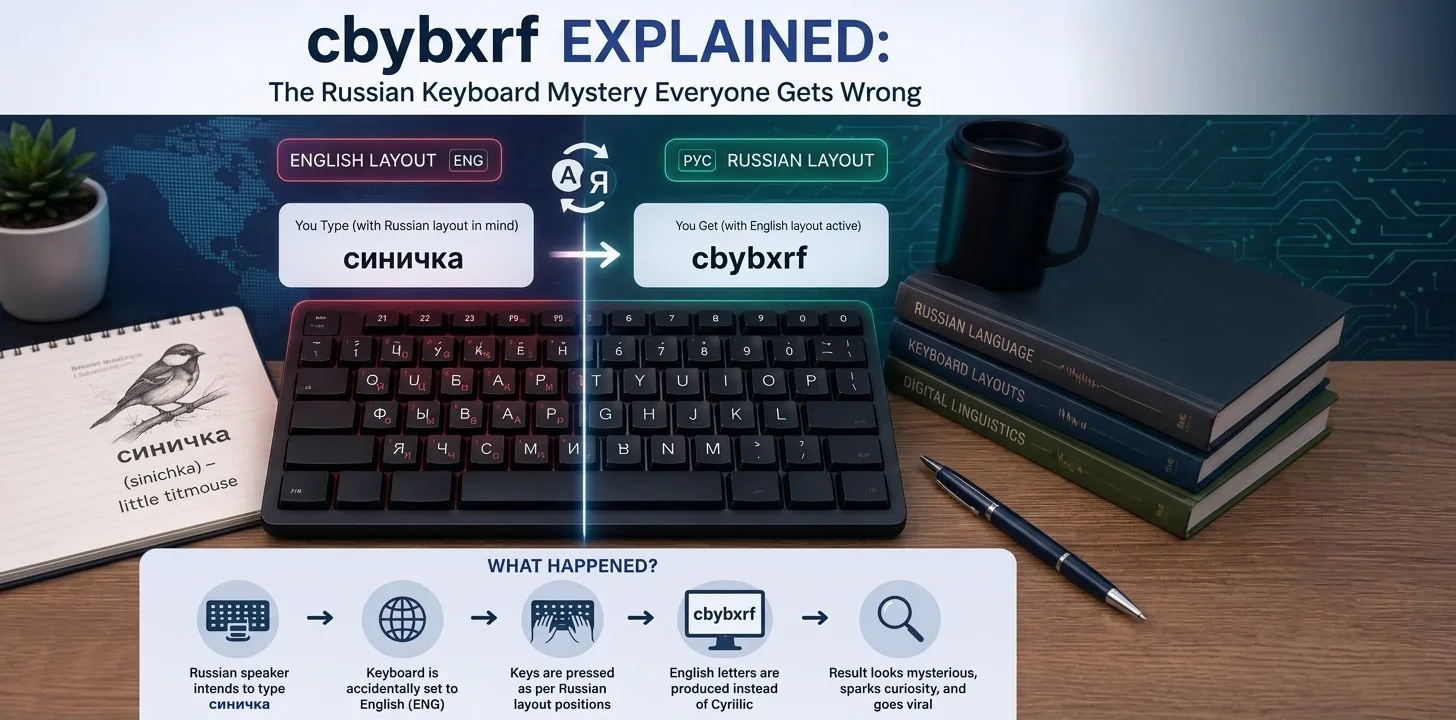
Here is the direct answer: cbybxrf is what happens when someone types the Russian word синичка (sinichka) while their keyboard is still set to English layout. The result is not gibberish. It is a real word wearing the wrong alphabet. Sinichka means “little titmouse,” a small, cheerful bird that lives across Russia and much of Europe. Once you know that, the whole mystery unlocks immediately.
But the story of cbybxrf does not end with one translation. It has become a genuine internet phenomenon, a case study in digital linguistics, and proof of something fascinating about how language behaves online. This guide covers everything you need to know, accurately and completely.
What Cbybxrf Actually Means: The Real Answer Hiding in Plain Sight
Before diving into the mechanics, it helps to understand just how widespread this confusion is. Search for cbybxrf today and you will find articles claiming it is a cryptocurrency, a healthcare data platform, a new programming language, and an enterprise networking framework. Every single one of those articles is wrong.
They were generated by automated tools chasing low-competition keywords without any actual research. The accurate answer is simple and specific. Cbybxrf decodes to синичка, a Russian diminutive noun. Синичка comes from the base word синица (sinitsa), the common Eurasian tit or titmouse, a small passerine bird from the family Paridae.
The diminutive suffix “-ка” adds affection to the word, making синичка closer to “little tit” or “dear little bird” in emotional tone. Russians use this word the way English speakers might say “little sparrow” as a term of endearment or a casual reference to the bird itself. The bird синица is found across Russia, Eastern Europe, Central Asia, and Western Europe.
It appears in Russian folk sayings, children’s literature, and classic poetry. The phrase “лучше синица в руках, чем журавль в небе” translates to “better a titmouse in hand than a crane in the sky,” the Russian equivalent of “a bird in the hand is worth two in the bush.”
That proverb has been part of Russian culture for centuries. So cbybxrf is not mysterious by nature. It is simply a bird, beloved in Russian tradition, rendered unrecognizable by a keyboard that did not know which language it was supposed to be serving.
How the Keyboard Turns синичка Into Cbybxrf
The Russian-English Layout Mismatch Explained
Every keyboard has a physical layout of keys. When you switch the input language on your computer or phone, those same physical keys now produce different characters. The key labeled “C” on an English keyboard produces “с” in Russian layout. The key labeled “B” produces “ы.” The key labeled “Y” produces “н.” And so on.
When a Russian speaker types синичка but forgets to switch their keyboard from English to Russian, the physical key presses still register. The computer just records English characters instead of Cyrillic ones. Here is the full letter-by-letter breakdown:
| Physical Key Pressed | Russian Character Produced | English Character Recorded |
| C | с (s) | C |
| B | ы (y) | B |
| Y | н (n) | Y |
| B | и (i) | B |
| X | ч (ch) | X |
| R | к (k) | R |
| F | а (a) | F |
Typing those seven keys in sequence on a Russian layout produces синичка. Typing those same seven keys while the system is in English layout produces cbybxrf. The keys are identical. The output language is different. That is the entire mechanism.
Why This Happens So Frequently
Language-switching errors are extremely common in multilingual computing environments. A 2019 usability study by the Multilingual Computing Research Group at Utrecht University found that bilingual users switch keyboard languages more than 40 times per hour during typical work sessions.
Every switch is an opportunity for one or two keystrokes to land in the wrong layout before the user notices. Russian-English is one of the most common pairings for this error. Russia has over 146 million Russian speakers, and millions more live in Ukraine, Kazakhstan, Belarus, Germany, the United States, and the United Kingdom.
Many of them work with both languages daily. The Russian Cyrillic alphabet uses 33 characters, none of which overlap visually with Latin letters, so the mismatch produces results that look completely foreign to anyone reading in English. On mobile phones, the problem compounds further.
Auto-correct sometimes overrides the language switch. Messaging apps like Telegram and WhatsApp have their own language detection systems. A fast typist who switches mid-sentence may not catch the error for several words. The result lands in a chat message, a social media post, or a document, and suddenly cbybxrf is out in the world.
Why Cbybxrf Went Viral on the Internet
Curiosity Is a Powerful Search Engine
There is a specific kind of internet behavior that drives searches for terms like cbybxrf. People see it, cannot place it, and feel a pull to understand it. Psychologists call this the “information gap” effect. George Loewenstein at Carnegie Mellon University described it in his 1994 paper on the psychology of curiosity: when people sense a gap between what they know and what they want to know, they feel compelled to close it. Cbybxrf triggers exactly that response.
The word looks like it could be a technical term, a brand name, a programming command, or a foreign language word. It does not look like random noise. That near-coherence is what makes it sticky. People do not search for pure gibberish. They search for things that seem like they might mean something. Cbybxrf hits that sweet spot perfectly.
Search Engines Amplify the Mystery
Once a small number of users search for cbybxrf, search engine algorithms begin treating it as a real query with demand. They surface results. Those results attract more clicks. More clicks signal relevance. Within weeks, a keyboard error can become a trending search term with dozens of articles written about it, most of them fabricated to fill the gap rather than explain it honestly.
This is how low-quality SEO content floods the internet around ambiguous keywords. The term cbybxrf became a target for automated article generation because it had search volume but no authoritative answer.
The result was a landscape full of confident-sounding articles claiming cbybxrf is a blockchain currency, an AI framework, or a healthcare system, none of which have any basis in reality. The irony is that the real story is far more interesting than any of those inventions.
Cbybxrf and the Синичка: A Closer Look at the Bird
What Makes the Little Titmouse Special in Russian Culture
The синичка is not just any bird. In Russian folklore and literature, it carries genuine symbolic weight. It represents resourcefulness, cheerfulness in cold weather, and resilience. The bird is small but loud, energetic in winter when other birds go quiet. Russian children grow up learning to feed синицы during winter months, a tradition that continues in cities today.
Moscow parks, Saint Petersburg gardens, and Siberian villages all see синицы flocking to feeders every November through February. The bird belongs to the genus Parus and the family Paridae. The most common species in Russia is the great tit (Parus major), which Russians call большая синица.
The blue tit (Cyanistes caeruleus) is equally familiar across European Russia and is often called голубая синичка in casual speech. Both species are year-round residents, not migratory, which is part of why they have become symbols of winter endurance in Russian culture. In Russian children’s songs and poetry, the синичка appears as a small, brave, singing creature facing winter alone.
This emotional association gives the word синичка a warmth that simple translation cannot fully capture. When a Russian speaker types синичка, they are likely not just naming a bird. They may be using it as a term of affection for a child, a pet, or a loved one. That tenderness travels into cbybxrf, undetected, the moment the keyboard fails to cooperate.
How to Decode Cbybxrf and Other Russian Keyboard Errors
The Simple Method Anyone Can Use
Decoding a Russian keyboard error does not require specialist software. You need only a basic understanding of the Russian-English keyboard mapping. The standard layout used in Russia is called the ЙЦУКЕН layout, named after the first six letters on the top row, the same way QWERTY is named in English.
Here is a practical approach for decoding words like cbybxrf:
- Open any online Russian keyboard tool or the keyboard layout chart for ЙЦУКЕН
- Match each English letter in the mystery word to its Russian equivalent in that layout
- Read the resulting Cyrillic letters as a Russian word
- Run that word through any Russian-English dictionary or translation service
The process takes under two minutes for any word. For cbybxrf specifically, the mapping produces с-ы-н-и-ч-к-а, which spells синичка without any ambiguity.
Several free online tools perform this conversion automatically. Keyboard layout converters exist for Russian-English, Ukrainian-English, Bulgarian-English, Greek-English, and dozens of other language pairs. Linguists and localization professionals use these tools daily.
Other Common Russian Keyboard Errors You Might Recognize
Cbybxrf is not unique. Hundreds of Russian words produce recognizable patterns when typed on English layout. Some appear frequently enough to have their own search traffic:
| English Layout Output | Correct Russian Word | English Meaning |
| Ghbdtn | Привет | Hello |
| Cgfcbdj | Спасибо | Thank you |
| K.,jdm | Любовь | Love |
| Vfvf | Мама | Mom |
| Hf,jnf | Работа | Work |
Each of these follows the same mechanism as cbybxrf. Each could theoretically become a trending search term if enough people stumbled across it without context.
Why So Many Articles Get Cbybxrf Dangerously Wrong
The AI Content Problem Behind the Confusion
The most important thing to understand about cbybxrf online is this: the majority of articles about it are fabricated. Not exaggerated. Not slightly inaccurate. Fabricated from scratch by AI tools that identified cbybxrf as a search term with demand but no authoritative content, then invented plausible-sounding explanations to fill the gap.
This is a documented pattern in low-competition keyword targeting. An AI tool detects a keyword with search volume. It has no real information about that keyword. Rather than producing nothing, it invents a coherent-sounding explanation. Because the keyword is obscure, no human editor catches the fabrication. The article ranks. Other AI tools scrape it. The false information multiplies.
The SIIT Technology Blog published one of the few genuinely researched articles on cbybxrf in April 2026, noting explicitly that articles describing cbybxrf as a cryptocurrency, healthcare platform, or enterprise framework were all generated by AI tools without any factual basis.
This matters beyond the specific case of cbybxrf. It illustrates how quickly misinformation scales when search volume outpaces genuine knowledge. Google’s Helpful Content System, updated significantly in 2023 and 2024, specifically targets this type of content. Yet low-competition, high-curiosity keywords remain vulnerable because human editors rarely prioritize them.
How to Spot Fabricated Articles About cbybxrf
Fabricated articles about cbybxrf share several telltale patterns:
- They describe it as a specific product, platform, or technology without naming any company, developer, or release date
- They use vague phrases like “many users report” or “studies show” without citing any source
- They pivot from one definition to another within the same article, as if the word can mean anything
- They never mention синичка or the Russian keyboard mechanism, which is the only accurate explanation
If an article about cbybxrf does not mention the Russian word синичка within the first few paragraphs, treat its claims with serious skepticism.
The Broader Lesson: What Cbybxrf Teaches About Digital Language
When Typing Errors Become Cultural Artifacts
Cbybxrf is a small but genuinely interesting example of how language evolves in the digital era. A bird beloved in Russian culture crossed through a keyboard error and emerged as a searchable mystery in English. The original meaning survived, hidden inside the garbled output, waiting for someone to decode it.
This kind of linguistic accident has happened throughout history. When printing presses malfunctioned, they produced unintended letter combinations that sometimes entered common usage. When telegraphs corrupted messages, receivers invented meanings for the garbled text.
Today, keyboards misfire across language boundaries, and the internet preserves the results permanently. Cbybxrf will not be the last keyboard-error term to trend online. As global internet usage grows and more multilingual users type across language boundaries, these accidental words will keep appearing. Some will stay obscure.
Others will attract enough curiosity to become search phenomena in their own right. Understanding the mechanism behind cbybxrf means you will recognize the next one when it appears, and you will not need to read a fabricated article to understand it.
FAQs About Cbybxrf
What does cbybxrf mean?
Cbybxrf is the result of typing the Russian word синичка (sinichka) on a keyboard set to English layout instead of Russian. Sinichka means “little titmouse,” a small bird common across Russia and Europe. It is not a technology term, a currency, or a platform of any kind.
How do you decode cbybxrf back to Russian?
Use a Russian-English keyboard layout chart (ЙЦУКЕН layout). Match each English letter in cbybxrf to its Russian equivalent: C=с, B=ы, Y=н, B=и, X=ч, R=к, F=а. The result is синичка.
Why is cbybxrf trending in search engines?
Cbybxrf triggers curiosity because it looks like it might be a technical term or coded word. That curiosity drives searches, and search volume signals relevance to algorithms, creating a self-reinforcing cycle of attention around an otherwise simple keyboard error.
Is cbybxrf a real word in any language?
It is not a recognized word in any official language dictionary. However, it is the phonetic English-layout representation of синичка, which is a fully legitimate Russian word with centuries of cultural significance.
What is синичка in Russian culture?
Синичка (sinichka) is a term of affection referring to the titmouse bird. It appears in Russian proverbs, children’s songs, poetry, and everyday speech. The most famous Russian proverb involving синица is “лучше синица в руках, чем журавль в небе,” meaning “a bird in the hand is worth two in the bush.”
Why do Russian keyboard errors produce consonant-heavy strings?
The Russian Cyrillic alphabet maps to the same physical keys as English, but the distribution of vowels and consonants differs significantly between the two layouts. Russian vowels tend to cluster on the right side of the keyboard. When Cyrillic vowel positions are typed as English, they often produce English consonants, resulting in vowel-sparse, consonant-heavy strings like cbybxrf.
Are there tools to automatically decode Russian keyboard errors?
Yes. Several free online converters decode Russian-to-English keyboard mismatches automatically. Tools like Typeracer’s keyboard layout converter, Punto Switcher (a Windows application), and various browser extensions can detect and correct layout errors in real time.
Is the information in most online articles about cbybxrf accurate?
No. Most articles about cbybxrf were generated by AI tools and describe it as a cryptocurrency, healthcare platform, programming language, or tech framework. None of those descriptions are accurate. The only correct explanation is the Russian keyboard error producing синичка.
Who is most likely to type cbybxrf by accident?
Russian-speaking users who work bilingually and switch frequently between Cyrillic and Latin keyboard layouts. This includes Russian diaspora communities in Europe, North America, and Central Asia, as well as non-native Russian learners and translators.
Can cbybxrf appear in professional documents or software code?
Yes. Keyboard layout errors like cbybxrf can appear in code comments, database entries, email bodies, and spreadsheet cells whenever a user types in the wrong layout. Localization teams and international software developers encounter these errors regularly and use dedicated tools to detect and correct them.
Conclusion
Cbybxrf is proof that the internet’s most mysterious-looking things often have the simplest, most human explanations. Behind the strange string of letters sits a small bird, affectionately named in Russian, accidentally scrambled by a keyboard that did not switch languages fast enough.
The real story of cbybxrf is more compelling than any fabricated tech definition could ever be. It connects Russian folklore, multilingual computing, internet psychology, and the strange way curiosity scales online. The синичка, resilient and cheerful through Russian winters, ended up as one of the more fascinating linguistic accidents of the digital age.
Next time you see an unfamiliar string of consonants that looks vaguely word-shaped, think before you trust the first article that claims it is a revolutionary platform. The answer is almost always simpler, more honest, and more interesting than that.
For further reading on keyboard layout errors and multilingual computing, the relevant foundation for understanding this phenomenon is covered on Wikipedia’s article on keyboard layouts.
Read More: Seekde Explained: 7 Surprisingly Powerful Ways This Platform Destroys Broken Search Forever