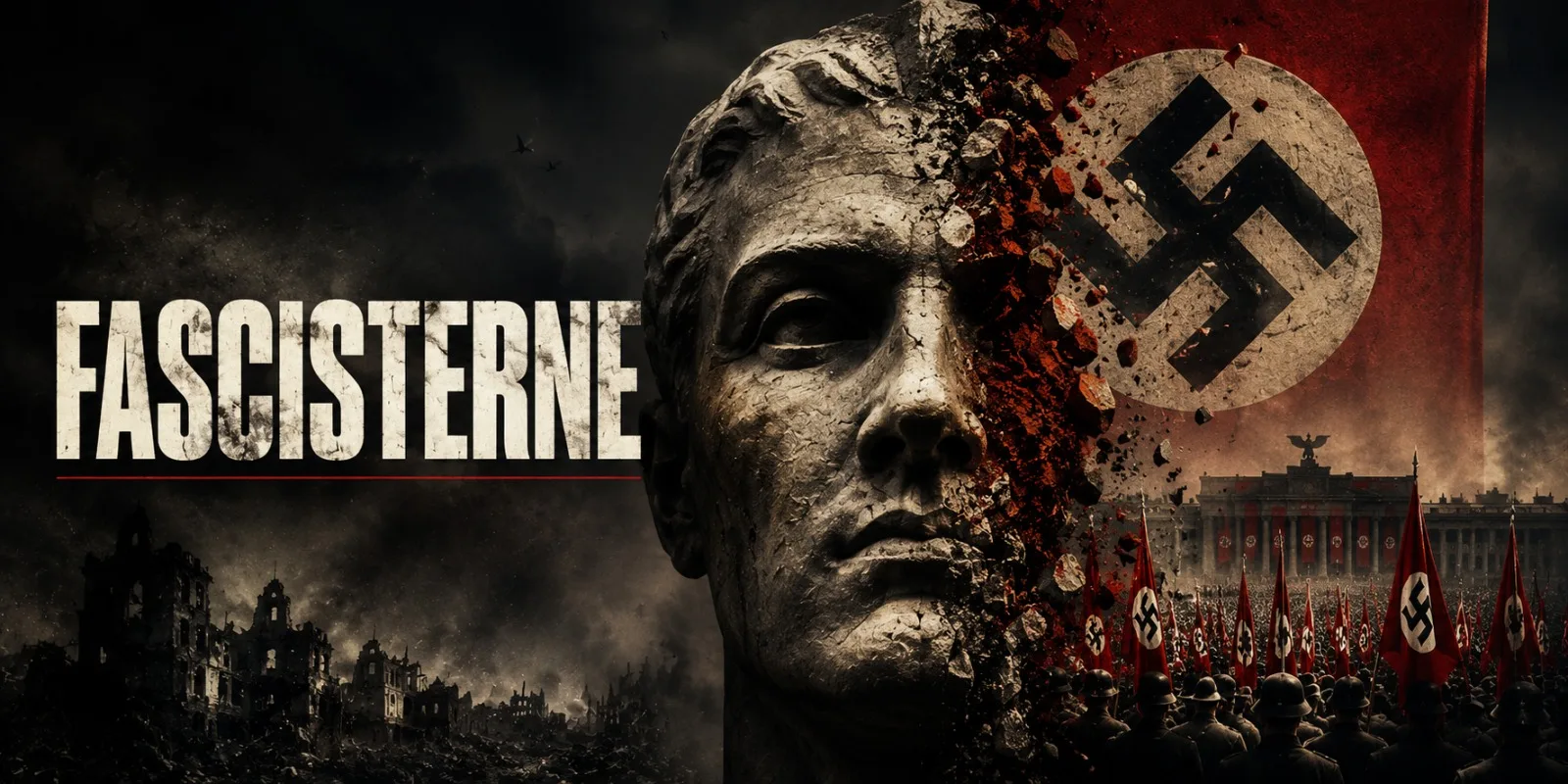
Fascisterne. One word. And yet, it carries the weight of burning books, silenced courts, marching boots, and millions of shattered lives. The term originates from Danish and Norwegian, directly translating to “the fascists” in English, and it describes one of the most destructive political movements the modern world has ever produced. If you want to understand how fascisterne rose from the rubble of World War I, how they controlled entire nations through fear and myth, and why their tactics keep reappearing in 2026, this is where that understanding begins.
Fascisterne refers to the adherents and promoters of fascism, a political ideology built on ultranationalism, authoritarian single-party rule, the violent suppression of dissent, and the glorification of the state over the individual. Within the first decades of the twentieth century, fascisterne transformed the political landscape of Europe so completely that the aftershocks still shape democratic institutions today.
What Does Fascisterne Actually Mean? The Linguistic Truth Most Articles Skip
Most English-language articles treat “fascisterne” as a rough synonym for “fascism.” That is not quite right. The word is specifically Danish and Norwegian plural, meaning “the fascists” as a defined group of people. In Scandinavian political discourse, the term fascisterne was used during the 1930s and 1940s to describe the real, identifiable human beings who chose to embrace fascist ideology, collaborate with occupiers, or join far-right parties in Denmark and Norway.
The Latin and Italian Roots Behind the Word
The broader family of words traces back to the Latin fasces, a bundle of wooden rods bound together around an axe, carried in ancient Rome as a symbol of collective strength and the magistrate’s authority to punish. Benito Mussolini’s movement, the Fasci Italiani di Combattimento, founded in Milan on 23 March 1919, deliberately borrowed this symbol.
From fascio came fascismo, and from that, every derivative in every European language, including fascisterne in Scandinavia. This linguistic history matters. It shows that fascisterne were not an abstract ideology. They were specific people, with names, ranks, and choices. Understanding that is the first step toward recognizing them.
The Exact Conditions That Made Fascisterne Possible
Nothing about the rise of fascisterne was inevitable. It happened because specific, measurable conditions existed at a specific moment in history. World War I ended in November 1918. The Treaty of Versailles, signed on 28 June 1919, imposed crushing reparations on Germany, totaling 132 billion gold marks. Germany’s unemployment rate hit 30 percent by 1932. Austria-Hungary had collapsed.
Italy, despite being on the winning side, received far less territory than it had been promised. These were not vague grievances. They were concrete economic and political wounds. Into this vacuum stepped the fascisterne with a three-part offer: national pride, economic order, and an enemy to blame. That combination has worked in every century it has been tried.
Why Economic Collapse Is the Incubator of Fascisterne
When people lose their savings, their jobs, and their sense of the future, they become vulnerable to simple explanations. Fascisterne were masters of simple explanations. They did not offer complex policy debates. They offered identity. “You are not poor because the system failed. You are poor because they took from you.” That message resonated in Weimar Germany, in post-war Italy, and in the fragile democracies of 1930s Europe.
The sociologist Wilhelm Reich analyzed this process in his 1933 work The Mass Psychology of Fascism, published in Copenhagen. He argued that fascist movements succeed not despite their irrationality, but partly because of it. They offer emotional certainty in a time of rational confusion. That insight has never become less true.
Key Fascisterne Regimes and Leaders: A Comparative Overview

Below is a factual comparison of the major fascisterne movements of the twentieth century, their founding dates, leaders, and the year they collapsed.
| Country | Movement Name | Key Leader | Year Founded | Year Collapsed |
| Italy | Fasci di Combattimento / PNF | Benito Mussolini | 1919 | 1943 |
| Germany | National Socialist German Workers’ Party (NSDAP) | Adolf Hitler | 1920 | 1945 |
| Spain | Falange Española | Francisco Franco / José Antonio Primo de Rivera | 1933 | Gradually, post-1975 |
| Norway | Nasjonal Samling | Vidkun Quisling | 1933 | 1945 |
| Hungary | Arrow Cross Party | Ferenc Szálasi | 1935 | 1945 |
| Romania | Iron Guard | Corneliu Zelea Codreanu | 1923 | 1941 |
Each of these movements shared core DNA with the others. They all centered on a charismatic leader presented as the embodiment of the national will. They all used violence as a political tool. They all collapsed only when external military force defeated them.
Fascisterne in Scandinavia: The Chapter Most Western Articles Ignore
Here is something the competitor article and most English-language pieces completely skip. Fascisterne had a real, documented presence in Scandinavia, and the damage done there is part of why the Danish and Norwegian word exists with such weight.
Vidkun Quisling and Norway’s Nasjonal Samling
In Norway, the most notorious figure among local fascisterne was Vidkun Quisling. Born on 18 July 1887 in Fyresdal, Norway, Quisling founded the Nasjonal Samling (National Union) party on 17 May 1933. The party openly modeled itself on Mussolini’s movement and later on Hitler’s NSDAP. When Nazi Germany invaded Norway on 9 April 1940, Quisling attempted a self-proclaimed coup.
The Germans eventually installed him as Minister President in February 1942. He served as a willing collaborator for the entire occupation. After Norway’s liberation in May 1945, Quisling was arrested, tried for high treason, and executed by firing squad on 24 October 1945. His name became so synonymous with treasonous collaboration that the word “quisling” entered the English language as a common noun meaning traitor.
Danish Fascisterne During the German Occupation
In Denmark, fascisterne operated under the Danish National Socialist Workers’ Party (DNSAP), founded in 1930 by Cay Lembcke and later led by Frits Clausen. The party reached its peak membership of around 43,000 members in 1943. When the war ended, Danish fascisterne faced legal reckoning. More than 15,000 Danes were prosecuted for collaboration between 1945 and 1948. This is why the word fascisterne carries particular meaning in Danish and Norwegian. It refers to real neighbors who made real choices.
The 7 Core Characteristics of Fascisterne Ideology
Political scientists, including Robert Paxton in his landmark 2004 study The Anatomy of Fascism (published by Knopf), identified recurring features that define fascisterne across all national contexts. Here are the seven most consistent.
- Ultranationalism with a mythologized past. Fascisterne did not promote ordinary patriotism. They promoted the idea that their nation had a special destiny, a glorious ancient identity that had been stolen and must be reclaimed through struggle.
- Authoritarian leadership cult. Every major fascisterne movement built its politics around a single supreme leader: Mussolini, Hitler, Franco, Quisling. The leader was presented not as a politician but as a near-mystical embodiment of the national spirit.
- Violent rejection of political opposition. Fascisterne did not tolerate competing political parties, free trade unions, or independent courts. They dismantled these institutions using both legal maneuvers and direct physical violence.
- State control of the economy. Fascisterne rejected both free-market capitalism and Marxist communism. They imposed a “third way” where private ownership was permitted but strictly subordinated to state goals, particularly military production.
- Glorification of violence and war. Unlike most political movements, fascisterne openly celebrated militarism. War was not a regrettable necessity. For fascisterne, war was a purifying national experience.
- Scapegoating of an internal enemy. Every fascisterne movement identified a group within the nation as the cause of national decline. In Germany, this was Jewish people. In Italy, it was socialists and liberals. The scapegoat served to unify supporters around a shared hatred.
- Mass mobilization through spectacle. Fascisterne understood that politics must feel like theater. Nuremberg rallies, Roman salutes, torchlit processions, uniforms: all of it was designed to create emotional intoxication rather than rational consent.
How Fascisterne Controlled the Mind: Propaganda as a Weapon
Joseph Goebbels, appointed Reich Minister of Propaganda by Hitler on 13 March 1933, turned mass communication into the most effective weapon fascisterne possessed.
The Radio as a Tool of Fascisterne Control
In Germany, radio ownership jumped from 4 million households in 1933 to over 16 million by 1939. Goebbels subsidized the production of cheap “People’s Receivers” (Volksempfänger) so that ordinary families could afford them. The purpose was simple: fill every home with the voice of the state. Every major fascisterne regime followed the same playbook. Control the broadcast. Control the newspaper. Control the school curriculum. Once you own what people hear and read, you can shape what they believe.
The Psychology of Fascisterne Propaganda
Fascisterne propaganda worked on three psychological levels simultaneously. At the surface level, it offered information, usually heavily distorted but presented as fact. At the emotional level, it triggered pride, fear, and righteous anger. At the identity level, it told people who they were and who their enemies were.
This three-layer approach made fascisterne messaging extremely difficult to counter. When someone’s identity is wrapped up in a belief, factual correction does not work. It actually strengthens the belief. Psychologists call this “the backfire effect,” and fascisterne exploited it decades before the term was coined.
Fascisterne and the Holocaust: When Ideology Becomes Atrocity
The most devastating consequence of fascisterne ideology was the Holocaust. Between 1941 and 1945, Nazi Germany systematically murdered approximately six million Jewish people, along with an estimated five to six million others, including Roma, disabled people, political prisoners, and LGBTQ+ individuals.
The Holocaust did not begin with gas chambers. It began with words. With legislation. With the 1935 Nuremberg Laws, which stripped Jewish Germans of their citizenship. It began with the rhetoric that fascisterne had been using since the 1920s: that certain groups were threats to national purity. The atrocity was the logical endpoint of an ideology that had been openly stating its intentions for years.
Antonio Gramsci, the Italian Marxist philosopher imprisoned by Mussolini’s government in 1926, understood this trajectory. Writing from prison, he argued that fascisterne gained power not by conquering a hostile population, but by achieving “hegemony,” winning the passive consent of ordinary people through culture, education, and the normalization of authoritarian ideas. His Prison Notebooks, written between 1929 and 1935, remain the most incisive analysis of how fascisterne manufacture social consent.
The Fall of Fascisterne: How the Ideology Collapsed
Fascisterne did not fall because people suddenly rejected the ideology. They fell because they were militarily defeated. Mussolini was removed from office by Italy’s own Grand Council of Fascism on 25 July 1943. He was arrested, later freed by a German rescue operation, and finally captured and killed by Italian partisans on 28 April 1945. His body was hung upside down in Milan’s Piazzale Loreto. Hitler died by suicide on 30 April 1945 in his Berlin bunker as Soviet forces closed in. Germany surrendered on 8 May 1945.
The Nuremberg Trials, held between November 1945 and October 1946, prosecuted twenty-four major Nazi war criminals. Twelve received death sentences. The trials established, for the first time in international law, that following orders was not an acceptable defense for crimes against humanity. That principle, born from the ruins of fascisterne, remains the foundation of international humanitarian law today.
Fascisterne in 2026: The Dangerous Echoes You Need to Recognize
The original fascisterne regimes are gone. But in 2026, the tactics, rhetoric, and psychological architecture that made them work are reappearing, adapted for the digital age.
How Social Media Repackages Fascisterne Ideas
Modern movements inspired by fascisterne do not typically use open symbols or direct language from the 1930s. They have learned from history. Instead, they enter through lifestyle content: fitness culture, traditional values, anti-globalism, economic anxiety. The shift from self-help to scapegoating happens gradually, and social media algorithms optimize for the content that produces the most emotional engagement.
Investigations in early 2026 into nationalist funding networks found that opaque financial structures, including cryptocurrency donations, allow fringe movements to project the appearance of massive popular support that does not actually exist. The “Patriot Fund” leaks documented how as few as five offshore accounts could fund the social media infrastructure of entire nationalist movements.
The Semantic Inflation Problem
One of the most dangerous trends in 2026 is what analysts call “semantic inflation” when the label fascisterne or fascist is applied so broadly to ordinary political opponents that the word loses precision. When that happens, actual fascisterne benefit. They tell their followers: “They call everyone a fascist, so the word means nothing.” Maintaining analytical precision is itself an act of democratic defense.
Warning Signs That Political Observers Track in 2026
These are the specific behaviors political scientists use to identify fascisterne-adjacent movements today:
- Framing democratic institutions as inherently corrupt and beyond reform
- Presenting a single charismatic figure as the only solution to national crisis
- Identifying a specific ethnic, religious, or cultural group as responsible for national decline
- Using the language of emergency to justify suspending normal legal protections
- Romanticizing a mythologized national past as the standard to return to
None of these signs alone defines fascisterne. But when several appear together, consistently, in the same movement, history teaches us to pay attention.
What Distinguishes Fascisterne From Other Authoritarian Systems
| Feature | Fascisterne | Communism | Military Dictatorship |
| Economic model | State-directed capitalism | State ownership of all production | Variable, often crony capitalism |
| Ideological driver | Ultranationalism | Class struggle and internationalism | Stability and elite control |
| Leader cult | Central and quasi-mystical | Sometimes present | Usually present |
| Role of violence | Celebrated and glorified | Justified as revolutionary necessity | Used instrumentally |
| Treatment of minorities | Systematic scapegoating | Class-based discrimination | Variable |
| Historical period of peak influence | 1919 to 1945 | 1917 to 1991 | Ongoing in various regions |
This comparison reveals why fascisterne occupy a unique and particularly dangerous political space. They combine the emotional intensity of a religious movement with the machinery of a modern industrial state.
The Lessons Fascisterne Left Behind: A Warning for Every Generation
Studying fascisterne is not an academic exercise. It is a practical skill for any person living in a democracy in 2026. The historian Timothy Snyder, in his 2017 book On Tyranny (published by Tim Duggan Books), identified twenty lessons from the twentieth century’s encounters with fascisterne and totalitarianism. Among the most urgent: defend institutions, because fascisterne destroy institutions before they destroy people. Support the work of fact-based journalism. Be suspicious of politicians who claim that a national emergency justifies ignoring the law.
These are not abstract principles. They are the distilled experience of the people who lived under fascisterne and survived. Freedom is not self-sustaining. Every generation has to actively maintain it. The people who suffered under fascisterne in Italy, Germany, Norway, Denmark, Spain, Hungary, and Romania did not lose their freedom because they were weak. They lost it because they assumed it was permanent. That assumption is the one luxury no generation can afford.
(FAQs) About Fascisterne
What is the precise meaning of the word fascisterne?
Fascisterne is a Danish and Norwegian plural noun that translates directly to “the fascists” in English. It refers specifically to the people who adhered to, promoted, or collaborated with fascist movements, particularly during the 1930s and 1940s in Europe. The word carries particular historical weight in Scandinavian countries due to the lived experience of occupation and collaboration during World War II.
When did fascisterne first emerge as a political force?
The organized fascisterne movement emerged in Italy on 23 March 1919, when Benito Mussolini founded the Fasci Italiani di Combattimento in Milan. By 1922, Mussolini had become Italy’s Prime Minister following the March on Rome. The ideology spread rapidly to Germany, Spain, Hungary, Romania, and Scandinavia throughout the 1920s and 1930s.
What were the core beliefs of fascisterne?
Fascisterne believed in single-party authoritarian rule, ultranationalist ideology, the suppression of democratic institutions, state-directed economics, the glorification of military force, and the identification of internal ethnic or political enemies as threats to national unity. They rejected both liberal democracy and Marxist communism.
Who was Vidkun Quisling and why does he matter to understanding fascisterne?
Vidkun Quisling (1887 to 1945) was a Norwegian army officer who founded the Nasjonal Samling fascist party in 1933 and collaborated with the Nazi German occupation of Norway from 1940 to 1945. His name became a common English word meaning “traitor.” He was executed in Oslo on 24 October 1945. His story is central to understanding how fascisterne operated in Scandinavia.
How did fascisterne use propaganda to maintain power?
Fascisterne controlled all major media, including newspapers, radio broadcasts, and film. In Germany, Reich Minister Joseph Goebbels oversaw an apparatus that reached 16 million radio households by 1939. Propaganda operated on three levels: factual distortion, emotional manipulation, and identity reinforcement. Each level made the messaging resistant to factual correction.
What caused the fall of the major fascisterne regimes?
The primary cause was military defeat in World War II. Mussolini was removed from power in July 1943 and killed in April 1945. Hitler died by suicide on 30 April 1945. Germany surrendered on 8 May 1945. The subsequent Nuremberg Trials, held between 1945 and 1946, prosecuted twenty-four major figures and established that following orders did not excuse crimes against humanity.
How is the term fascisterne relevant in 2026?
In 2026, fascisterne remains relevant as both a historical category and an analytical tool. Movements with fascisterne characteristics, including ultranationalism, leader cults, scapegoating, and anti-democratic rhetoric, continue to operate in various countries. Digital platforms and cryptocurrency funding have allowed these movements to spread and finance themselves in new ways. Analysts warn against “semantic inflation,” overusing the label to the point where it loses its analytical power.
What is the difference between fascisterne and ordinary nationalism?
Nationalism, in its moderate forms, is a positive identification with one’s country and culture. Fascisterne takes nationalism to a pathological extreme: the nation becomes an absolute value that overrides individual rights, the rights of minorities, international law, and basic human decency. The difference is not one of degree but of kind. Moderate nationalism works within democratic frameworks. Fascisterne destroys them.
How did fascisterne affect ordinary civilian life?
Life under fascisterne rule meant the elimination of independent trade unions, the censorship of all media, the prohibition of opposition political parties, surveillance of private communications, compulsory participation in state-organized rallies and youth groups, and the constant threat of arrest for anyone who expressed dissent. In countries with racial laws, it also meant systematic discrimination, dispossession, and ultimately genocide.
What is the best way to protect democracy from fascisterne in the modern era?
Political scientists and historians point to several practical defenses: maintaining strong, independent judicial systems; supporting free and fact-based journalism; resisting the normalization of political violence; protecting the right of opposition parties to compete fairly; educating each generation about the specific tactics fascisterne have historically used; and refusing to apply the label so broadly that it loses meaning and protects the very movements it should describe.
Conclusion: Fascisterne Are History’s Clearest Warning
Fascisterne did not rise from nowhere. They rose from specific conditions: economic despair, wounded national pride, weak institutions, and a population that was told a simple story about who was to blame. Those conditions are not unique to the 1920s. They can and do recur. The difference between then and now is knowledge. We know what fascisterne look like in their early stages. We know the language they use, the psychological levers they pull, and the institutions they target first.
That knowledge is not just academic. It is a practical tool for every person who wants to live in a free society. The seven disturbing truths about fascisterne are not comfortable reading. They are not meant to be. They are meant to be useful. History has already paid an unimaginable price for the lesson. The least we can do is learn it.
For further foundational reading on the definition and historical development of fascism, the Wikipedia article on fascism provides a documented starting point with extensive academic sourcing.
Read More: Cellulogia Exposed: What No One Tells You About This Skin Trend