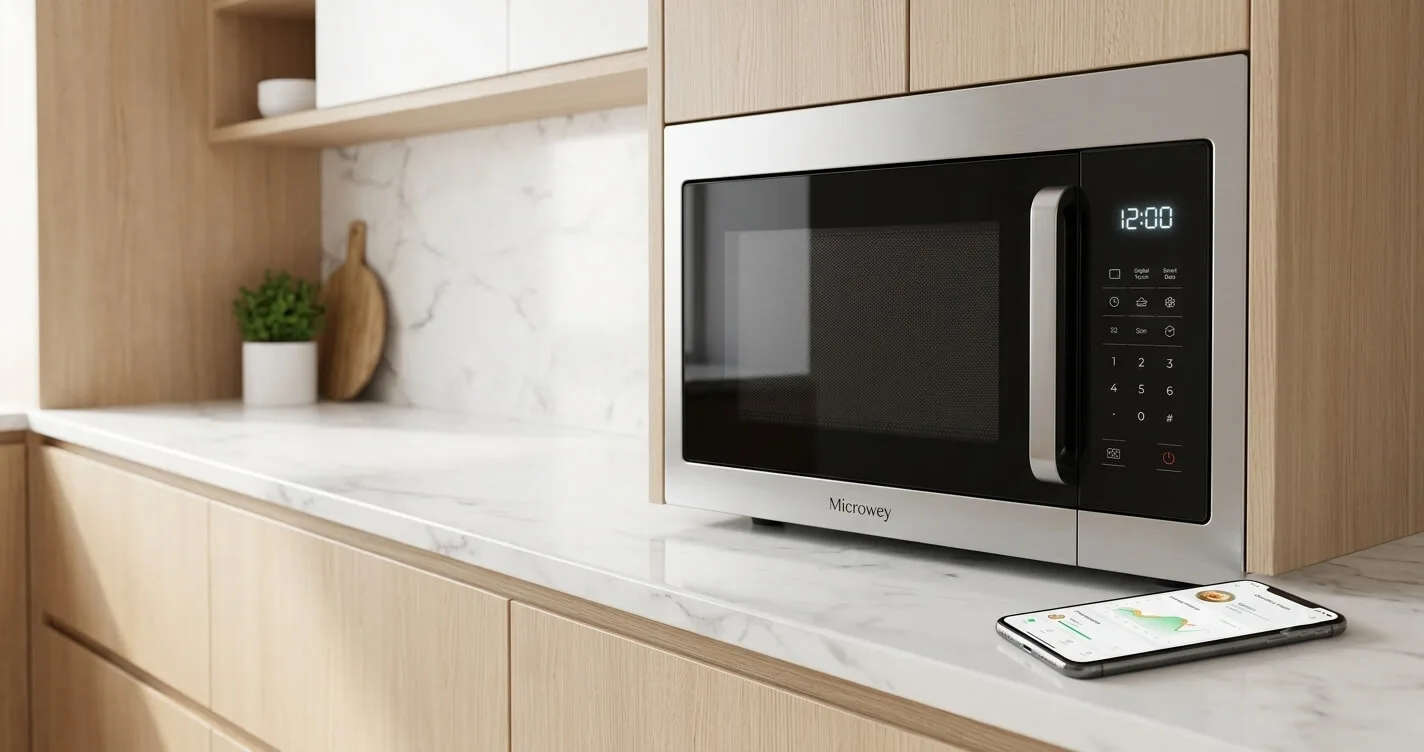
In recent years, kitchen technology has evolved far beyond simple mechanical timers, basic heating coils, and rotating glass plates. With the rapid rise of internet-of-things (IoT) appliances and smart technology concepts like Microwey automation, everyday meal preparation is undergoing a massive digital transformation.
If you have ever suffered through unevenly defrosted meat, rubbery leftovers, scorched popcorn, or overly complicated control panels that require a manual to decode, you already know the day-to-day frustrations of traditional appliances. Modern smart microwave features are engineered specifically to eliminate these exact kitchen headaches, bringing precision engineering into home cooking.
Below, we provide an exhaustive breakdown of how these advanced smart microwave features are revolutionizing home cooking, saving utility costs, and optimizing kitchen workflows.
1. Advanced Sensor Cooking Technology vs. Time Guesswork
Traditional microwaves rely entirely on arbitrary time guesswork. You select a random number of minutes, press start, and hope the food doesn’t explode or remain frozen in the center. Analyzing advanced smart microwave features shifts this dynamic completely by focusing on actual physical indicators rather than manual timers.
How Sensor Cooking Works
Built-in sensors measure the exact humidity, steam, and gas levels emitted from the food as it heats. The internal microprocessor analyzes this data in real-time and dynamically adjusts the power output and remaining cooking duration.
- Prevents Overcooking: The moment the sensor detects a specific steam threshold indicating the food has reached its ideal internal moisture level, it automatically reduces power or stops the cycle.
- Eliminates Cold Spots: By tracking environmental changes inside the cavity, it ensures that dense frozen items are heated thoroughly without turning the outer edges into hard, unchewable crusts.
2. Smart Inverter Technology for Consistent Thermal Energy
To understand why traditional heating fails, you have to look at how old-school appliances operate. A standard microwave cannot actually lower its power. If you set it to 50% power, it simply runs at 100% power for half the time, pulsing on and off. This creates intense thermal shocks followed by cooling periods, which ruins delicate proteins and dairy.
The Inverter Advantage
When evaluating premium smart microwave features, continuous power delivery stands out as a crucial upgrade. Modern smart inverter technology delivers a continuous, unbroken stream of low-intensity energy. If you select 30% power for a delicate defrosting task, the inverter delivers a true, steady 30% power stream throughout the entire duration.
Traditional Pulse Method: [100% Power] —> [0% Off] —> [100% Power] —> [0% Off]
Smart Inverter Method: [Continuous, Unbroken Low-Intensity Thermal Stream]
This precise control preserves the structural integrity of food vitamins, prevents rubbery textures in meat, and allows you to easily melt chocolate or soften butter without the risk of scorching.
3. Hands-Free Voice Control and Multi-Ecosystem Integration

Modern kitchen workflows often leave your hands covered in flour, oil, or water, making physical interaction with appliance buttons unhygienic and inconvenient. The integration of voice control capabilities resolves this barrier by introducing true hands-free operation.
Smart Home Compatibility
Leading manufacturers now design their systems to connect seamlessly over 2.4GHz/5GHz Wi-Fi networks, integrating directly with popular smart home ecosystems. These smart microwave features allow for seamless interaction:
- Amazon Alexa Support: Launch custom kitchen routines or ask your assistant to add specific microwave presets.
- Google Assistant Compatibility: Remotely check the status of a cooking cycle using simple voice prompts from anywhere in your home.
- Apple HomeKit / Matter Protocol: Future-proofing appliances by allowing them to talk to various smart hubs across a standardized local network.
4. Multi-Stage Automated Cooking Profiles

One of the most tedious aspects of cooking raw frozen meals is the need to stop the appliance midway, manually press new buttons, adjust power levels, and restart the process. Multi-stage automated profiling removes human intervention from complex multi-step recipes.
Seamless Operational Transitions
An automated cooking profile allows you to program a sequential series of distinct functional stages before you ever press start. These programmable smart microwave features can be configured to execute the following stages automatically:
- Stage 1 (Defrost): Runs at true 20% inverter power for 6 minutes to safely thaw a frozen portion of lasagne.
- Stage 2 (Cook): Automatically ramps up to 80% power for 4 minutes to rapidly heat the core components.
- Stage 3 (Crisp/Grill): Activates an upper halogen or quartz heating element at 100% capacity for 2 minutes to brown the cheese layer to perfection.
5. Mobile App Connectivity, Diagnostics, and Notifications
The traditional kitchen requires you to stand by the appliance, watching the timer count down to ensure nothing boils over. Mobile app integration unchains you from the kitchen counter by moving the entire user interface directly onto your smartphone or tablet.
Beyond Simple Controls
Companion applications provided by modern smart kitchen brands offer deep utility smart microwave features that go far beyond starting a timer remotely:
- Real-Time Push Alerts: Receive an immediate smartphone notification the exact second a cycle completes or when it is time to stir a dish.
- Predictive Maintenance & Diagnostics: The appliance runs internal self-checks and sends error codes directly to your app if a component requires cleaning or technical attention, preventing costly repair bills.
- Cloud Recipe Libraries: Sync step-by-step cooking settings directly from online culinary databases straight to your appliance’s internal memory.
6. Scan-to-Cook Functionality
Reading tiny, convoluted cooking instructions on the back of packaged food boxes is a universal chore. Scan-to-cook functionality streamlines this process into a single, effortless smartphone gesture.
Eliminating User Error
By utilizing your smartphone’s camera via the appliance’s companion app, you can scan the universal barcode on thousands of participating pre-packaged food items.
The application looks up the specific product in its verified database, downloads the precise, manufacturer-recommended heating curve, and transmits the exact power adjustments, stage transitions, and timing directly to the microwave. Among all modern smart microwave features, this barcode automation provides the quickest setup for daily meals.
7. Energy-Efficient Standby Modes and Smart Eco-Design
Traditional household appliances are major contributors to “vampire power draw”—the electricity consumed by devices while they are sitting completely idle. The collective clock displays, active Wi-Fi standby chips, and internal sensors of older units slowly drain energy 24 hours a day.
Eco-Friendly Power Management
Modern eco-conscious engineering introduces hyper-efficient standby modes. When the appliance detects no user activity for a specific period, it enters a deep sleep state. These energy-saving smart microwave features drop its power draw to near-zero levels while maintaining an ultra-low-power localized handshake with your home router, helping reduce monthly household utility costs without sacrificing smart functionality.
📊 Traditional vs. Smart Microwave Features Comparison
To help you visualize how these upgrades directly impact your daily routine, here is a side-by-side comparison of traditional systems versus modern smart utility systems:
| Feature Criteria | Traditional Microwave Systems | Modern Smart Microwave Systems |
| Power Distribution | On/Off Pulsing (Creates uneven hot/cold spots) | Continuous Inverter Flow (Gentle, uniform heating) |
| Cooking Logic | Fixed timers selected manually by user | Internal humidity and steam sensors |
| Interactivity | Physical buttons and membrane touchpads | Voice control, mobile apps, and smart sync |
| Prepackaged Food | Manual input based on tiny packaging text | Scan-to-Cook barcode automation |
| System Health | No alerts until a complete breakdown occurs | Remote predictive diagnostics via app |
🛠️ Troubleshooting Common Smart Kitchen Tech Issues
While smart microwave features offer incredible convenience, moving from analog to digital tech can occasionally introduce technical questions. Here is how to keep your modern kitchen system running smoothly:
Issue 1: The Microwave Disconnects from Home Wi-Fi
- The Cause: Most smart kitchen appliances utilize the 2.4GHz Wi-Fi band for longer range through walls, whereas smartphones often default to 5GHz bands.
- The Fix: Ensure your home router broadcasts a split or hybrid network. Keep your microwave within reasonable range of your primary router or install a network extender near the kitchen.
Issue 2: Sensor Cooking Leaves Food Slightly Too Damp
- The Cause: Blocking the internal steam vents with oversized plates or heavy plastic wrap traps moisture prematurely, tricking the sensors.
- The Fix: Always use microwave-safe covers with vented openings to allow steam to escape naturally, enabling the internal sensors to get an accurate reading.
Conclusion: Is It Time to Upgrade Your Kitchen Architecture?
The evolution of smart kitchen appliances—ranging from early conceptual designs like Microwey automation to mainstream premium appliances—proves that modern home design is focused entirely on maximizing efficiency, reducing waste, and eliminating human error.
Investing in a cooking appliance equipped with dedicated smart microwave features does not simply save a few minutes every evening; it completely eliminates the daily friction, guesswork, and safety risks associated with traditional meal preparation. As kitchens become increasingly connected, moving toward automated sensor-driven appliances is the single best step you can take to future-proof your home.
(FAQs)
What is the primary difference between an inverter microwave and a regular microwave?
A regular microwave can only operate at 100% power or 0% power, pulsing back and forth to simulate lower settings. An inverter microwave provides a true, continuous stream of lower power, which ensures uniform heating without destroying food textures.
What are the most essential smart microwave features for busy households?
For fast-paced environments, sensor cooking, multi-stage profiling, and scan-to-cook functionality are considered the most essential options, as they minimize manual monitoring.
Can smart microwaves be safely operated if the home internet goes down?
Yes. If your Wi-Fi or internet connection drops, a microwave with advanced digital systems will still function perfectly as a traditional high-quality appliance. You will still be able to manually input times, adjust standard power levels, and use basic control panels.
The word started as a typo. In 2026, it stands for something real: a kitchen that works a little smarter than it did before. That is not a small thing. For more background on the science behind microwave cooking, the Wikipedia article on microwave ovens provides a well-sourced overview of the technology’s history and physics.
Read More: Ottans: 7 Brilliant Reasons This Green Bio-Material Is Revolutionising Design in 2026