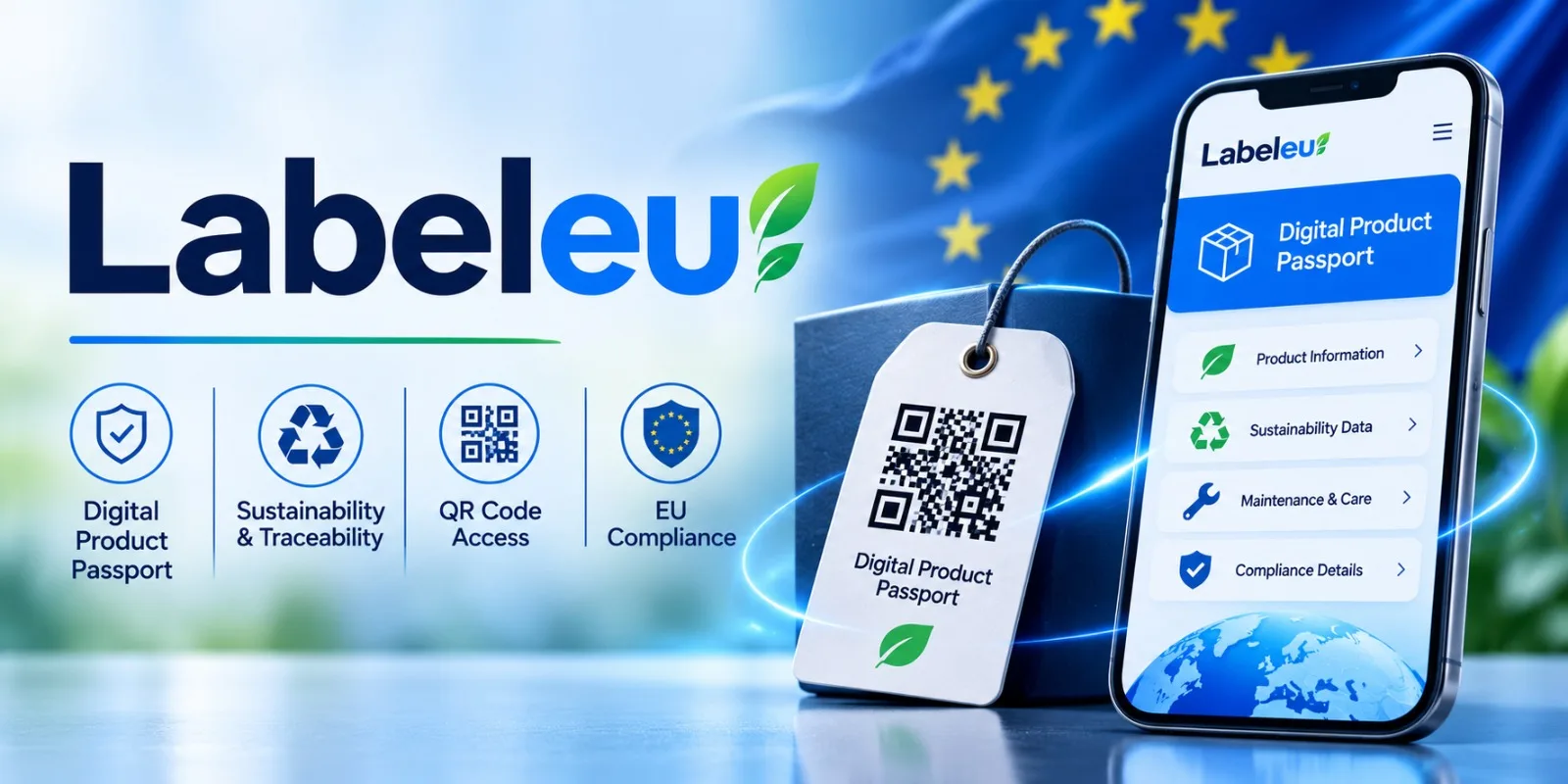
Labeleu is a digital platform associated with the creation, management, and preparation of Digital Product Passports (DPPs). It is designed to help businesses organise product information, create digital records, and connect product details with QR-code-based access. As European product regulations increasingly focus on transparency, traceability, and sustainability-related information, tools for managing product data are becoming more relevant to manufacturers, retailers, importers, and brands.
The platform, available through labeleu.app, presents itself as a software solution intended to simplify the process of preparing Digital Product Passports. Its advertised functionality includes structured product information, passport creation, label design, data imports, and related tools. These features are intended to help businesses organise information that may be needed for product documentation and future regulatory requirements.
However, Labeleu is not an official European Union authority, certification body, or regulator. Using a software platform to organise product information does not automatically make a product legally compliant. Businesses still need to understand the legislation applicable to their products, verify the accuracy of their data, and meet their own legal responsibilities.
This guide explains what Labeleu is, how Digital Product Passports work, the platform’s advertised features, its pricing status, potential benefits, limitations, and what businesses should consider before using such a tool.
What Is Labeleu?
Labeleu is a Software-as-a-Service platform focused on creating and managing Digital Product Passports. A Digital Product Passport is a digital record associated with a product that can provide information about its identity, materials, relevant characteristics, and other details, depending on the applicable regulations and product category.
The Labeleu platform aims to help businesses organise this information into structured digital records. Instead of managing product details through separate spreadsheets, documents, and manual processes, users can prepare information within a digital workflow and generate passport-related outputs.
Its website describes tools for creating passport pages, organising product data, generating QR-code-related outputs, designing labels, and importing information. These are platform features advertised by the service and should not be confused with independently verified performance or a guarantee of legal compliance.
The platform is particularly relevant to businesses researching Digital Product Passports and the evolving European regulatory landscape. Product information requirements can vary depending on the type of goods, the legislation that applies, and the product’s place in the supply chain.
Labeleu should therefore be understood as a product-information management tool intended to support businesses in preparing and organising digital documentation, rather than a service that independently certifies products.
What Are Digital Product Passports?
Digital Product Passports are digital records that can provide information about products throughout their lifecycle. Their purpose, required content, accessibility, and technical structure depend on the applicable regulatory framework.
The European Union has introduced the Digital Product Passport concept through its Ecodesign for Sustainable Products Regulation, commonly known as ESPR. The regulation establishes a framework for developing product-specific requirements, including requirements related to digital product information.
A Digital Product Passport may contain information such as:
- Product identification and model details.
- Materials and components.
- Relevant product characteristics.
- Information about manufacturers or economic operators.
- Repair and maintenance information, where applicable.
- Recycling or disposal guidance, where applicable.
- Sustainability-related information required by relevant rules.
- Product-specific information required by legislation.
Not every passport will contain the same information. The required data depends on the product category, the applicable legal requirements, and relevant implementing or delegated acts.
The idea is to make relevant product information more accessible to the people and organisations who need it, including consumers, businesses, authorities, repair providers, and recycling operators, where applicable.
Digital Product Passports are not simply QR codes. A QR code or another data carrier can provide access to a digital record, but the information behind it, its accessibility, accuracy, and compliance with applicable requirements are equally important.
Businesses researching DPP software should first understand the framework and requirements relevant to their products before choosing a platform.
How Does Labeleu Work?
Labeleu describes a workflow designed to help businesses prepare product information, create digital passports, and organise associated labels or digital access points.
The general workflow presented by the platform involves entering product information, creating a passport, and preparing QR-code or label-related outputs when the relevant functionality is available.
1. Enter Product Information
The first step involves organising the information associated with a product. Businesses may need to collect product identifiers, materials, manufacturer information, relevant specifications, and other details depending on their products.
Labeleu advertises structured forms intended to make product-data entry more organised. Users can prepare information within the platform rather than relying entirely on manually maintained documents.
However, the software cannot automatically guarantee that the information entered by a business is accurate. Product data should be reviewed against reliable records, supplier documentation, and applicable requirements.
2. Create a Digital Product Passport
Once the information has been entered, the platform provides tools for creating a Digital Product Passport.
A passport can organise information into a digital format intended to make product details easier to access. Its actual content depends on the data entered and the requirements relevant to the product.
The platform advertises passport creation and editing functionality, although publishing availability depends on the current service arrangements.
3. Prepare QR Codes and Labels
Digital Product Passports may be accessed through a data carrier, such as a QR code, depending on the applicable technical and legal requirements.
Labeleu advertises QR-code-related functionality and label-design tools. These features are intended to help businesses prepare labels associated with product information.
A QR code alone does not establish compliance. The code must provide access to the appropriate information, and the complete product information system must meet applicable requirements.
4. Review and Manage Product Data
Businesses need to maintain product information as products, materials, suppliers, specifications, or regulatory requirements change.
Digital platforms may make it easier to organise records and manage updates, but companies remain responsible for maintaining accurate information.
The usefulness of the workflow depends on how well businesses manage their underlying data and how effectively they review their records.
Key Features of Labeleu
Labeleu advertises several features intended to support Digital Product Passport preparation and product-information management. These features may be useful to businesses that are exploring digital documentation workflows.
Digital Product Passport Editor
The platform advertises an editor for creating and organising Digital Product Passport information.
A structured editor can help businesses work with product data in a more consistent format. It may also reduce the need to manually create separate digital pages for each product.
The value of an editor depends on whether its fields, workflow, and output formats suit the business’s requirements. Companies should check the current platform functionality before relying on it for operational processes.
Product Data Importing
Labeleu advertises data-import options, including CSV-related and Shopify-related importing functionality.
Import tools can potentially reduce manual data-entry work for businesses managing multiple products. They may also help organisations transfer existing information into a structured system.
However, imported information still needs to be checked. Data formats, missing fields, inconsistent product identifiers, and outdated supplier records can create problems if they are not reviewed.
Businesses should test imports with a small dataset before attempting to move larger product catalogues.
QR-Code-Related Functionality
QR codes can provide a convenient way to connect physical products with digital information.
Labeleu advertises QR-code-related functionality associated with its Digital Product Passport workflow. Depending on the service availability and requirements, these codes may be used to access product information through a digital page.
Businesses should confirm how the codes are generated, how published pages are maintained, and what happens if product information is updated.
Label Designer
The platform also advertises a label-design tool intended to help businesses prepare product-related labels.
Label design can be useful for companies that need to organise digital access information alongside existing product labels. However, the required label format, data carrier, size, placement, and information depend on applicable legislation and product-specific requirements.
A design tool does not independently determine whether a label is legally compliant.
Product Data Export
Exporting information can be important for businesses that want to retain copies of their product records or move data between systems.
Labeleu advertises data export-related functionality. Businesses should review the formats supported, the export process, and any limitations before relying on the platform as their primary product-information system.
API-Related Functionality
The platform advertises API access as part of its feature set.
An API can allow software systems to communicate with one another and exchange information. This may be useful for businesses that manage product information across e-commerce platforms, internal systems, or other applications.
The actual integration requirements, access arrangements, documentation, and availability should be checked directly with the provider.
Who Can Use Labeleu?
Labeleu is intended for businesses and organisations that need to organise product information or explore Digital Product Passport workflows.
Its potential audience includes several types of businesses.
Manufacturers
Manufacturers often manage product specifications, materials, components, production-related information, and supplier records.
A structured digital system may help manufacturers organise this information for different products. It may also support preparation for product-specific documentation requirements.
However, manufacturers should confirm which data is required by the legislation applicable to their products.
Retailers
Retailers may need to manage information about products supplied by different manufacturers and brands.
Digital tools can potentially help organise product records, especially when a retailer manages a large product catalogue.
The usefulness of a platform depends on the retailer’s role under the applicable legislation and whether the product information available from suppliers is complete.
Importers
Importers may need access to product information, documentation, and compliance-related records depending on the products they place on the market.
A digital information-management system may help organise documents and product data, but importers should not assume that a software platform transfers or removes their legal responsibilities.
Small and Medium-Sized Businesses
Smaller businesses may have limited resources for developing their own product-information systems.
A ready-made software platform can potentially provide a more accessible way to explore structured product-data workflows without building an entirely custom system.
The actual value depends on cost, available functionality, data requirements, and the business’s product range.
E-Commerce Businesses
Online retailers may manage products through platforms such as Shopify or other inventory systems.
Import and export tools can potentially help connect existing product information with a digital passport workflow.
Businesses should test the available integration features and confirm their suitability before depending on them for regular operations.
How Labeleu Relates to EU Regulations
The European Union’s Ecodesign for Sustainable Products Regulation, Regulation (EU) 2024/1781, establishes a framework for product-specific ecodesign requirements and Digital Product Passports.
The regulation does not mean that every product currently sold in the EU must immediately have a Digital Product Passport.
Requirements are developed through relevant product-specific legislation and regulatory measures. Different products may have different requirements, timelines, information fields, and obligations.
Businesses need to understand the legislation applicable to their products rather than treating the DPP framework as a universal requirement with one deadline.
What Is the Ecodesign for Sustainable Products Regulation?
The Ecodesign for Sustainable Products Regulation is a European Union framework intended to improve the environmental sustainability of products through requirements that may address different aspects of product design and information.
The regulation establishes a framework for developing rules concerning aspects such as durability, reparability, resource efficiency, and product information, where applicable.
Digital Product Passports form part of this framework, but the specific information and obligations depend on the relevant product category and applicable measures.
The official EU regulation can be consulted through EUR-Lex – Regulation (EU) 2024/1781.
Does Every Product Need a Digital Product Passport?
No. A universal DPP obligation for every product does not currently apply simply because the ESPR exists.
Requirements depend on the applicable legislation, product category, and relevant measures adopted under the regulatory framework.
Businesses should monitor the legislation affecting their products and avoid assuming that a general DPP software platform automatically covers every regulatory requirement.
Are Digital Product Passports Already Required for Batteries?
Certain batteries have specific requirements under the EU Batteries Regulation, Regulation (EU) 2023/1542.
Article 77 provides for a battery passport for specified categories of batteries, including certain electric-vehicle batteries, light means of transport batteries, and industrial batteries above the relevant capacity threshold.
The applicable requirement is scheduled to apply from 18 February 2027 for the categories covered by Article 77.
This is a product-specific legal requirement, not a universal deadline for all products.
The official legislation is available through EUR-Lex – Regulation (EU) 2023/1542.
Does Using Labeleu Make a Product EU-Compliant?
No. Using a Digital Product Passport software platform does not automatically make a product compliant with EU legislation.
Compliance depends on the requirements applicable to the product, the accuracy and completeness of the information, the relevant technical requirements, and the business’s responsibilities.
Labeleu should be viewed as a potential documentation and product-information management tool, not a substitute for legal or regulatory assessment.
Labeleu Pricing and Availability
Labeleu’s official pricing page describes proposed passport packs, but the website currently states that these packages are not available for purchase.
The platform advertises a free option for creating up to three draft passports, allowing users to explore the editor and related functionality.
Its pricing page lists the following proposed packages:
| Package | Proposed Passport Credits | Listed Price | Current Availability |
|---|---|---|---|
| Starter | 5 | €50 | Not on sale |
| Growth | 25 | €199 | Not on sale |
| Scale | 100 | €699 | Not on sale |
These prices are published as intended pricing rather than currently available offers. They should not be interpreted as active purchasing options.
The website also describes the free draft option, which allows users to explore passport-related functionality without purchasing a pack.
Businesses considering the platform should check the official Labeleu pricing page for current availability and any changes to the service.
Potential Benefits of Using Labeleu
Labeleu may offer practical advantages for businesses exploring Digital Product Passport workflows. The potential benefits depend on the company’s existing systems, product information, regulatory requirements, and the platform’s available functionality.
More Organised Product Information
A structured system may help businesses organise product information in a consistent format.
Companies that manage multiple products may find it easier to work with a centralised system than separate documents and spreadsheets.
Reduced Manual Data Entry
Import functionality can potentially reduce repetitive data-entry work.
This may be useful when product information already exists in CSV files or supported e-commerce systems.
However, imported records still need to be reviewed for completeness and accuracy.
Easier Preparation of Digital Records
An editor designed for Digital Product Passports may help businesses prepare structured product information without building a custom software system.
This could be useful for organisations that are unfamiliar with DPP workflows and want to explore how product data can be organised.
Label-Related Tools
Label-design functionality may help businesses prepare layouts associated with digital product information.
However, businesses must ensure that the label and data carrier meet the requirements applicable to their products.
Potentially Useful for Smaller Businesses
A ready-made platform may provide smaller businesses with an opportunity to explore product-information management without developing a custom system from scratch.
Whether it is cost-effective depends on the company’s needs and the platform’s current availability.
Limitations and Important Considerations
Before using Labeleu, businesses should understand the limitations of digital product-information tools.
The Platform Is Not an EU Authority
Labeleu is not an official European Union regulator or certification organisation.
Businesses should consult official legislation and relevant regulatory guidance rather than relying solely on a software platform’s interpretation.
Product Data Must Be Accurate
A Digital Product Passport is only as useful as the information it contains.
Businesses need to verify product records, supplier information, materials, identifiers, and any other relevant data before publishing or using it.
Regulatory Requirements Can Differ
Different product categories may be subject to different requirements.
A business should identify the legislation applicable to its products before deciding which fields, documents, and data carriers are needed.
Paid Packs Are Not Currently Available
The platform’s published pricing page states that the passport packs are not currently on sale.
Businesses should verify the availability of publishing functionality and commercial services before planning a large-scale implementation.
Software Features Should Be Tested
Advertised features should not automatically be treated as independently verified performance.
Businesses should test the workflow, importing, exporting, editing, and any integration functionality they intend to use.
Data Security Should Be Reviewed
Businesses should consider the sensitivity of the information they upload.
Product records may include commercially sensitive details about suppliers, materials, production processes, or product specifications.
Before uploading confidential data, organisations should review the platform’s privacy policy, terms, data-handling arrangements, security information, and any relevant contractual details.
The official Labeleu Privacy Policy provides a starting point for reviewing its published data-handling information.
Labeleu vs. Building a Custom Digital Product Passport System
Businesses exploring Digital Product Passports may consider using a ready-made platform or developing their own system.
A ready-made tool may provide a quicker way to explore a structured workflow. A custom system, on the other hand, may offer greater flexibility when a business has specific technical requirements.
The choice depends on several factors.
| Consideration | Ready-Made Platform | Custom System |
|---|---|---|
| Initial setup | May be simpler | Usually requires planning and development |
| Customisation | Depends on platform features | Can be tailored to business needs |
| Integration | Depends on available integrations | Can be developed for specific systems |
| Maintenance | Depends on provider | Business or development team responsibility |
| Cost | Depends on pricing and availability | Depends on development and ongoing costs |
| Technical expertise | May require less initial development | Often requires technical resources |
| Data control | Depends on service arrangements | Depends on system design and hosting |
Neither approach is automatically better for every business.
A company with a small product catalogue may prefer a ready-made platform, while a larger organisation with complex product systems may require a more tailored solution.
Is Labeleu Worth Exploring?
Labeleu may be worth exploring for businesses that want to understand Digital Product Passport workflows and organise product information in a structured format.
Its advertised features include passport editing, product-data importing, label design, QR-code-related functionality, and other tools intended to support product-information management.
However, the platform’s usefulness depends on the business’s actual requirements. Companies should confirm that its functionality, data structure, integration options, and availability meet their needs.
The platform should not be selected solely because Digital Product Passports are becoming part of the EU regulatory framework.
Businesses should first identify their applicable requirements, review their existing product data, and determine whether a software tool would solve a genuine operational problem.
Frequently Asked Questions About Labeleu
What is Labeleu?
Labeleu is a software platform focused on creating, organising, and managing Digital Product Passports. Its advertised functionality includes product-data editing, passport creation, importing, label design, and QR-code-related tools.
What is Labeleu used for?
Labeleu is intended to help businesses organise product information and prepare digital product records. It is associated with Digital Product Passport workflows and product-information management.
Is Labeleu an official EU platform?
No. Labeleu is a software service, not an official European Union regulator or certification authority. Businesses remain responsible for meeting applicable legal requirements.
Is Labeleu free?
The platform currently advertises a free option for creating up to three draft passports. Its proposed paid passport packs are not currently available for purchase according to its pricing page.
What is a Digital Product Passport?
A Digital Product Passport is a digital record associated with a product that can provide information about its identity, materials, relevant characteristics, and other details depending on applicable legislation.
Does Labeleu generate QR codes?
Labeleu advertises QR-code-related functionality as part of its Digital Product Passport workflow. Businesses should verify current publishing availability and technical details directly with the platform.
Can Labeleu help with EU compliance?
The platform may help businesses organise product information and prepare documentation. However, using Labeleu does not automatically make a product compliant with EU legislation. Companies must verify applicable requirements and their own obligations.
Which businesses can use Labeleu?
Manufacturers, retailers, importers, brands, and other organisations managing product information may find its workflow relevant. Suitability depends on their products, data requirements, and the platform’s functionality.
Is Labeleu suitable for small businesses?
It may be useful for small businesses exploring Digital Product Passports, particularly those that want to organise product information without developing a custom system. However, businesses should review its current availability, features, and costs.
Is Labeleu selling paid passport packs?
According to its published pricing page, the proposed passport packs are not currently on sale. Businesses should check the official website for updated commercial availability.
Does every product sold in the EU need a Digital Product Passport?
No. Requirements depend on applicable product-specific legislation and relevant regulatory measures. The ESPR framework does not mean that every product currently requires a passport.
Is Labeleu safe to use?
The safety and suitability of any software service should be assessed through its published privacy policy, terms, security information, data-handling practices, and relevant contractual arrangements. Businesses should review these details before uploading confidential information.
Final Thoughts
Labeleu is a Digital Product Passport platform designed to help businesses organise product information and explore digital documentation workflows. Its advertised tools include structured product-data editing, passport creation, importing, label design, and QR-code-related functionality.
The platform is relevant to businesses researching Digital Product Passports and the European Union’s evolving product-information requirements. However, the regulatory framework is product-specific, and using a software tool does not automatically establish compliance.
Businesses should start by identifying the legislation applicable to their products, reviewing their existing product information, and determining whether Labeleu’s features and availability meet their needs.
The platform may offer a practical starting point for exploring Digital Product Passport management, but accurate data, regulatory understanding, and appropriate business processes remain essential.
For businesses considering Labeleu, the best approach is to evaluate the platform carefully, verify its current functionality, and use official regulatory sources to guide compliance-related decisions.
For more informational articles and digital topics, explore Zents Magazine.