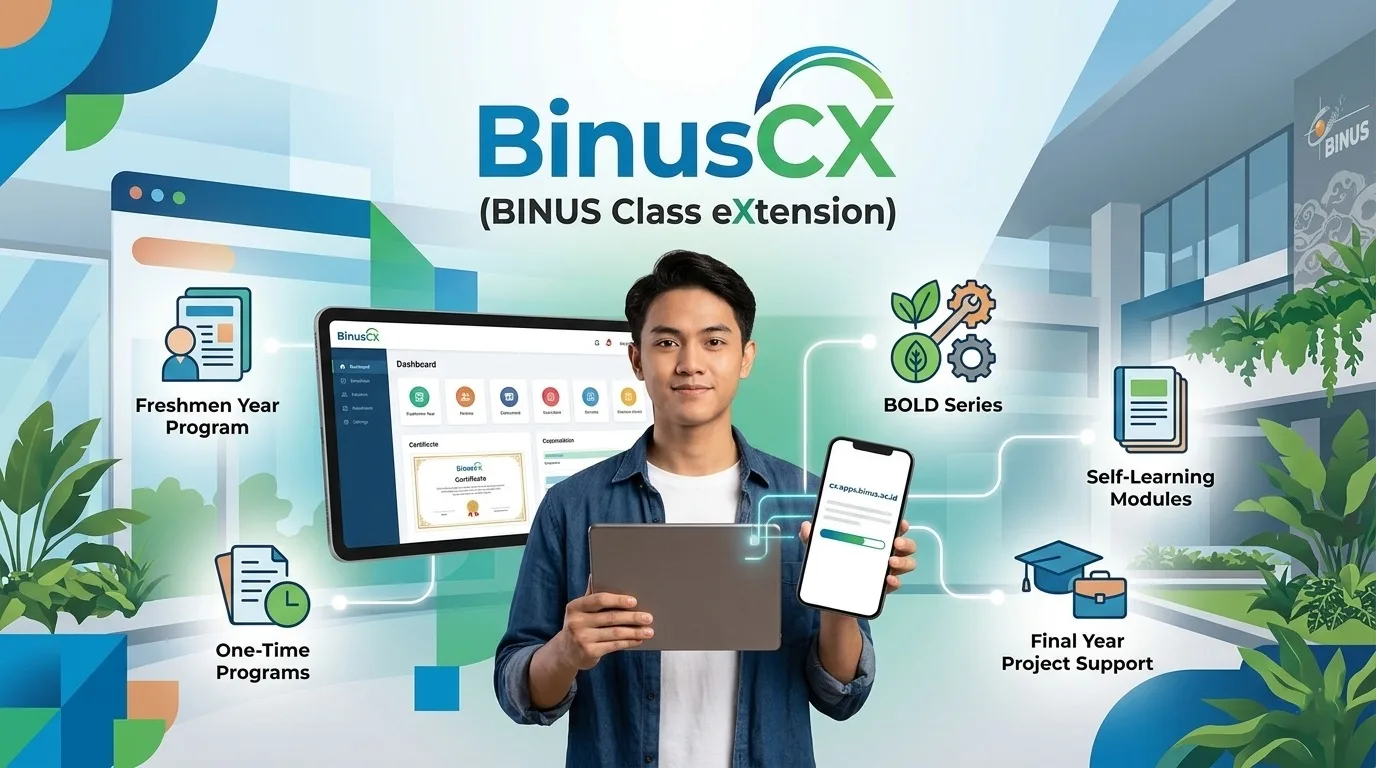
If you searched “BinusCX” expecting a vague explainer, you deserve better. BinusCX, the official abbreviation for BINUS Class eXtension, is a purpose-built digital learning platform developed by Bina Nusantara University in Jakarta, Indonesia. It was officially launched in October 2020 and has since grown into one of Southeast Asia’s most integrated academic ecosystems, serving tens of thousands of students across disciplines ranging from Computer Science to International Business Management.
This is not a generic customer experience tool wearing a university badge. BinusCX is a structured, cloud-hosted, and gamified learning platform accessible at cx.apps.binus.ac.id. Understanding what it actually is, how it works, and why it matters in 2026 is the goal of this guide
What Is BinusCX and What Does the Name Actually Mean?
The name causes genuine confusion online. Many websites incorrectly position BinusCX as some kind of enterprise customer experience software. The reality is specific and straightforward.
BinusCX stands for BINUS Class eXtension. The “CX” is not a reference to customer experience in the commercial sense. It signals the platform’s core ambition: to extend what happens inside a BINUS classroom into a flexible, interactive, and skills-focused digital environment. The university wanted to go beyond lectures, textbooks, and exams. BinusCX is their answer.
BINUS University, formally Bina Nusantara University, is one of Indonesia’s most respected private institutions. It holds an Excellent accreditation from BAN-PT, Indonesia’s National Accreditation Board for Higher Education, and carries a 5-star QS rating. In the 2024 World University Rankings, it placed among Indonesia’s top ten institutions. Building a platform of this scale reflects that institutional ambition directly.
BinusCX sits alongside two other key BINUS digital tools. BINUSMAYA handles official academic records, grades, and course administration. BINUS Mobile delivers notifications, schedules, and quick access on smartphones. BinusCX occupies a different lane entirely: it is where students go to build skills that employers actually want.
How BinusCX Was Born: The Origin Story Worth Knowing
The Problem That Created the Platform
Before BinusCX existed, BINUS students had access to solid academic instruction. What they lacked was a structured, on-demand space for developing the soft skills and digital competencies that do not always emerge from a traditional lecture format.
A small group of young BINUS employees noticed this gap around 2019. They watched the global shift toward digital education gathering speed and recognised that the university needed more than a temporary fix. They wanted a long-term learning infrastructure.
From Prototype to Platform in 2020
The first version of BinusCX launched as a prototype, refined through constant input from students, lecturers, and IT professionals. By October 28, 2020, the university formally rolled it out to support Digital Class programs and Student Independent Learning Activities, known in Indonesian as Kegiatan Belajar Mandiri Mahasiswa.
The timing was significant. The COVID-19 pandemic had already pushed global education online. But BinusCX was designed to outlast the crisis. Its founders built it as a permanent investment in the future of learning, not a stopgap.
Growing Beyond the Campus in 2024
In September 2024, BINUS took a bold step. The BINUS Alam Sutera campus hosted the Grand Opening of Extension Classes at Mall @Alam Sutera, physically embedding the BinusCX hybrid learning model into the broader community. The event signalled something important: this platform is not just for students inside campus walls. It is designed for lifelong learners too.
How BinusCX Actually Works: Inside the Platform

The Dashboard and Navigation
When a student logs into cx.apps.binus.ac.id, the first thing they see is a central dashboard. It surfaces active courses, upcoming deadlines, progress indicators, and announcements in one clean view. Students do not need to hunt across multiple applications. Everything is visible and actionable from one screen.
The platform uses single sign-on integration with BINUS University’s broader digital stack, including Microsoft 365. This means students who are already working in tools like Microsoft Teams or OneDrive move into BinusCX without needing separate credentials or a learning curve on top of a learning curve.
Self-Paced Learning and Course Structure
Courses on BinusCX are designed to be modular. Many run for as little as two hours, packed with practical content rather than padding. Students can complete them between classes, during a commute, or across a weekend. There are no rigid attendance requirements on the BinusCX side of things.
The platform supports a full multimedia content stack. Video lectures, interactive quizzes, downloadable reading materials, and discussion forums are all built in. This keeps learners actively engaged rather than passively absorbing slides.
Gamification and Motivation
One of BinusCX’s most distinctive design choices is its gamification engine. The system awards digital badges, leaderboard positions, and achievement certificates based on module completions and milestone performance. These are not cosmetic rewards. The certificates are stored digitally, carry verifiable metadata, and can be shared directly to LinkedIn or downloaded as PDFs.
For students preparing portfolios ahead of internship applications, this matters. Demonstrating completed BOLD Series certifications or a Freshmen Year Program track on a professional profile adds concrete evidence of skill development.
Mobile Access and Technical Architecture
BinusCX uses a progressive web app structure, meaning it works responsively across smartphones, tablets, and laptops without requiring a separate native app download. The backend relies on cloud infrastructure for reliability and scalability, allowing thousands of concurrent users during peak periods like semester kickoffs without significant downtime.
The platform’s technical team rolls out feature updates every quarter, driven by student feedback and evolving educational technology trends. Recent updates have included improved mobile navigation, accessibility features such as screen reader support and font resizing, and new AI-integrated leadership development tracks.
The Five Core Learning Categories on BinusCX
BinusCX organises its offerings into five major programme categories. Each one targets specific stages of a student’s academic journey.
| Category | Purpose | Who It’s For |
| Freshmen Year Program (FYP) | Orientation, digital tool onboarding, university life | Incoming BINUS students |
| One-Time Programs (OTP) | Specific skill workshops and topic-focused sessions | All students |
| BOLD Series | Industry-aligned tracks for emerging careers | Students across disciplines |
| Self-Learning Modules | Independently chosen skill development courses | All users |
| Final Year Project (FYP) Support | Career prep, resume guidance, capstone assistance | Senior students |
Freshmen Year Program: Where Every BinusCX Journey Begins
New BINUS students start with the Freshmen Year Program on BinusCX. The signature entry point is a course called “Hands on CX,” a structured orientation that walks students through the platform itself. It covers how to enroll in courses, navigate features, and access programme-specific materials for FYP activities.
From there, FYP Introduction modules cover university policies, campus resources, and study strategies. Specialized tracks like “Hands on BINUSMAYA” and “Hands on Microsoft 365” build the digital literacy students need to function in BINUS’s broader academic environment. Faculty Q&A webinars and reflective tasks run alongside these modules, helping students establish time management habits from their first semester onward.
BOLD Series: The Career-Readiness Engine
The BOLD Series is one of BinusCX’s most ambitious offerings. These are industry-specific learning tracks aligned with real employer demand. One active example is the BOLD Series IE module on Green Waste Management, covering sustainability policy and practice. Another is the BOLD Series IS module on Product Development for competitive advantage.
These are not generic career tips. They are designed with specific academic departments in mind, Information Engineering and Information Systems in those two examples, and they connect theoretical frameworks with real industry case studies.
BINUS Career Integration
Senior students on BinusCX can access BINUS Career services directly through the platform. This includes career counseling, resume review sessions, internship opportunity listings, and job placement support. The connection between the learning environment and the employment pipeline is intentional and direct.
What BinusCX Teaches: Skills That Employers Actually Want
Why Soft Skills Matter as Much as Technical Knowledge
Indonesia’s digital economy was projected to reach $130 billion by 2025, according to research from Google, Temasek, and Bain & Company. The workforce supporting that economy needs more than coding ability. It needs communication skills, adaptive thinking, and the capacity to lead teams across digital tools and remote environments.
BinusCX was designed with exactly this skills gap in mind. Its curriculum covers communication, leadership, emotional intelligence, digital literacy, and collaborative problem-solving. These are the competencies that consistently appear at the top of Southeast Asian employer surveys but rarely emerge from traditional lecture-based instruction alone.
The Platform’s Learning Philosophy
BinusCX leans on a project-based learning model. Rather than asking students to memorise and reproduce information, it asks them to apply knowledge in scenarios that mirror real work challenges. Group projects, industry case studies, real simulations, and peer review processes all feature across the platform’s modules.
This approach is backed by decades of educational research. Project-based learning, when implemented well, produces stronger retention, better collaborative skills, and graduates who can actually do the work on their first day in a job, rather than spending months bridging the gap between classroom theory and workplace reality.
BinusCX Compared to Other Learning Management Systems
Where BinusCX Stands Apart
Many universities in Southeast Asia use off-the-shelf LMS platforms like Moodle, Canvas, or Blackboard. These are capable systems, but they are generic. They were not designed around the specific profile of an Indonesian university student preparing for a regional job market.
BinusCX is different for several reasons:
- It is purpose-built for BINUS’s curriculum and graduate attribute framework, meaning every module connects to measurable learning outcomes that the university tracks.
- Its gamification layer is native to the platform, not a bolt-on feature.
- Its integration with Microsoft 365 and BINUSMAYA creates a cohesive digital environment rather than a fragmented set of tools.
- Its BOLD Series tracks are updated based on real industry feedback, not static curriculum committees reviewing content every few years.
- Its certification system produces verifiable credentials that employers in Indonesia recognise.
What BinusCX Does Not Replace
BinusCX supplements formal coursework. It does not replace BINUSMAYA’s role in managing grades, official class records, or formal academic administration. Students who expect BinusCX to function as their primary academic management system will find it is not designed for that. It is an extension, by its own name, not a replacement.
Real Student Experiences with BinusCX
Student testimonials consistently highlight two themes. The first is flexibility. Students managing part-time work, family obligations, or long commutes find that BinusCX’s self-paced structure allows them to engage with learning on their own schedule without sacrificing quality.
The second is practical relevance. Students like Jessica Eveline, cited in platform reviews, noted that BinusCX allowed her to balance running a small business with her studies. Finddy Wong, another student whose experience appears in platform documentation, pointed to how applying theoretical concepts from BinusCX modules directly to his work deepened his understanding of ideas that might otherwise have remained abstract.
These are not extraordinary cases. They reflect the platform’s design intent. When learning tools are built around real student lives rather than ideal student schedules, outcomes improve.
Challenges and Honest Limitations of BinusCX
No honest account of BinusCX leaves out its friction points.
Internet Dependency
BinusCX is a cloud-hosted platform. Students without reliable broadband face real barriers, particularly in regions of Indonesia where connectivity remains uneven. The platform’s development team is working on offline-ready modules to address this, but as of 2026, a stable internet connection remains a prerequisite for meaningful use.
The Learning Curve for New Users
First-time users sometimes feel disoriented. The platform has a significant depth of content and features. The “Hands on CX” orientation module helps considerably, but students who skip it and dive straight into course content sometimes spend their first sessions navigating rather than learning.
Occasional Server Downtime
During peak enrollment periods, particularly at the start of each semester, the platform experiences occasional slowdowns. BINUS’s IT infrastructure team addresses these through cloud scaling mechanisms, but they are a real if intermittent frustration.
Communication Gaps in Group Projects
Collaborative modules require students to coordinate across schedules, time zones in the case of international programs, and varying levels of digital communication comfort. The platform provides the tools. Whether teams use them effectively depends on the individuals involved.
BinusCX and Indonesia’s Broader Digital Education Landscape
Indonesia has over 4,500 registered universities and higher education institutions, according to the Ministry of Education and Culture’s 2023 data. The pressure to produce graduates who are genuinely work-ready, not just degree-holding, is acute. Employers consistently report that soft skills deficits are their primary hiring challenge, not technical knowledge gaps.
BinusCX represents one of the most structurally serious attempts by an Indonesian institution to close that gap at scale. By embedding skill development directly into the academic lifecycle, from freshmen orientation through to final-year project support, BINUS is not treating soft skills as optional enrichment. It is treating them as core curriculum.
This model has implications beyond BINUS’s own student population. As Indonesia’s digital economy continues to expand and as remote and hybrid work becomes standard across sectors from fintech to e-commerce to logistics, the demand for graduates who can communicate clearly, collaborate digitally, and adapt quickly will only intensify.
Quick Reference: BinusCX at a Glance
| Fact | Detail |
| Full Name | BINUS Class eXtension |
| Developer | Bina Nusantara University (BINUS), Jakarta, Indonesia |
| Official Launch | October 28, 2020 |
| Platform URL | cx.apps.binus.ac.id |
| Primary Users | BINUS students, lecturers, industry partners |
| Core Function | Supplementary digital learning and skill development |
| Key Features | Gamification, certificates, self-paced modules, BOLD Series |
| Integration | BINUSMAYA, Microsoft 365, BINUS Mobile |
| Access | Multi-device via progressive web app |
| Total Enrollments | Over 90,000 across key foundation tracks |
Frequently Asked Questions About BinusCX
What does BinusCX stand for?
BinusCX stands for BINUS Class eXtension. It is a digital learning platform developed by Bina Nusantara University in Jakarta, Indonesia. The “CX” refers to the concept of extending classroom learning into an interactive, flexible online environment, not to commercial customer experience software.
When was BinusCX officially launched?
BinusCX was officially launched on October 28, 2020. It was originally conceived in 2019 by a group of BINUS employees who identified the need for a long-term digital learning infrastructure, not just a pandemic response.
Who can use BinusCX?
BinusCX is primarily designed for BINUS University students, from freshmen entering their first semester through to final-year students preparing for graduation and employment. Lecturers and industry partners also use the platform to create content, post project opportunities, and engage with students in collaborative learning activities.
Is BinusCX the same as BINUSMAYA?
No. BINUSMAYA handles official academic records, class schedules, grade management, and formal course administration. BinusCX is a separate platform focused on supplementary skill development, soft skills training, industry certification, and project-based learning. The two platforms integrate but serve different purposes.
Can I access BinusCX on a phone?
Yes. BinusCX uses a progressive web app structure, which means it works across smartphones, tablets, and desktop computers without requiring a separate native app. The mobile experience is responsive and functional across standard Android and iOS browsers.
What is the BOLD Series on BinusCX?
The BOLD Series is a set of industry-specific learning tracks on BinusCX aligned with emerging career demands. Examples include modules on Green Waste Management and sustainability policy for Information Engineering students, and Product Development for competitive advantage for Information Systems students. These tracks are updated regularly to reflect real employer needs.
Are BinusCX certificates recognised by employers?
Certificates earned through BinusCX are stored digitally with verifiable metadata. They can be shared directly to LinkedIn or downloaded as PDFs. The certificates are designed to align with BINUS’s graduate attribute framework and reflect skills that Indonesian employers specifically seek in candidates.
How does BinusCX use gamification?
BinusCX awards digital badges, leaderboard positions, and achievement certificates based on module completions and milestone performance. A custom-built gamification engine tracks user activity and awards these credentials dynamically as students progress through course content.
What is the “Hands on CX” module?
Hands-on CX is BinusCX’s signature onboarding module for new users. It provides a guided tour of the platform’s interface, explains how to enrol in courses, and covers the key features students will use throughout the Freshmen Year Program. It is the recommended starting point for all new BinusCX users.
What challenges do BinusCX users typically face?
The most commonly reported challenges are internet connectivity dependency, an initial learning curve for new users who skip the orientation module, and occasional server slowdowns during peak enrollment periods. Students engaged in collaborative modules also report communication challenges when group members have different levels of digital communication familiarity.
The Future of BinusCX in 2026 and Beyond
BINUS University continues to develop BinusCX as a living platform rather than a static tool. The most recent updates have introduced AI-integrated leadership development tracks, improved mobile accessibility features, and new offline module support for students in lower-connectivity regions.
The trajectory is clear. As Indonesia’s digital economy matures and as more BINUS graduates enter industries built on remote collaboration, data analysis, and digital communication, the skills BinusCX develops become more valuable, not less. The platform is positioned not as a nice-to-have enrichment tool but as a core part of what it means to be a BINUS graduate in the 2020s.
For students entering BINUS University today, BinusCX is not optional. It is the environment where much of their professional formation will happen, alongside their formal academic coursework. Understanding it, using it consistently, and taking its certifications seriously can genuinely differentiate a graduate in a competitive job market.
For anyone researching BinusCX from outside Indonesia, the platform represents a model worth studying. It shows what a university looks like when it stops treating soft skills as a secondary concern and builds an entire digital ecosystem around developing them at scale.
You can read more about digital learning ecosystems and their evolution at Wikipedia’s article on learning management systems.
Read More: David Hefner: The Full Story of Hugh Hefner’s Eldest Son Who Chose His Own Path