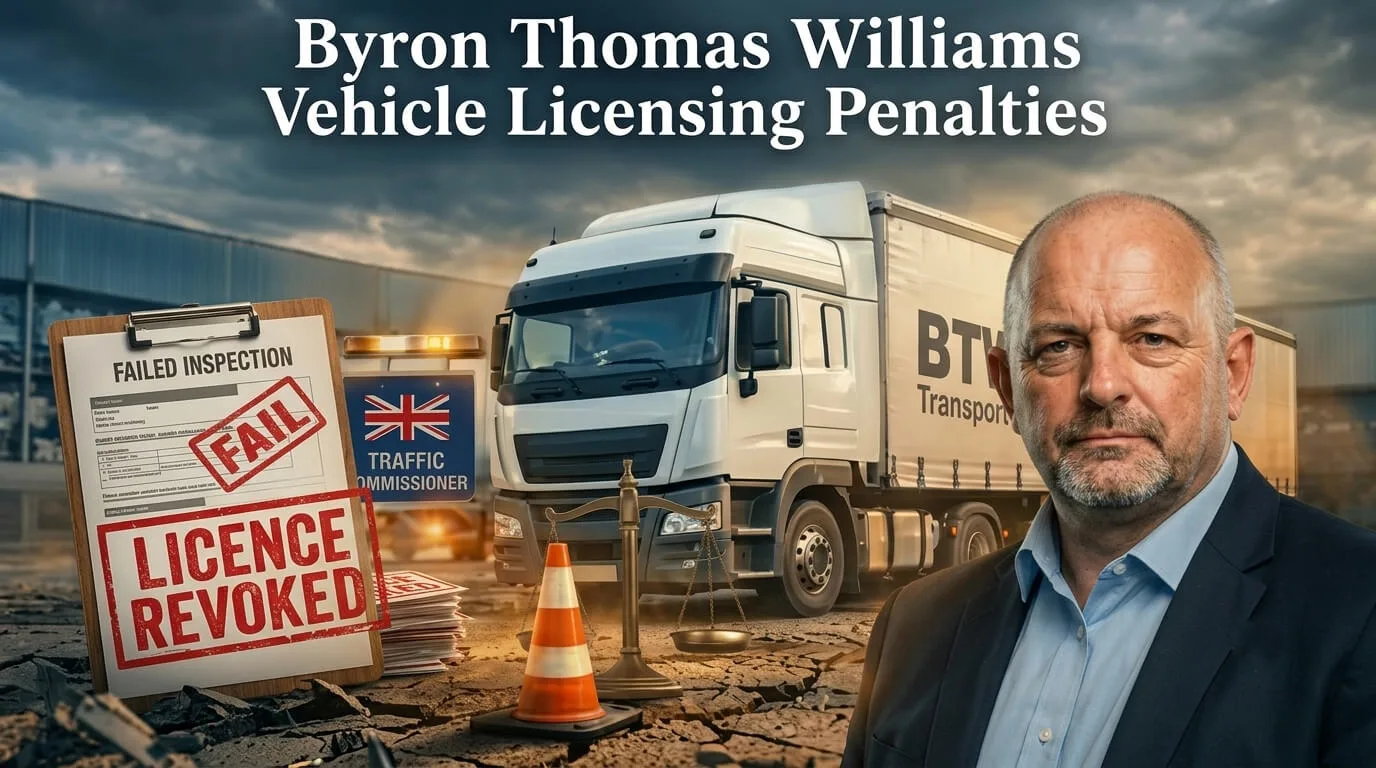
A single vehicle inspection in West Yorkshire set off a chain of events that would end a haulage business, destroy a career, and put two people’s reputations in front of a public inquiry. The Byron Thomas Williams vehicle licensing penalties case is not a cautionary tale buried in legal footnotes.
It is a documented, real-world collapse that happened because a director repeatedly chose convenience over compliance and got away with it just long enough to lose everything. If you run a transport company, manage a fleet, or hold an operator’s licence in the UK, analyzing the Byron Thomas Williams vehicle licensing penalties should stop you in your tracks. The same regulatory framework that caught BTW Transport Ltd applies to every operator on British roads today.
Who Is Byron Thomas Williams?
Byron Thomas Williams, also referred to in official Traffic Commissioner documents as Byron Williams, was the sole director of BTW Transport Ltd, a haulage company based in West Yorkshire, operating out of the North East of England.
| Detail | Information |
| Full Name | Byron Thomas Williams |
| Role | Sole Director, BTW Transport Ltd |
| Company | BTW Transport Ltd |
| Licence Type | Standard National Goods Vehicle Operator’s Licence |
| Vehicles Authorised | 7 lorries, 8 trailers |
| Inquiry Location | Leeds |
| Presiding Official | Deputy Traffic Commissioner Gerallt Evans |
| Licence Revocation Date | 22 October 2025 |
| Disqualification Period | 12 months (until 22 October 2026) |
The company held a standard national goods vehicle operator’s licence, authorised to run seven lorries and eight trailers. That licence gave BTW Transport Ltd the legal right to use heavy goods vehicles on public roads for paid haulage work across England. Williams was not a passive shareholder. He was the company’s sole director, which made him directly responsible for everything that happened inside that business.
What Is a UK Operator’s Licence and Why Losing It Is Catastrophic
Before unpacking how the Byron Thomas Williams vehicle licensing penalties unfolded, it helps to understand exactly what an operator’s licence means in the UK transport industry. Any business that wants to use heavy goods vehicles over 3.5 tonnes for commercial purposes must hold an operator’s licence issued by the Traffic Commissioner.
The Traffic Commissioners for Great Britain are independent regulators appointed by the government. They monitor compliance on an ongoing basis, respond to inspection reports from the Driver and Vehicle Standards Agency (DVSA), and hold public inquiries when operators fail to meet their obligations.
When a company receives a licence, it formally commits to:
- Maintaining all vehicles in a fit and serviceable condition.
- Using an adequate system for inspecting vehicles at agreed intervals.
- Keeping maintenance records that accurately reflect the condition of each vehicle.
- Ensuring drivers carry out and properly report daily walkaround checks.
When those undertakings are broken consistently, the Traffic Commissioner can restrict, suspend, or revoke the licence entirely. Revocation means the business stops operating immediately. The Byron Thomas Williams vehicle licensing penalties case ended in exactly that outcome.
How the Investigation Began
The case did not begin with a dramatic crash or a whistleblower exposé. It began the way most compliance failures in the transport industry get exposed: a routine roadside inspection by DVSA enforcement officers. During that check, inspectors found serious defects on one of BTW Transport’s vehicles.
The DVSA Inspection That Changed Everything
The roadside inspection uncovered defects that should never have been present on a vehicle leaving a well-managed depot. In one single inspection, a vehicle and trailer combination from BTW Transport received eight immediate prohibitions.
To put that in context: a prohibition notice means a vehicle is judged unfit for use on public roads. A single prohibition is serious. Eight on one vehicle is a catastrophic failure of every maintenance and inspection process that should have caught those problems weeks or months earlier.
The S-Marked Tyre Problem
Among the most serious individual findings were multiple “S”-marked prohibitions for defective tyres. In DVSA enforcement language, an “S”-marked prohibition is issued when a vehicle presents a serious and imminent danger to road safety. Finding multiple S-marked prohibitions across BTW Transport’s fleet told inspectors that this was not a one-off failure; it was a severe operational pattern.
What the Public Inquiry Uncovered
Because the inspection results were so alarming, the case was referred for a public inquiry before Deputy Traffic Commissioner Gerallt Evans, held in Leeds. Public inquiries under the Traffic Commissioner system are formal regulatory proceedings. What emerged during the Leeds inquiry painted a deeply troubling picture of how BTW Transport Ltd had been run.
Falsified Preventive Maintenance Inspection Records
Investigators found that BTW Transport’s preventive maintenance inspection (PMI) records contained references to components that were not actually fitted to the vehicles. Listing parts in a maintenance record that do not exist on the vehicle means the record is false. Under the Traffic Commissioner’s Guide to Maintaining Roadworthiness, operators must keep accurate, auditable PMI records. False PMI records undermine that entire system.
Missing Brake Tests
Consistent brake testing is one of the most critical elements of any HGV maintenance regime. The Guide to Maintaining Roadworthiness is explicit: brake performance must be tested and recorded at every PMI. The inquiry found that BTW Transport’s maintenance records lacked consistent brake testing. Basic brake performance data was simply absent from the record.
Nil Defect Reports That Did Not Reflect Reality
Every day, drivers operating HGVs are required to carry out a walkaround check before departure and submit a defect report. At BTW Transport, drivers were regularly submitting “nil defect” reports at a time when DVSA inspectors were finding serious faults on the same vehicles. Either the drivers were not carrying out proper checks, or they were submitting reports that did not reflect what they actually found.
The Change of Maintenance Provider Breach
BTW Transport also failed to notify the Traffic Commissioner when it changed its maintenance provider. Under the terms of an operator’s licence, any material change to maintenance arrangements must be reported promptly. Vehicles were also not being inspected at the six-week intervals specified on the licence undertaking. Both failures are direct breaches of the conditions under which the licence was granted.
Deputy Traffic Commissioner Gerallt Evans on Williams’s Credibility
Perhaps the most damaging part of the public inquiry was the deputy commissioner’s assessment of Byron Williams himself. After hearing his evidence, Deputy Traffic Commissioner Gerallt Evans stated that Williams’s testimony “was at times disingenuous.” He added: “When challenged with difficult facts, he has a propensity to say the first thing that enters his mind to excuse or minimise the conduct alleged. That does not inspire confidence.”
Operating After Revocation and Further Breaches
This is the point in the case that separates it from ordinary compliance failures and makes the Byron Thomas Williams vehicle licensing penalties truly severe. BTW Transport’s operator’s licence was first revoked on 6 November 2024. Williams was personally informed of that decision.
Despite knowing the company no longer had a valid operator’s licence, the inquiry found that Williams “consciously and deliberately” allowed the company’s vehicles to continue operating for three weeks after the revocation notice was served.
Operating Without Valid Excise Duty
The inquiry also found that BTW Transport’s vehicles were used without valid excise duty (Vehicle Excise Duty, or VED). Failing to pay VED while continuing commercial operations gives a business an unfair financial advantage over compliant competitors who carry those costs. Combined with operating after licence revocation, it demonstrated a deliberate disregard for legal obligations at multiple levels.
The Full Penalties Handed Down in the Byron Williams Case
The outcome of the Leeds public inquiry, formally recorded on 22 October 2025, included severe administrative actions to safeguard public roads.
| Subject / Individual | Penalty Imposed by Traffic Commissioner |
| BTW Transport Ltd | Operator’s licence revoked at 23:45 on 22 October 2025 |
| BTW Transport Ltd | Disqualified from holding any operator’s licence until 22 October 2026 |
| Byron Thomas Williams | Disqualified for 12 months from holding or being involved in any operator’s licence |
| Nichola Ogilvie (Transport Manager) | Found to have lost good repute; disqualified indefinitely until further order |
The licence revocation means BTW Transport Ltd cannot legally operate HGVs at all. For Byron Williams personally, the 12-month disqualification prevents him from holding, obtaining, or being involved in any operator’s licence, including as a director of a new transport venture.
The penalty for transport manager Nichola Ogilvie carries no fixed end date. She was disqualified from acting as a transport manager until further order, meaning indefinitely pending a future review.
Why This Case Stands Out From Ordinary Licence Revocations
The UK Traffic Commissioner system handles dozens of licence revocations every year. However, the Byron Thomas Williams vehicle licensing penalties case attracted wider attention for specific reasons:
- Post-Revocation Operation: Continuing to run vehicles after being informed that the licence was revoked is an act of deliberate non-compliance, not an administrative oversight.
- The Breadth of Simultaneous Failures: This was not a company that had one weak area. Maintenance records were falsified, brake tests were missing, tyre conditions were dangerous, and VED was completely ignored.
- The Credibility Finding: A formal finding by a Deputy Traffic Commissioner that a director’s evidence was “disingenuous” reflects a complete breakdown of trust between the operator and the regulator.
How Transport Companies Can Avoid These Strategic Mistakes
The Byron Thomas Williams vehicle licensing penalties case serves as a practical corporate checklist of everything that can go wrong when compliance culture breaks down. Here is what modern fleet operators must enforce:
- Maintain a Robust PMI System: Preventive maintenance inspections must be carried out at the exact intervals specified in the licence undertaking (usually every six weeks). The paperwork must always reflect physical reality.
- Build a Real Defect Reporting Culture: Drivers must be trained to conduct rigorous walkaround checks. Managers who discourage defect reporting to avoid short-term workshop costs risk severe regulatory penalties.
- Keep the Regulator Informed: Any material change to maintenance arrangements, operating centres, or management structures must be notified to the Traffic Commissioner promptly.
- Respond Honestly to Scrutiny: When the DVSA asks questions, absolute transparency is the only viable path. Attempting to minimize or mislead during regulatory proceedings dramatically increases the severity of the sanctions.
Conclusion: The Lasting Lessons of the BTW Case
The Byron Thomas Williams vehicle licensing penalties did not arrive without warning. They were the accumulated result of systemic maintenance failures, inaccurate record-keeping, and operational decisions that prioritized short-term convenience over public safety.
An operator that falsifies maintenance records, ignores PMI intervals, fails to pay VED, and then continues to operate after a shutdown order cannot be trusted to keep heavy vehicles safe on public roads.
For transport directors analyzing corporate governance, the lesson is clear: an operator’s licence is not mere paperwork. It is a strict commitment to safety that must be renewed through daily compliance, transparent record-keeping, and absolute operational integrity.
(FAQs)
What exactly are the Byron Thomas Williams vehicle licensing penalties?
The Byron Thomas Williams vehicle licensing penalties refer to the formal regulatory sanctions imposed by Deputy Traffic Commissioner Gerallt Evans. These included the immediate revocation of BTW Transport Ltd’s licence, a 12-month ban for the company, and a personal 12-month disqualification for director Byron Williams.
Why was BTW Transport Ltd’s operator’s licence revoked?
The licence was revoked due to repeated failures in vehicle safety, including falsified PMI records, completely missing brake test data, dangerous tyre defects, and operating commercial vehicles after an official revocation notice.
Did BTW Transport really operate after losing its licence?
Yes. The public inquiry confirmed that Byron Thomas Williams consciously permitted the company’s HGVs to continue commercial operations for approximately three weeks after the initial revocation notice was served in November 2024.
What is the significance of an “S”-marked DVSA prohibition?
An “S”-marked prohibition indicates a critical defect that presents an immediate risk to road safety, signaling a significant failure in the company’s internal maintenance and vehicle inspection protocols.
How long is Byron Williams disqualified from the transport industry?
Byron Williams is personally disqualified from holding, obtaining, or being a director of any company holding an operator’s licence until 22 October 2026
For more background on the UK operator licensing framework and Traffic Commissioner functions, see the Traffic Commissioners for Great Britain.
Read More: Microwey: The Smart Microwave That Fixes Every Kitchen Problem