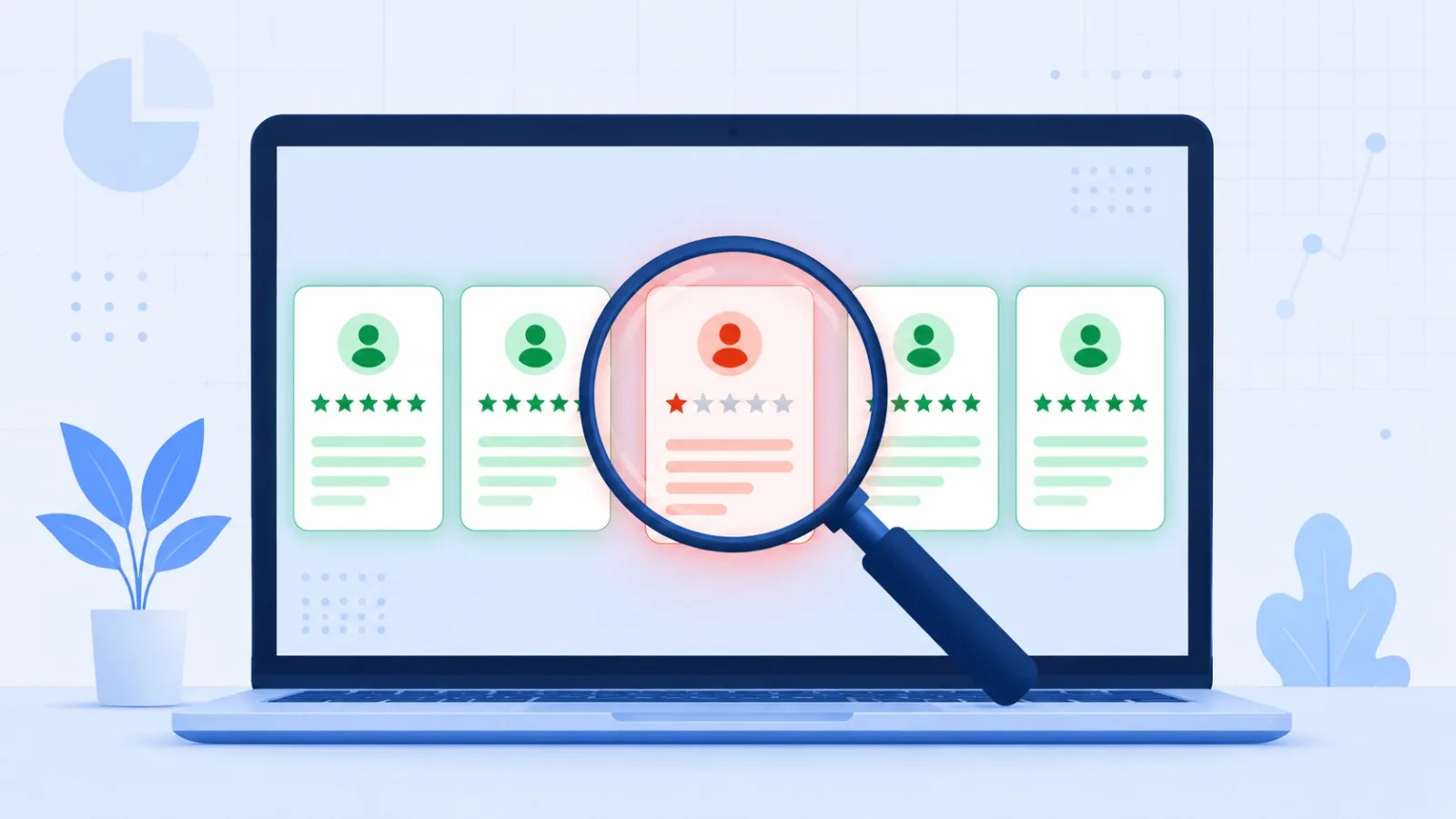
The fastest way to spot a fake Trustpilot review is to check the detail level, the posting pattern, and the reviewer history together. A fake Trustpilot review usually shows vague praise, no real detail, and a posting pattern that does not match the business size. Check the reviewer history, the review date pattern, and the language before you trust a star rating.
Fake Trustpilot reviews often use generic five star praise with no specific detail about the order. Genuine reviews mention small, ordinary things like delivery time, sizing, or a support call. If a business has a sudden flood of similar five star reviews in a short window, treat the rating with caution.
Key Takeaways
- Vague, overly polished five star reviews are the biggest warning sign.
- Sudden bursts of reviews in a short time often signal a paid campaign.
- Reviewer history tells you more than the review text alone.
- Trustpilot’s own detection tools remove millions of fake reviews every year, but not all of them.
- UK law now treats posting or buying fake reviews as a banned practice.
While pulling review data for this piece, one pattern kept repeating. The businesses with the most polished five star pages were often the ones with the thinnest reviewer histories behind them. That gap between a shiny score and shallow evidence is exactly why shoppers need to know how to spot a fake Trustpilot review before they buy.
A fake Trustpilot review is any review that does not come from a genuine buying experience. That includes reviews bought from a seller, written by a bot, or posted by someone with no real order. Trustpilot’s own moderation removed 4.5 million reviews in 2024 alone, roughly 7.4 percent of everything submitted that year, according to Trustpilot’s Trust Report.
What Counts as a Fake Trustpilot Review
A review counts as fake when it does not reflect a real transaction with the business. This includes reviews from a rival trying to damage a competitor’s score. It also includes glowing reviews traded for a discount or a free product.
Trustpilot’s own guidelines are direct about this. The platform states plainly that a fake review is one that does not reflect a genuine experience. That single line covers bought reviews, bot reviews, and reviews written by staff pretending to be customers.
Not every bad or unfair review is fake. A frustrated customer who exaggerates a small delay is still describing something real. The test is whether an actual purchase or interaction ever happened.
Why Fake Trustpilot Reviews Are Harder to Spot Now
Generative writing tools changed the game for review fraud. A few years ago, fake reviews often had stiff grammar or repeated phrases. Now a batch of a hundred unique sounding reviews can be produced in an afternoon.
The old advice to watch for bad spelling no longer holds up well. Text generated by modern tools reads smoothly and varies its wording. That means the words alone are a weaker signal than they used to be.
What still works is looking at behaviour rather than just language. Posting speed, account age, and review clustering are harder for a fake review campaign to fake convincingly. Those patterns sit behind the review, not inside the sentence itself.
The Clearest Signs of a Fake Trustpilot Review
Learning how to spot a fake Trustpilot review gets easier once you know which details actually matter. Use this checklist before you let a star rating decide a purchase.
- No specific detail about the product, order number, or delivery experience.
- Overly polished, marketing style language such as “exceeded all expectations.”
- A cluster of five star reviews posted within hours of each other.
- A reviewer profile with only one review ever, posted for that business.
- Star ratings that swing wildly with no middle ground reviews at all.
- A short review history that appeared right after a bad news story about the company.
Any single point on this list is not proof by itself. Genuine customers can also write short, generic praise. The signal gets stronger when several of these points line up together on the same page.
Genuine Review vs Fake Review Side by Side
Reading one review in isolation rarely tells you much. Comparing traits side by side makes the pattern clearer.
| Signal | Genuine Review | Likely Fake Review |
| Detail level | Names a specific product, size, or issue | Stays vague, praises “great service” only |
| Timing | Spread out over weeks or months | Clustered within hours or a single day |
| Reviewer history | Multiple reviews across different businesses | One review, one business, no other activity |
| Tone | Mixes praise with a minor complaint | Flawless, uniformly glowing, no nuance |
| Star pattern | Some three and four star reviews mixed in | Almost entirely five star with few exceptions |
This table is not a strict formula. A brand new customer can genuinely leave their first ever review. Treat it as a set of clues to weigh together, not a pass or fail test.
How to Check a Business Before You Trust Its Score
A high star average on its own does not confirm trust. A short verification routine takes under two minutes and adds real confidence.
- Open the reviewer’s profile and check how many reviews they have posted overall.
- Sort reviews by date and look for unnatural spikes in a short window.
- Read three or four of the lowest rated reviews for repeated complaints.
- Search the business name alongside the word reviews on a search engine.
- Check whether the business responds to negative reviews or ignores them.
This routine works for any review platform, not only Trustpilot. The habit of checking reviewer history before trusting a score is the real skill here. It transfers across Google Maps, Amazon, and app store ratings too.
What Trustpilot and UK Law Say About Fake Reviews
Trustpilot screens every review through automated detection before it goes live. According to Trustpilot’s own Trust Report, the platform removed 4.5 million fake reviews in 2024. Around 90 percent of those were caught automatically before a human ever saw them.
UK law has also caught up with the problem. Under the Digital Markets, Competition and Consumers Act 2024, posting, buying, or commissioning a fake review is now a banned commercial practice. The Competition and Markets Authority published detailed guidance on this rule in April 2025.
That guidance places legal responsibility on businesses, not just individual reviewers. A company that pays for reviews or hides incentivised feedback can face enforcement action. This shifts real financial risk onto brands that try to game their score.
What to Do If You Spot a Fake Trustpilot Review
Flagging a suspicious review takes only a few steps. Click the flag icon shown below the review text. Choose the reason that best matches what you noticed, such as no genuine experience.
Trustpilot then reviews the flag using both automated checks and human moderators. You will not always get a personal update on the outcome. The review either stays, gets a consumer alert label, or is taken down.
If you are the one being reviewed unfairly, Trustpilot’s business tools include a Find Reviewer feature. It lets a business request proof of a transaction from the reviewer. This helps separate genuine complaints from reviews with no real purchase behind them.
Is Trustpilot trustworthy as of 2026?
Trustpilot remains a widely used and largely reliable platform, though not every review on it is genuine. Its automated detection removes millions of fake reviews yearly, but a share of fraudulent content still slips through. Reading with a critical eye still matters, even on an established platform.
Can you tell a fake review just from the writing style?
Writing style alone is no longer a reliable test. Modern writing tools produce smooth, varied text that avoids the old red flags like poor grammar. Behaviour signals such as posting speed and reviewer history matter more now.
Why would a business buy fake Trustpilot reviews?
A higher star rating can influence buying decisions for a large share of shoppers. Some businesses see paid reviews as a shortcut to that trust. UK law now treats this as a banned practice with real enforcement risk attached.
Does Trustpilot remove fake reviews automatically?
Yes, Trustpilot runs every submitted review through automated detection technology first. Reviews that fail these checks are taken offline before most users ever see them. Flagged reviews that pass automated checks can still be reported by users afterward.
What should I do if I think a review is fake?
Click the flag icon under the review and select the closest matching reason. Trustpilot will investigate using a mix of automated tools and human review. You can also cross check the business name on another review platform for comparison.
Are one star reviews more likely to be fake than five star ones?
Both extremes can be manipulated, but five star clusters are the more common fake pattern. Rival businesses occasionally post fake one star reviews to damage a competitor. The same detection checklist applies regardless of which direction the fake review pushes the score.
In the end, no single trick catches every fake review on sight. Knowing how to spot a fake Trustpilot review is really a habit, not a one time check. Treat a star rating as a starting point, not a verdict, and the score becomes far more useful.
For general background on the platform, see the Trustpilot Wikipedia page. For the legal framework on fake reviews in the UK, see the official CMA fake reviews guidance, CMA208.
For a fuller picture of how the platform tracks and removes fraudulent reviews, Trustpilot publishes its own findings in its official Trust Report.