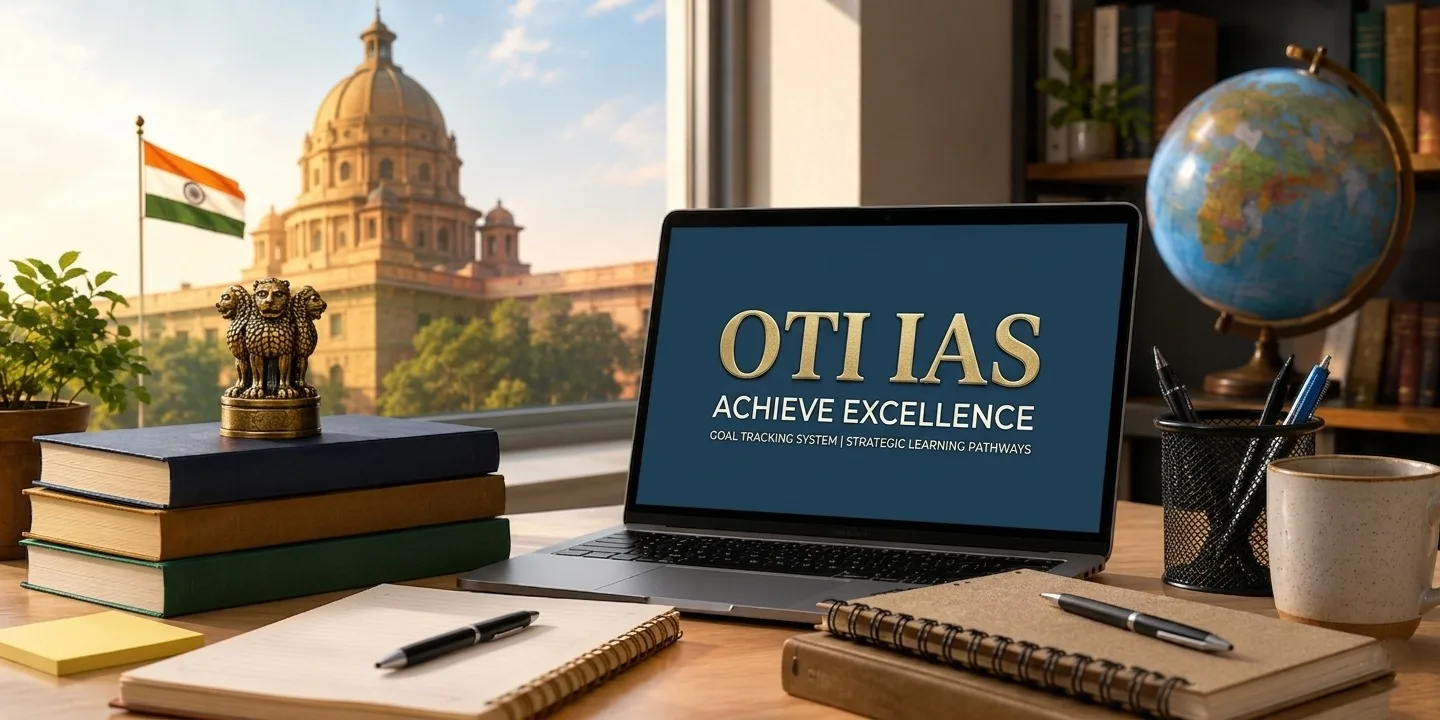
Every year, roughly 13.4 lakh candidates sit for the UPSC Civil Services Examination. Fewer than 1,100 of them make the final merit list. That is a pass rate of barely 0.2%. If you are preparing for this exam, you already know the odds. What you may not know is how a platform called OTI IAS is reshaping the way serious aspirants approach this challenge , and why it is becoming one of the most talked-about names in structured UPSC preparation today.
OTI IAS stands for Online Training Institute for Indian Administrative Services. It is a digital coaching platform built specifically to prepare candidates for all three stages of the UPSC Civil Services Examination , the Preliminary exam, the Mains, and the Personality Test (Interview). Unlike generic study apps or overloaded classroom institutes, OTI IAS delivers a focused, roadmap-driven preparation system designed to help aspirants move from confusion to clarity.
What Exactly Is OTI IAS and Who Is It For?
OTI IAS is a structured coaching ecosystem that brings together expert faculty, live and recorded classes, answer writing practice, mock tests, and one-on-one mentorship , all under one digital roof. It is built for candidates who want to crack the UPSC Civil Services Exam without relocating to Delhi or Hyderabad.
The platform serves four major categories of aspirants.
Fresh graduates who have just finished their bachelor’s degrees get a clear, subject-by-subject foundation course. They don’t need prior coaching experience to start.
Working professionals preparing alongside jobs benefit from flexible weekend batches and recorded sessions they can access after office hours.
Repeat aspirants , students who have attempted UPSC before but did not clear , get personalised gap analysis and targeted improvement plans.
NRI and diaspora aspirants who live outside India but meet UPSC’s citizenship and age requirements can access the full curriculum through time-zone-friendly batch schedules.
This breadth of reach is one of the reasons OTI IAS has built a growing reputation in a crowded coaching market.
The UPSC Civil Services Examination: Understanding the Mountain You Are Climbing
Before understanding how OTI IAS works, it helps to understand exactly what the UPSC Civil Services Examination demands. The Union Public Service Commission (UPSC), headquartered in New Delhi, conducts this exam annually to recruit candidates for services including the Indian Administrative Service (IAS), the Indian Police Service (IPS), and the Indian Foreign Service (IFS). The examination has three distinct stages.
Stage 1: Civil Services Preliminary Examination (Prelims)
The Prelims is a screening test consisting of two objective papers. Paper I is General Studies, with 100 questions worth 200 marks. Paper II is CSAT (Civil Services Aptitude Test), a qualifying paper with a 33% minimum threshold. Only marks from Paper I count toward the cut-off. In the 2024 UPSC Prelims, held on June 16, 2024, approximately 13.4 lakh candidates appeared across 79 centres. Just 14,627 cleared this stage , a qualification rate of roughly 1.09%.
Stage 2: Civil Services Mains Examination
The Mains is a nine-paper written examination that tests depth of knowledge, analytical thinking, and structured writing. It includes four General Studies papers (GS1, GS2, GS3, GS4), one Essay paper, one optional subject (two papers), and two language papers. The 2024 Mains was conducted from September 20 to 29, 2024. All 14,627 Prelims qualifiers appeared. From this group, 2,845 candidates advanced to the Interview stage.
Stage 3: Personality Test (Interview)
The Interview is conducted by a UPSC board in New Delhi and carries 275 marks. It tests personality, decision-making ability, ethical judgement, and communication skills. Final selection is based on the combined Mains and Interview score. In the 2024 cycle, Shakti Dubey from Uttar Pradesh secured All India Rank 1 with 1,043 marks.
This three-stage structure is why OTI IAS builds its entire curriculum around an integrated approach , treating Prelims, Mains, and Interview not as separate events but as a single, continuous journey.
How OTI IAS Works: The 5-Pillar Preparation System

OTI IAS is not simply a library of video lectures. Its value lies in a five-part system that keeps aspirants on track from day one through the final interview.
Pillar 1: Structured Syllabus Roadmap
The UPSC syllabus is enormous. It spans History, Geography, Polity, Economy, Environment, Science and Technology, Ethics, and Current Affairs , across both Prelims and Mains. Most aspirants who fail do so not because they are unintelligent, but because they study the wrong topics in the wrong order with no strategy.
OTI IAS solves this with a week-by-week syllabus plan. Each subject is divided into small, digestible modules. Aspirants always know what to study today, what to revise next week, and which topics need deeper attention. This structure eliminates the single biggest enemy of UPSC preparation: directionless studying.
Pillar 2: Expert Faculty and Conceptual Teaching
OTI IAS faculty members are experienced in the specific demands of UPSC, not just their subject areas. They teach conceptual clarity over surface-level facts. For example, when covering Indian Polity, the teaching method connects the original text of the Constitution of India (enacted on November 26, 1949) to contemporary governance challenges , the kind of analytical linkage that UPSC Mains questions demand.
This teaching approach is particularly important for the GS papers, where correct answers require connecting static knowledge with dynamic current affairs.
Pillar 3: Answer Writing Programme
Answer writing is the single most underrated skill in UPSC preparation. Thousands of aspirants who are knowledgeable still fail Mains because they cannot present their knowledge in the structured, time-bound format the exam requires. A typical UPSC Mains answer needs to be written in 7 to 10 minutes for a 10-mark question, covering multiple dimensions , historical context, current relevance, constitutional backing, and a forward-looking conclusion.
OTI IAS runs a dedicated answer writing programme where aspirants submit daily or weekly answers for faculty evaluation. Each submission receives detailed feedback on content, structure, language, and presentation. Over weeks of consistent practice, aspirants develop a writing rhythm that directly translates into higher Mains scores.
Pillar 4: Current Affairs Integration
Current Affairs is the backbone of both Prelims and Mains. UPSC regularly tests events and policy decisions from the past 12 to 18 months. What separates good current affairs preparation from bad preparation is the ability to analyse events , not just memorise them.
OTI IAS integrates current affairs directly into the static syllabus. For instance, a discussion of India’s fiscal policy under the Fifteenth Finance Commission connects seamlessly with GS3 topics on budgeting, economic growth, and centre-state relations. This method ensures that aspirants understand current events in their full analytical context, not as isolated news items.
Pillar 5: Personalised Mentorship
One-size-fits-all coaching is one of the most dangerous traps in UPSC preparation. A candidate strong in History but weak in Economy needs a completely different revision strategy than someone who struggles with Polity but excels at Essay writing. OTI IAS assigns mentors who assess individual profiles and design personalised improvement plans.
This mentorship extends to optional subject selection , one of the most consequential decisions an aspirant makes. Choosing the wrong optional can cost 50 to 100 marks in Mains, which can mean the difference between selection and rejection.
OTI IAS vs Traditional Classroom Coaching: 7 Critical Differences

Many aspirants wonder whether OTI IAS can truly compete with established offline institutes in cities like Delhi, Hyderabad, or Chennai. Here is a direct comparison across seven parameters.
| Parameter | OTI IAS (Online) | Traditional Classroom Coaching |
| Location requirement | None , study from anywhere | Must relocate to coaching hub cities |
| Schedule flexibility | Weekend batches, recorded sessions | Fixed daily schedules |
| Personalised mentorship | Assigned mentor per student | Shared faculty across large batches |
| Answer writing feedback | Individual written feedback | Group discussions or no feedback |
| Cost | Generally lower, no relocation costs | Coaching fees plus city living expenses |
| Current affairs updates | Real-time digital integration | Depends on institute update schedule |
| Access for NRIs | Full access with global batch timing | Not available outside India |
The advantage is clear for aspirants who cannot relocate or who need a flexible, self-paced structure alongside their current responsibilities.
OTI IAS Subjects and Syllabus Coverage
OTI IAS covers the complete UPSC Civil Services syllabus across both Prelims and Mains. Here is a subject-by-subject breakdown of what the platform prepares aspirants for.
General Studies Paper 1 (GS1)
GS1 covers Indian Heritage and Culture, Modern Indian History (from the mid-18th century onward), World History, Indian Society, Physical and Human Geography, and Disaster Management. OTI IAS teaches this through a timeline-based approach that makes it easier to retain dates, movements, and cause-effect relationships.
Why GS1 Trips Up So Many Aspirants
GS1 demands both breadth and depth. A question on the Revolt of 1857 may require discussing its causes, course, consequences, and legacy in 150 words , in under 10 minutes. OTI IAS trains aspirants to build structured mental templates for such questions during the answer writing phase.
General Studies Paper 2 (GS2)
GS2 focuses on Indian Constitution and Governance, Social Justice, and International Relations. It requires a strong grip on constitutional provisions, landmark Supreme Court judgments, welfare schemes, and India’s foreign policy , including recent developments in India’s engagement with bodies like the United Nations, ASEAN, and the BRICS grouping.
General Studies Paper 3 (GS3)
GS3 covers Economy, Agriculture, Environment, Science and Technology, and Internal Security. This paper has become increasingly analytical in recent years, with questions requiring candidates to connect economic data with policy consequences. OTI IAS integrates Union Budget analyses, Economic Survey summaries, and RBI reports into its GS3 curriculum.
General Studies Paper 4 (GS4 , Ethics)
GS4 is perhaps the most unique paper in any Indian competitive exam. It tests ethical theory, integrity in public service, emotional intelligence, and case-study-based ethical decision-making. OTI IAS runs dedicated Ethics sessions that combine philosophical frameworks , from Immanuel Kant’s deontological ethics to Indian thinkers like Swami Vivekananda and Mahatma Gandhi , with real administrative case studies.
Essay Paper
The Essay paper carries 250 marks and requires writing two essays of approximately 1,000 to 1,200 words each on abstract or policy themes. OTI IAS trains aspirants in essay structure, vocabulary building, and developing a personal writing voice , a skill that takes months to develop and cannot be crammed in the final weeks before the exam.
The OTI IAS Approach to Prelims: Accuracy Over Volume
Most UPSC Prelims failures happen because aspirants study too broadly without building accuracy. The Prelims uses negative marking , one-third mark is deducted for every wrong answer. This means random guessing is actively harmful. OTI IAS focuses Prelims preparation on three things: concept clarity to eliminate obviously wrong options, previous year paper analysis (going back at least 10 years), and regular mock tests with detailed solution discussions.
The platform does not encourage reading dozens of books. It focuses on a curated set of standard sources , NCERT textbooks from Class 6 to 12, standard references like Laxmikanth’s Indian Polity, and selected government reports , and ensures deep understanding of each source rather than shallow exposure to many.
How Mock Tests Work in OTI IAS
Mock tests at OTI IAS are not just practice papers. After each test, the platform provides performance analytics showing which subjects need more revision, what the average score is for the batch, and where an individual aspirant stands. This data-driven feedback loop is one of the features that separates OTI IAS from traditional coaching approaches where students take mocks but receive no structured analysis of their results.
How OTI IAS Prepares Aspirants for the UPSC Interview
The Personality Test is where many aspirants lose marks that their Mains score should have secured. The UPSC Interview board is not looking for knowledge alone. It tests confidence, consistency of views, awareness of current events, and the ability to think calmly under pressure. OTI IAS runs mock interview sessions conducted by former civil servants, retired UPSC board members, and senior faculty.
Aspirants receive recorded feedback on their body language, response structure, and communication clarity. The institute also prepares aspirants for Detailed Application Form (DAF) based questions , the board often asks about hobbies, academic background, home state, and optional subject, so each answer must be well-considered and genuine.
Who Should Choose OTI IAS Over a Physical Coaching Institute?
The honest answer is that OTI IAS is not the right fit for everyone. Aspirants who thrive in highly structured, in-person classroom environments and who can afford to relocate to Delhi or Hyderabad may prefer established physical institutes. OTI IAS is the stronger choice if any of the following apply to your situation.
You are a working professional who cannot take a full career break. You live outside major Indian cities and cannot relocate. You are an NRI who wants to prepare for UPSC without returning to India before the exam. You prefer recorded sessions that allow you to rewatch difficult topics.
You want personalised mentorship rather than the anonymity of large batch coaching. You have attempted UPSC before and need a personalised gap-analysis approach rather than a repeat of the same content. For these aspirants, OTI IAS offers something that most physical institutes simply cannot , flexibility without compromise on quality.
Real Study Habits That OTI IAS Builds Over Time
Beyond its formal curriculum, OTI IAS builds four habits in aspirants that separate consistent performers from those who burn out.
Consistent daily revision over intensive weekend cramming, because UPSC is a marathon, not a sprint. Aspirants who revise what they learn within 24 hours retain significantly more over months of preparation.
Answer writing as a daily practice, not just as an exam strategy. Writing answers regularly builds speed, clarity, and the ability to structure arguments , all critical for Mains.
Selective current affairs reading, focused on five or six high-quality daily sources rather than every news platform, which leads to information overload without deeper understanding.
Regular self-assessment through mock tests and mentor feedback sessions, which prevents the dangerous illusion of preparation , the feeling of having studied a lot without actually retaining it.
Common Mistakes OTI IAS Helps Aspirants Avoid
Several preparation mistakes are extremely common among UPSC aspirants, and OTI IAS structures its programme specifically to prevent them. Reading too many sources without mastering any is probably the most common error. The UPSC syllabus is wide, and it is tempting to collect material from dozens of books, blogs, and YouTube channels.
OTI IAS enforces source discipline from day one. Neglecting answer writing until Mains preparation begins is a critical error. Aspirants who begin writing practice only after Prelims results are at a severe disadvantage compared to those who have practised for months.
Ignoring the optional subject until the last stages of preparation leaves too little time for the two optional papers that carry 500 marks in Mains , a significant portion of the final score.
Underestimating the Interview is a mistake that costs many aspirants their final rank. Clearing Mains with a strong score and then losing marks in the Personality Test can push an aspirant from the IAS to a less preferred service.
OTI IAS and the Democratisation of UPSC Coaching
One of the most important things OTI IAS represents goes beyond coaching quality. It represents access. For decades, serious UPSC preparation was geographically concentrated. Aspirants from Bihar, Jharkhand, Rajasthan, or smaller states in the Northeast had to choose between moving to Delhi and competing without the same resources as those who could afford to be there.
Online platforms like OTI IAS have fundamentally changed this dynamic. A student in Muzaffarpur, Bihar or Imphal, Manipur now has access to the same faculty, the same mock tests, and the same mentorship as someone attending a premium coaching institute in Mukherjee Nagar, Delhi. This democratisation of quality preparation is one of the most significant developments in Indian competitive examination culture in the last decade.
FAQs About OTI IAS
Q1: What does OTI IAS stand for?
OTI IAS stands for Online Training Institute for Indian Administrative Services. It is a digital coaching platform dedicated to preparing candidates for the UPSC Civil Services Examination, covering all three stages , Prelims, Mains, and the Personality Test (Interview).
Q2: Is OTI IAS suitable for first-time UPSC aspirants?
Yes. OTI IAS is designed for both beginners and experienced aspirants. First-time candidates benefit from foundation courses that build conceptual clarity from scratch, subject by subject, before advancing to higher-level analytical preparation.
Q3: How does OTI IAS help with answer writing for UPSC Mains?
OTI IAS runs a dedicated answer writing programme where aspirants write answers to Mains-style questions on a daily or weekly basis. Faculty members review each submission and provide detailed feedback on structure, content, time management, and presentation. This consistent practice is critical because Mains answers must be well-structured, multi-dimensional, and written under strict time constraints.
Q4: Can working professionals manage OTI IAS alongside a full-time job?
Yes. OTI IAS offers weekend batches and provides recorded sessions that aspirants can access at any time. This makes it possible for working professionals to maintain preparation without taking a career break.
Q5: Does OTI IAS cover current affairs, and how does it integrate them?
Current affairs preparation at OTI IAS is integrated directly into the static GS syllabus rather than treated as a separate module. This approach helps aspirants understand current events in their policy and historical context , which is exactly how UPSC Mains questions are framed.
Q6: How does OTI IAS handle optional subject preparation?
OTI IAS mentors help aspirants choose the right optional subject based on their academic background, interest, and scoring potential. The platform offers preparation for multiple optional subjects and provides the same level of structured guidance for optionals as it does for GS papers.
Q7: Is OTI IAS available for NRI aspirants outside India?
Yes. OTI IAS is fully online, making it accessible to NRI aspirants living abroad who meet UPSC’s citizenship and age eligibility requirements. The platform accommodates different time zones through batch scheduling and recorded session access.
Q8: How does OTI IAS prepare candidates for the UPSC Interview?
OTI IAS conducts mock interview sessions led by experienced faculty and former civil servants. Aspirants receive recorded feedback on their body language, communication, response structure, and DAF-based answers. The platform also helps candidates prepare for board-specific question patterns.
Q9: What makes OTI IAS different from YouTube-based free UPSC content?
Free YouTube content is widely available but lacks structure, mentorship, answer writing feedback, and personalised guidance. OTI IAS provides a complete preparation system , not just lectures , including mock tests, performance analytics, faculty interaction, and mentor-driven study plans. The difference is the structure and accountability that free content cannot provide.
Q10: How long does it take to complete the OTI IAS UPSC preparation programme?
A standard first-attempt UPSC preparation cycle takes 12 to 18 months. OTI IAS structures its foundation and advanced courses within this timeline. Repeat aspirants with prior knowledge may move through specific modules faster. The platform allows aspirants to adjust their pace based on how much time they can dedicate each day.
The Honest Verdict on OTI IAS
OTI IAS is not a magic solution. No coaching platform can guarantee success in an examination as demanding as the UPSC Civil Services Exam. What OTI IAS does offer is structure, guidance, expert support, and the kind of disciplined preparation environment that gives serious aspirants a real edge.
In a competition where 13.4 lakh candidates fight for roughly 1,100 positions, the margin between success and failure is often not intelligence , it is preparation quality. An aspirant who spends 14 months with a clear roadmap, daily answer writing practice, regular mock tests, and personalised mentorship is measurably better placed than one who spends the same time reading without direction.
OTI IAS exists to provide that direction. For aspirants who want to serve India through the civil services , whether they sit in Delhi or Dubai, in Mumbai or Manchester , it offers a genuine, accessible path to one of the most respected careers the country has to offer.
The dream of becoming an IAS officer is not naïve. It is demanding, it is long, and it is competitive. But it is achievable , with the right preparation, the right guidance, and the right platform to back you up every step of the way.
For more background on the UPSC Civil Services Examination’s structure and history, see the Union Public Service Commission entry on Wikipedia.
Read More: Mansutfer Decoded: 9 Things Nobody Tells You About This Misunderstood but Powerful Concept